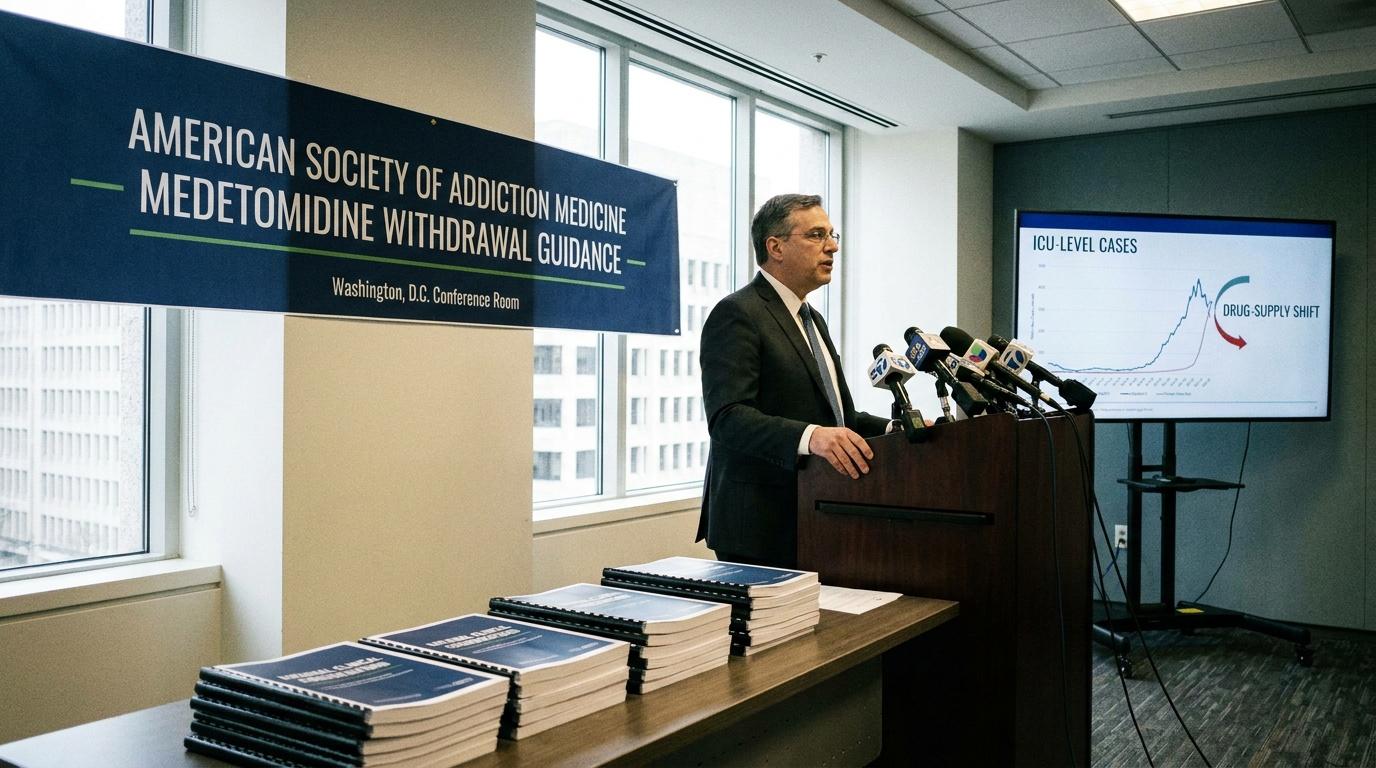
The American Society of Addiction Medicine this week released the first national guidance for treating patients exposed to medetomidine, a sedative that clinicians say is increasingly appearing alongside illicit opioids and causing a withdrawal syndrome severe enough in some cases to require intensive care.
The document is framed as clinical “considerations,” not formal guidelines, because researchers have not yet conducted larger studies to validate what emergency and addiction physicians are learning in practice. Even so, its publication marks a shift from local improvisation to an early national playbook for a drug that clinicians say changed the overdose and withdrawal picture after emerging in the supply.
The Clinical Pattern
Clinicians first noticed medetomidine in the Philadelphia drug supply during the spring of 2024, when a cluster of overdoses left patients more sedated and with lower heart rates than expected after receiving naloxone. At that stage, the cases raised concern but did not yet define a new pattern. None of the patients died, and most went home the same day.
According to Jeanmarie Perrone of the Penn Medicine Center for Addiction Medicine and Policy, the more serious signal emerged in autumn, when patients started presenting with severe withdrawal. She said it took time for people to be consistently exposed through the drug supply in amounts sufficient to trigger rapid withdrawal when use stopped.
If someone appears to be overdosing, the considerations say naloxone should still be the first step because medetomidine is nearly always used in combination with illicit opioids. But patients may remain unresponsive even after breathing improves, reflecting the sedative effect of the adulterant rather than a failure of naloxone.
For acute intoxication, low heart rate and low blood pressure can be managed with IV fluids and other basic care. Withdrawal tends to begin with nausea and vomiting, without the diarrhea typically associated with opioid withdrawal, Perrone said.
Treating Withdrawal In A Thin-Evidence Setting
The considerations recommend clonidine early, because it acts as an alpha-2 agonist like medetomidine and xylazine. If that approach fails or patients cannot keep the medication down, they may progress within hours to very high blood pressure and a fast heart rate. At that point, the related IV drug dexmedetomidine, or Precedex, may be needed.
Kory London of Thomas Jefferson University said treatment can be difficult even for experienced providers, adding that doses of clonidine and dexmedetomidine now being used are higher than he would have expected years ago during the first wave of xylazine adulteration. He said avoiding an ICU admission can be especially challenging without familiarity with the syndrome.
That is one reason the new document matters beyond Philadelphia and other hotspots. The clinical picture may resemble other conditions, including sepsis, making awareness of local drug-supply changes part of diagnosis rather than just public health surveillance.
What This Signals
Before medetomidine spread, xylazine was the dominant adulterant in much of the U.S. drug supply. Experts cited in the report said medetomidine does not appear to cause the same wounds associated with xylazine, but it is a more potent sedative. By the end of 2025, it had been detected in at least 18 states.
The broader signal is that addiction medicine and emergency care are being forced to build response protocols before conventional evidence development catches up. Michael Lynch of the University of Pittsburgh Medical Center said the next adulterant, and the one after that, are coming whether or not communities have the resources for regular drug checking.
There are test strips for medetomidine, but experts said more research is needed to understand long-term effects and to develop better treatments. Some patients who complete withdrawal and begin medications for opioid use disorder still report cravings that clinicians suspect may reflect medetomidine rather than opioids. London said that points to the possibility of a novel substance use disorder centered on alpha-2 agonist sedatives, a category for which the system does not yet have a mature treatment framework.