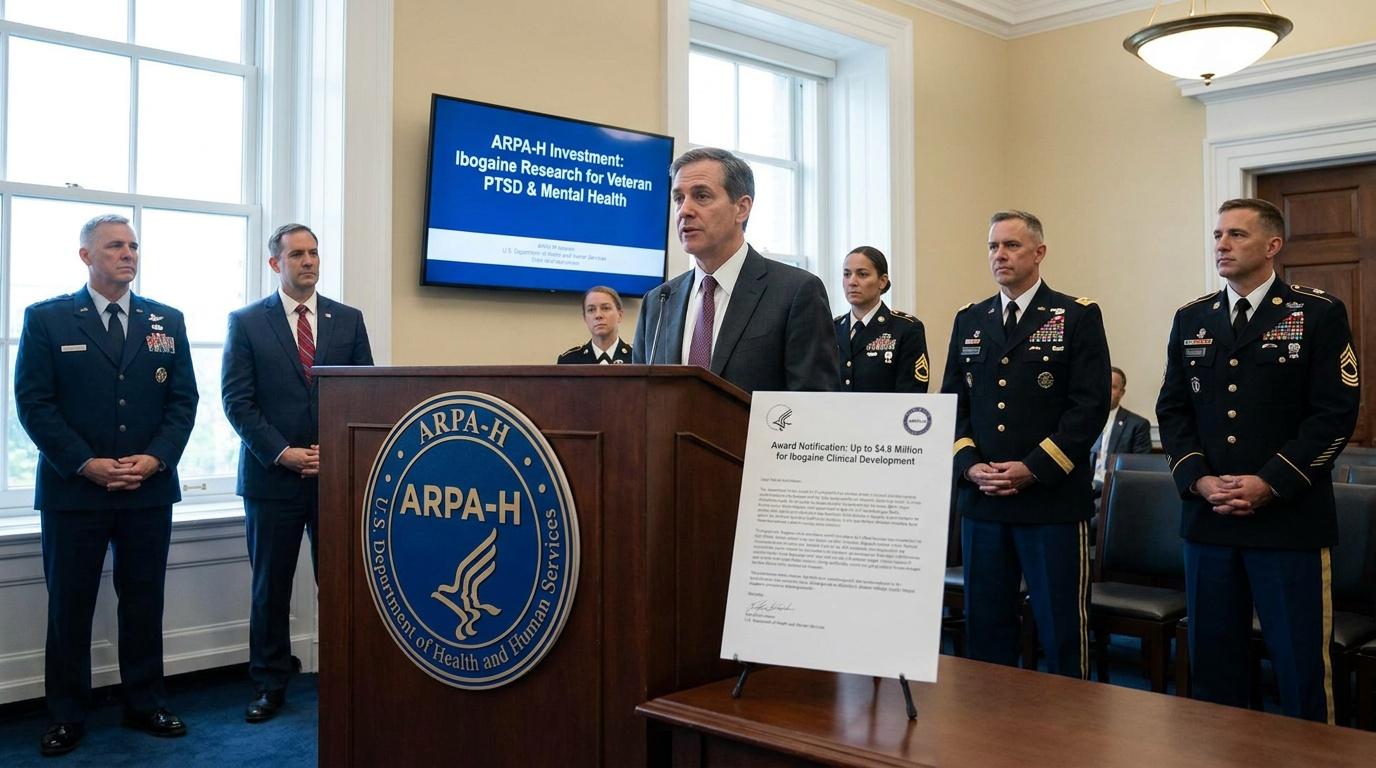
The U.S. Department of Health and Human Services has announced an up to $4.9 million award over five years from the Advanced Research Projects Agency for Health to advance ibogaine for post-traumatic stress disorder and other mental illnesses. The effort will include a focus on use in veterans, according to the agency’s Nov. 12 announcement.
ARPA-H also said future awards beyond the potential $4.9 million will evaluate ibogaine in multiple substance use disorders, including opioid use disorder, with the goal of pursuing INDs across multiple indications. The agency said it is taking that approach rather than "betting on a single path," with the aim of increasing the odds that at least one program produces clear answers about whether ibogaine can be an effective rapid-treatment option for veterans and other Americans with serious mental illness.
Why This Matters
The policy signal is broader than the dollar amount. Federal support for psychedelic-adjacent drug development has recently centered on expedited review mechanisms and on more established candidates such as psilocybin. By funding ibogaine work through ARPA-H and pairing it with a separate National Institute of Mental Health opportunity to build a research network for rapid-acting psychotropic interventional drugs, the government is indicating interest in a wider pipeline of mental health modalities.
That diversification matters because the field’s regulatory record is mixed. Lykos Therapeutics’ MDMA compound for PTSD, intended to accompany therapy, was rejected in August 2024. At the same time, Compass Pathways and Usona Institute received national priority vouchers for psilocybin treatments for depression, and Transcend Therapeutics received a voucher for its methylone PTSD treatment, TSND-201, after a phase 2 study last July met its primary endpoint and showed significant improvement on the Clinician-Administered PTSD Scale.
The Development Strategy
ARPA-H framed the ibogaine program as a portfolio effort rather than a single-asset wager. That is a notable choice for a substance that has drawn attention from veterans and public figures but still lacks a standard late-stage development path.
Researchers have studied ibogaine as a potential treatment for opioid dependence and for depression and anxiety among veterans with traumatic brain injuries. One group also found that veterans who took magnesium-ibogaine reported greater intensity of “mystical experiences” and larger reductions in PTSD both immediately and one month after treatment.
Secretary Robert F. Kennedy Jr. and other agency leaders have said that, according to veterans, ibogaine changed their lives. For developers, however, anecdotal support is not the same as registrational evidence. ARPA-H’s structure suggests the government wants to move the conversation from testimonials toward indication-specific development packages that can support INDs.
In the same announcement cycle, the National Institute of Mental Health published a $20 million funding opportunity to support a research network studying rapid-acting psychotropic interventional drugs such as ketamine, esketamine, psilocybin and other emerging treatments for serious mental illnesses. Taken together, the two moves point to a federal strategy that is trying to build evidence infrastructure around a class of therapies that has generated attention faster than regulatory consensus.