In late 2022, Milwaukee teacher Kat Zilka asked her 12th grade digital journalism students to reflect on their relationships to devices. What came back, according to STAT, was a picture of teenagers enduring online abuse, using phones all night without their parents’ knowledge, and cycling through deleting and redownloading social media. For Zilka, the assignment confirmed what she had already been seeing in class, especially since Covid: students whose attention and affect had changed in ways that felt deeper than ordinary distraction.
That experience pushed her from classroom observation into intervention. At the time, STAT notes, there were no surgeon general advisories on the issue and no wave of state legislatures yet pressing crackdowns on phones. People like Zilka were trying to respond to what they saw as an encroaching mental health crisis with minimal guidance, building local experiments while mainstream politics and science moved more slowly.
A Local Model For Digital Harm Reduction
Over winter break, Zilka designed an elective called "Digital Detox." Students responded well, she said, in part because the class created something uncommon in school: the first 10 minutes were spent simply sitting with their thoughts. By the middle of the semester, she said, students were "hankering for it."
But she also came to see a limit in the school-based format. The course was intended to relieve mental strain while still adding academic pressure. That tension led her toward something closer in spirit to Alcoholics Anonymous or the church youth groups she remembered from childhood, organized around connection rather than coursework.
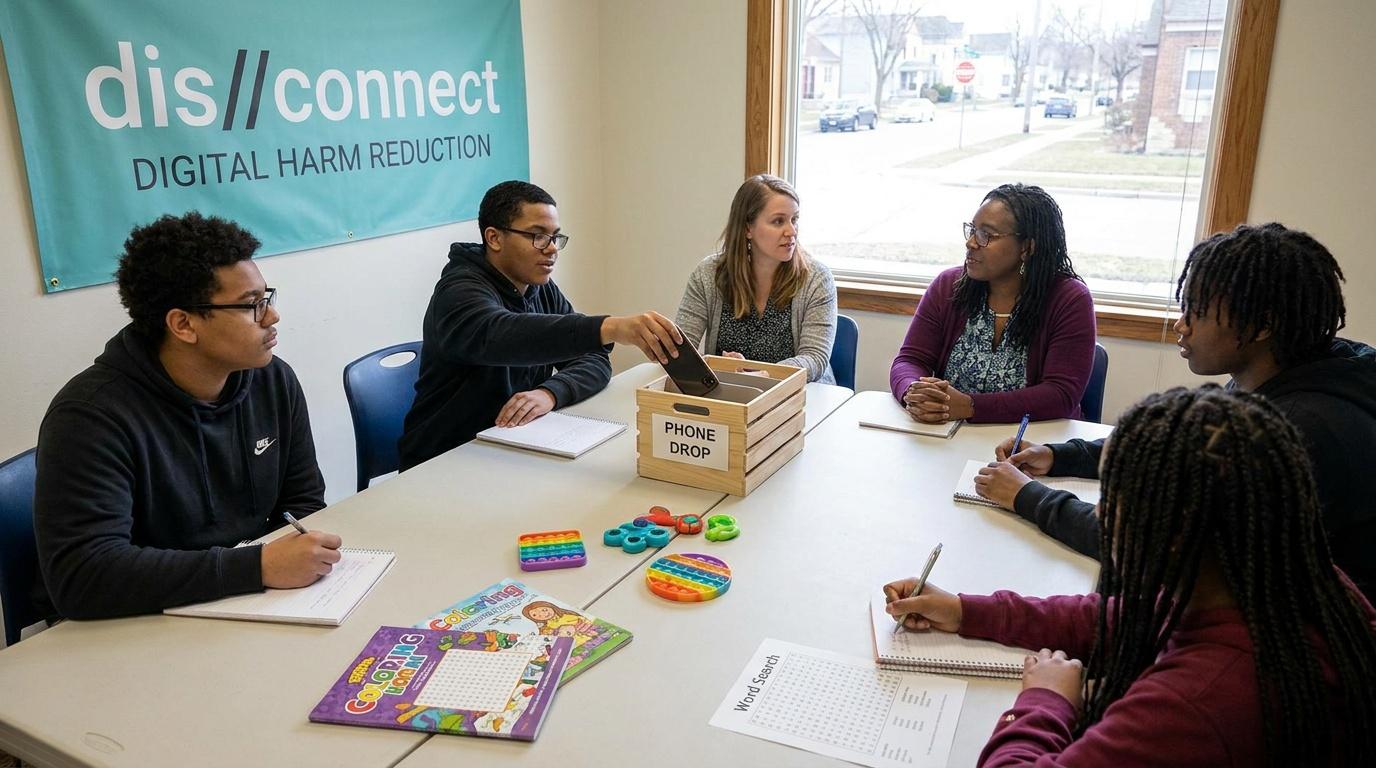
Zilka eventually formed a nonprofit called dis//connect and left teaching. The first meeting took place in May 2024, and she raised around $1,200 to support the effort. About a year ago, she brought in clinical psychologist Thekla Ross, whom STAT describes as a leader in the emerging field of "digital harm reduction," to measure how well the program is working and to find ways to expand the model.
On most Monday and Thursday nights, Zilka and Ross now meet with about 8 high schoolers in their respective groups. The hourlong sessions begin with logging average daily screen time by hand and placing silenced phones into a filing box. Students then discuss the "slow media" they are consuming and sit quietly for 10 minutes. The physical setup includes fidget toys, coloring books, and word searches, giving participants something tactile to do while they talk through stressors such as friend breakups, difficult teachers, and the pressure of behaving as though they might always be recorded.
Why Grassroots Efforts Matter
Rachel Hanebutt, a Georgetown University researcher studying teens’ relationship to tech, told STAT that young people are still developing and "don’t really have time for us to wait 10 years to find out how to help them." That is the core strategic point in the story. As regulators and researchers struggle to respond to platforms that keep changing, community-built programs can adapt faster.
Those efforts vary. Some teach firm boundaries around social media and try to pull teenagers toward richer in-person experiences. Others are more explicitly political, channeling adolescent frustration toward Big Tech itself. Their shared goal, as STAT describes it, is to give children raised with an iPad and educated with a Chromebook a practical route back into offline life.
The policy signal is that the response to phone-related harm is no longer waiting for a single federal framework or a settled scientific endpoint. In this reporting, the most active experimentation is happening at ground level, where educators, clinicians, and teens are testing interventions in real time because the formal system has not moved at the speed of the problem.