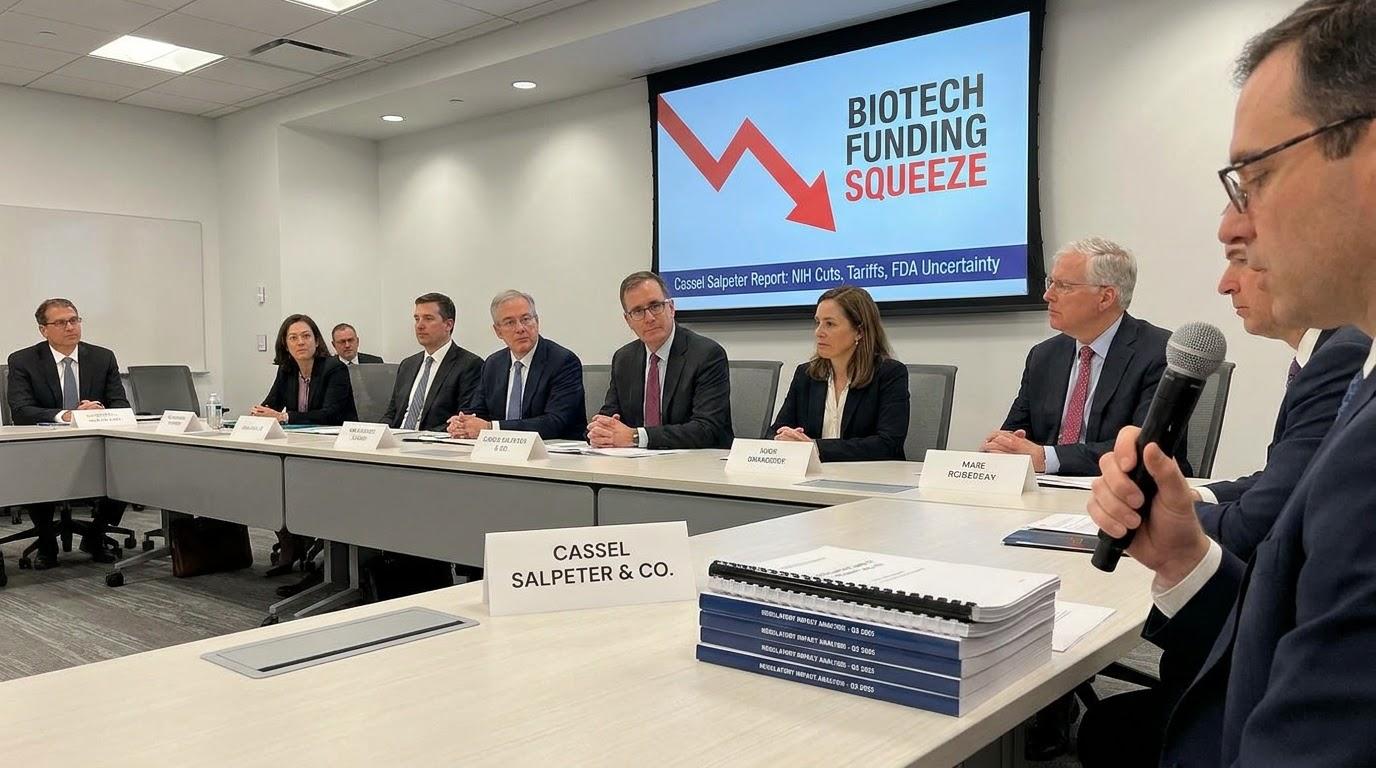
Early-stage biotech financing is facing another headwind beyond weak risk appetite: policy uncertainty. In a new third-quarter healthcare investment report, Cassel Salpeter said tariff uncertainties, FDA disruption and other U.S. government actions are deterring investors from backing young biotech companies and compounding already difficult fundraising conditions.
The firm’s read is that the pressure is not evenly distributed. Cassel Salpeter said smaller biotechs may lack the resources to onshore manufacturing, leaving them more exposed to tariffs than larger drugmakers that have avoided some of that risk by committing to U.S. investments and striking deals with the government. Larger companies may also be better able to absorb any tariffs they do pay.
Where The Pressure Is Concentrating
Cassel Salpeter said the ongoing uncertainty around tariffs is keeping investors on the sidelines for early-stage companies. It paired that with a slowdown of federal grants and higher operating costs, concluding that the current environment makes fundraising extremely difficult.
The report also points to a second-order problem for research-stage startups: tariffs raise the cost of imported materials used in lab work. For companies that are still precommercial, that kind of cost inflation can extend timelines without creating a clear path to offset the expense.
On reshoring, Cassel Salpeter took a skeptical view, describing investments in domestic production capacity as “wasteful” and asking why companies should build redundant U.S. facilities when that money could go to research or possibly lowering the prices of new drugs. Whether or not that view gains traction politically, it highlights a basic capital-allocation issue for smaller developers that do not have the balance sheets to fund both infrastructure shifts and pipeline progress.
Funding And FDA Disruption
Cassel Salpeter also highlighted the Trump administration’s attempts to cut research spending. While Congress has pushed back against the cuts, the investment bank said there have been “major disruptions” in funding for new applications and renewals of existing grants and contracts.
The report cites the One Big Beautiful Bill Act, which President Donald Trump signed into law this summer, as cutting National Institutes of Health funding by $18 billion and bringing the agency’s budget down to $27.5 billion in 2026. For small biotechs that rely on grants and academic collaboration, that matters not just as a budget line but as a constraint on the broader early research system that feeds future company formation and translational work.
Cassel Salpeter said the administration’s actions have also affected drug developers of all sizes through layoffs, delays and upheavals at the FDA after Trump began his second term in January 2025.
Alongside that policy analysis, the firm tracked 41 biotech and pharma takeovers in the third quarter, up slightly from 40 in the third quarter of 2025 but below the prior three quarters. The signal is that dealmaking has not stopped, but the easier path for larger incumbents may be buying selectively while smaller innovators face a tougher standalone financing market.
The report arrives shortly after BIO proposed that the Trump administration create a new White House Office of Biotechnology as part of a broader plan to strengthen the American biotech ecosystem and accelerate medical breakthroughs.