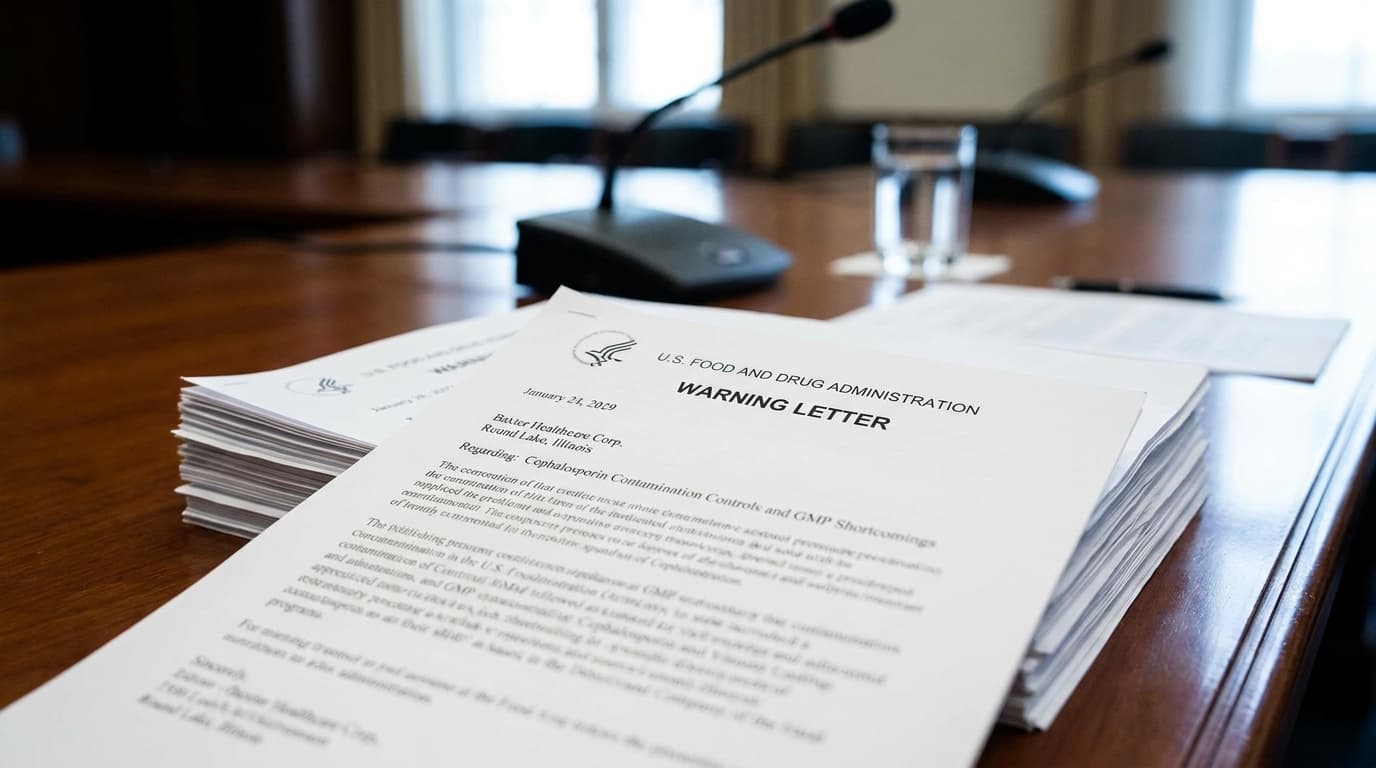
Baxter has received an FDA warning letter tied to its Round Lake, Illinois, facility, with the agency faulting the company’s controls for preventing antibiotics from contaminating other drug products. The letter followed inspections in March and April, but the FDA cast the issues as part of a longer-running pattern rather than an isolated manufacturing lapse.
That broader framing is the more consequential takeaway. The agency cited similar violations at the Round Lake site in January 2025 and related issues at other Baxter plants, concluding that “management oversight and control over the manufacture of drugs is inadequate.” For a company whose Round Lake site is one of its three main pharmaceutical manufacturing plants and its only one on the U.S. mainland, that language raises both regulatory and operational pressure.
What The FDA Found
The warning letter centers in part on Baxter’s inability to reliably contain cephalosporin materials. Round Lake manufactures products including cefazolin, vancomycin and Zosyn, and cefazolin is a first-generation cephalosporin antibiotic in the beta lactam class that can cause life-threatening allergic reactions.
FDA investigators said Baxter’s facilities and controls were inadequate to prevent conditions that could allow cephalosporin contamination of other drugs. Baxter had relied on a wall separating the relevant parts of the building and said the wall was fully sealed, with dedicated heating, ventilation and air conditioning units installed. Even with those precautions, Baxter’s environmental monitoring program detected cephalosporin in multiple areas on the other side of the building on several occasions since January 2025.
The FDA said the monitoring program was good enough to show recurring cross-contamination, but not good enough to promptly detect the containment failure itself. The agency added that the site’s inadequacies could underrepresent true contamination hazards across the facility and create the potential for false negative results. In the FDA’s view, that leaves the quality unit without the information needed to make “sound risk-based decisions.”
Why This Matters
Baxter told the FDA that personnel movement is a weakness in the containment strategy, though unlikely to be the sole factor behind the detected incidents. The root cause remains unclear, which is itself part of the regulatory problem: the company committed to strengthen its investigations, but the FDA said Baxter’s response was inadequate because it did not ensure complete and comprehensive separation across the plant and did not thoroughly reevaluate the original risk management decisions.
Cephalosporin contamination was only one of four overarching concerns in the warning letter. The FDA also criticized Baxter’s efforts to prevent microbiological contamination and to establish laboratory controls for identity, strength, quality and purity. That combination suggests the agency is questioning not just one engineering control, but the reliability of the plant’s broader quality system.