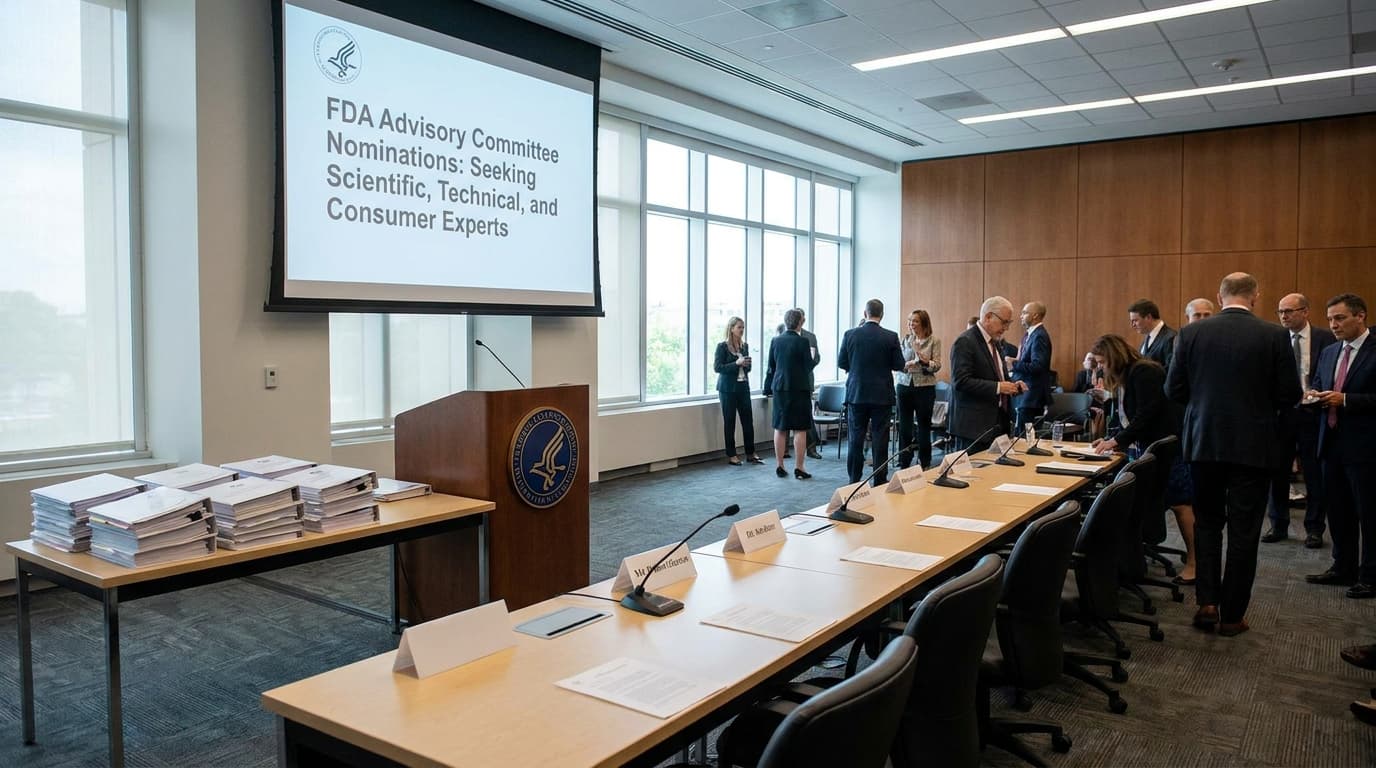
The FDA is recruiting new members for all of its advisory committees, seeking both scientific or technical experts and consumer representatives as it looks to broaden participation in bodies that review experimental drugs, vaccines and medical devices ahead of agency decisions.
In notices tied to the Federal Register, the agency said it aims to “expand the range of qualified voices and perspective on its advisory committees.” One notice covers current or anticipated vacancies for people with scientific or technical expertise, while a second focuses on consumer representatives.
Why This Matters
The FDA currently has 50 technical and scientific advisory committees spanning multiple topics, including newer areas such as digital health. Most committees include members with relevant expertise as well as consumer and industry representatives, and temporary members can be added depending on the subject of a given meeting.
These panels do not determine the FDA’s final action. Their votes are nonbinding, but the discussion leading up to those votes feeds into the regulator’s decision-making. That makes committee composition consequential: the practical value is not just how members vote, but what questions they raise in public and how they frame benefit, risk and evidentiary gaps.
Committees usually meet up to four times a year, though frequency has varied. Meetings became less frequent during the tenure of former FDA Commissioner Marty Makary, and there has been an uptick since he departed the agency in May. Last week, the Molecular and Clinical Genetics Devices Panel of the Medical Devices Advisory Committee spent a day debating Galleri, Grail’s liquid biopsy for detecting signs of cancer, and majorities supported the test on three separate voting questions.
The Recruitment Push
The FDA said it is recruiting across disciplines including oncology, cardiovascular medicine, neurology and medical devices. Scientific or technical voting members must show relevant expertise, the ability to interpret complex scientific and technical information, understanding of public health implications and the capacity to provide objective, independent advice.
Terms can last up to four years. The agency said it will accept nominations on a continuing basis, but set nearer-term deadlines of Nov. 30 for scientific, technical, professional and other voting-member positions and Nov. 15 for consumer representative positions. The FDA also said self-nominations are allowed.
In a prepared statement, acting FDA Commissioner Kyle Diamantas said the panels provide independent expertise and rigorous scrutiny as the FDA navigates complex and rapidly evolving areas of science. The immediate signal for industry is procedural rather than substantive: after a period of fewer meetings, the FDA appears to be rebuilding the advisory infrastructure that can influence review expectations across product categories.