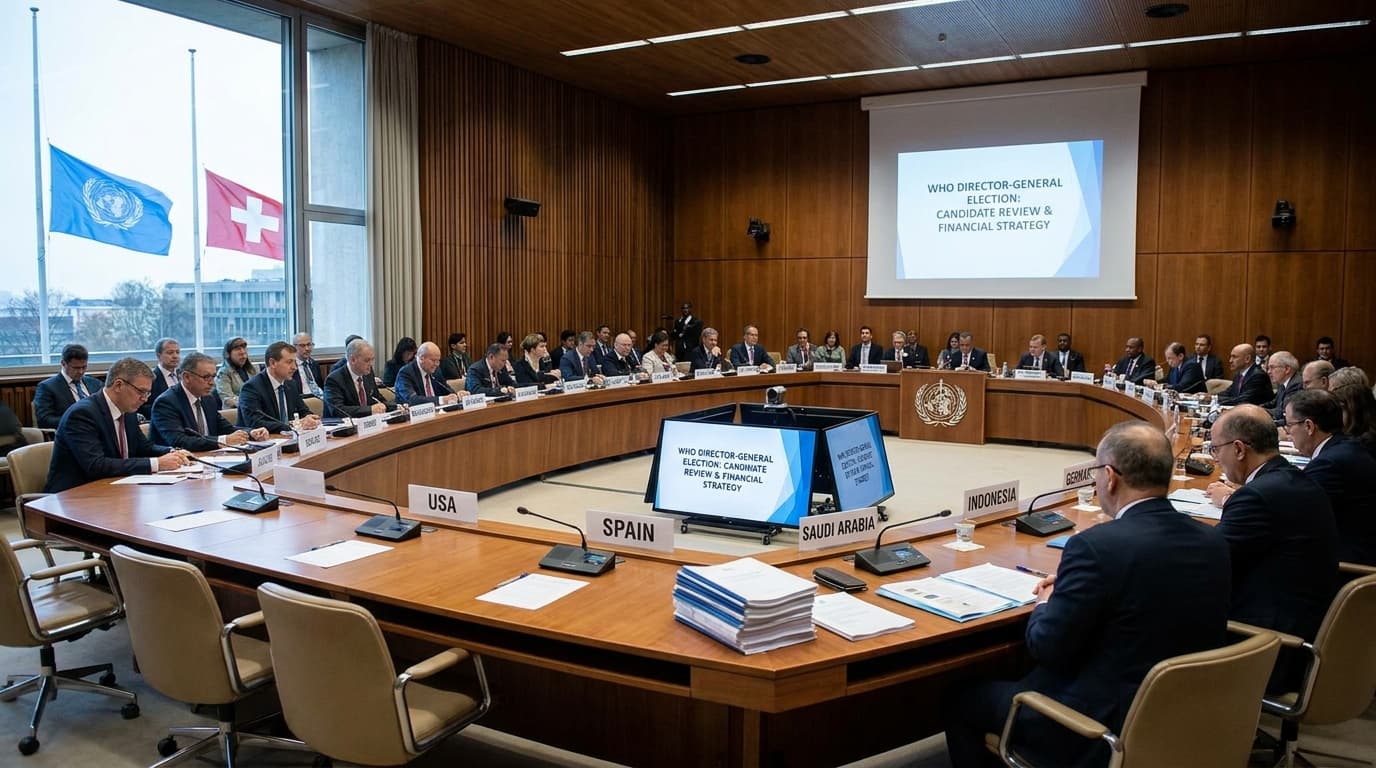
At least five candidates are seeking to become the next director-general of the World Health Organization, a race that comes at a difficult moment for the Geneva-based agency. The central issue hanging over the contest is the withdrawal of the United States, previously the WHO’s largest funder, alongside a broader contraction in international spending on global health.
Lawrence Gostin, director of Georgetown University’s World Health Organization Collaborating Center on Public Health Law and Human Rights, called it the most consequential director-general election in modern WHO history because the organization is in a more vulnerable position than at any point in the last 25 years he can recall. For the eventual winner, one of the biggest strategic questions will be whether and how to persuade the U.S. to re-engage, or at least work more collaboratively with the WHO.
The Candidates
The nomination period closed Thursday. Five candidates are listed on the WHO’s website, including Maria Neira, a late entrant nominated by Spain. The WHO will not publish the official list until all regional WHO divisions complete their fall meetings, which conclude in early November, and additional candidates could in theory still be named over the coming weeks.
Among the named contenders are Neira, who has worked at the WHO for the past 21 years and previously served in Spain as vice minister of health and consumer affairs and as president of the Spanish Food Safety and Nutrition Agency. She is a physician trained in endocrinology and metabolic diseases.
Also in the field is Saudi Arabia’s candidate Balkhy, who previously served at WHO headquarters as assistant director-general for antimicrobial resistance. She is a pediatrician who trained in Saudi Arabia and the U.S. STAT reported that Balkhy was born in the United States and has dual citizenship, though she told the publication in April, “I’m Saudi.”
A candidate from the WHO Europe region previously worked internationally for Doctors Without Borders in Africa, Asia and Russia, with a focus on tuberculosis and HIV, and later led the WHO’s Europe region through the Covid-19 pandemic and the emergence in Europe of mpox. Another contender, Al-Kuwari, previously served as managing director of Hamad Medical Corporation from 2007 to 2024, has served on the WHO’s Executive Board and holds a Ph.D. in health care management from Brunel University in the United Kingdom.
Indonesia’s Budi is notable for a different reason. If elected, he would be the first director-general without either a medical degree or an advanced degree. He holds a bachelor of science degree in engineering physics from the Bandung Institute of Technology, had a long business career mainly in banking and led his country through the Covid pandemic.
The Financial Backdrop
The U.S. departure left a major hole in the WHO’s finances. Assessed contributions for 2025 totaled $130 million, which the country did not pay before leaving. Though the congressional resolution allowing withdrawal stipulated that outstanding monies should be paid first, the Trump administration left nearly $278 million in unpaid fees when it quit.
Beyond assessed contributions, the U.S. had also been a major source of voluntary funding for priorities important to the donor country. In the 2022-2023 budget period, the U.S. provided nearly $1.3 billion in dues and voluntary contributions. Germany, the next largest contributor, provided $856 million.
What The Election Signals
Experts cited by STAT do not see a clear frontrunner. Thomas Bollyky of the Council on Foreign Relations said he expected a more geographically diverse field, while Suerie Moon of the Geneva Graduate Institute said regional voting blocs are unlikely to hold firmly and that the idea of regions taking turns no longer carries much weight.
Gostin said he sees support building for Budi, arguing that the WHO may now find a former banker and corporate executive appealing alongside the usual public health credentials. That view captures the strategic shift in this race: the next WHO leader will not only need health expertise, but also credibility in managing a multilateral institution under sustained financial pressure.