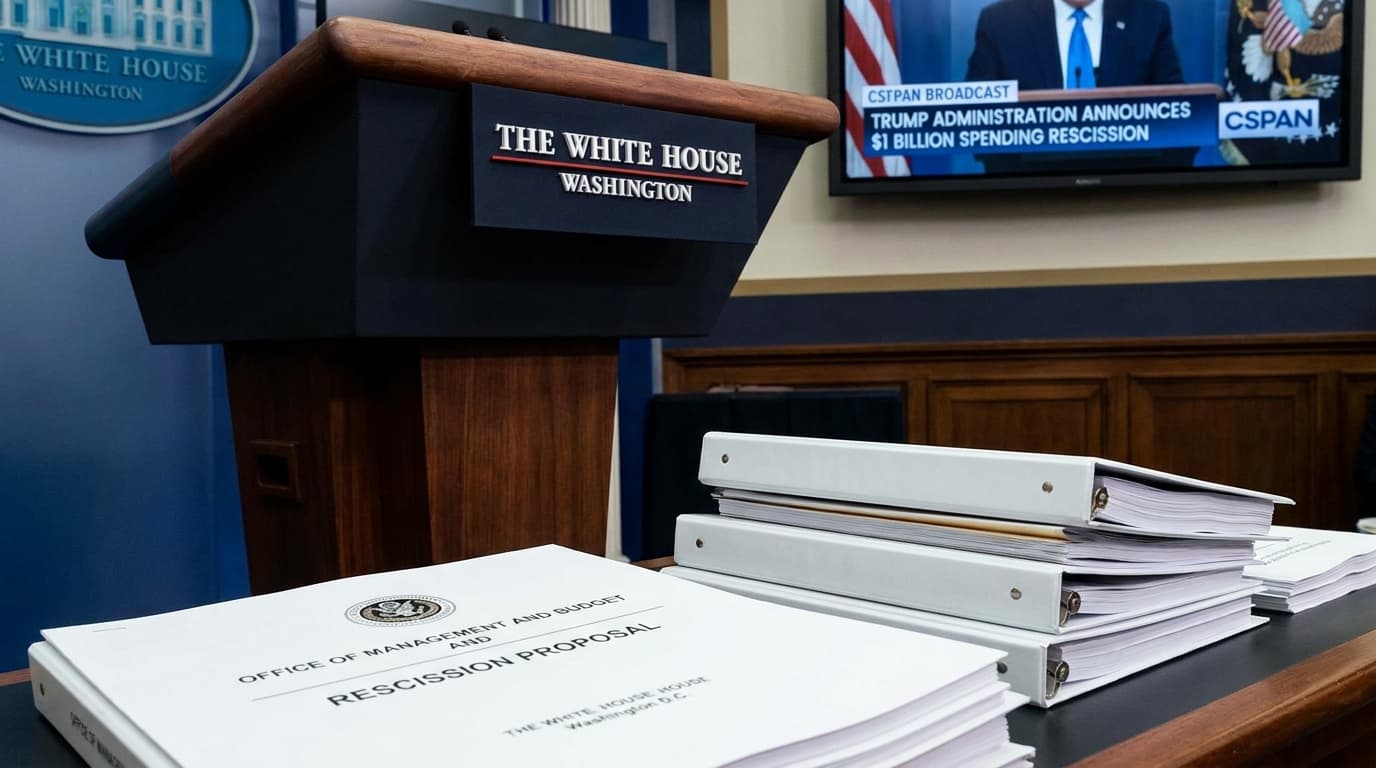
President Donald Trump is canceling nearly $1 billion in spending that Congress had already approved, with the White House announcing Friday that it will use a rare rescission tool to eliminate funding for immigrant services and diversity-focused initiatives. Most of the reductions are aimed at Health and Human Services programs serving refugees and unaccompanied minors accused of being in the country illegally.
Trump’s Office of Management and Budget said the cuts are focused on “the most harmful government spending” and argued the immigrant-service funds are no longer necessary because illegal border crossings have diminished considerably. The decision matters beyond the dollar amount because it pushes a disputed executive-branch tactic further into domestic spending, where the administration does not have the same foreign-affairs argument that helped it the last time.
What The White House Is Cutting
Beyond immigrant services, the White House said it is rescinding $70 million for what it called “woke” international education programs, $28 million in grant funding for Health and Human Services research programs, and $9 million in debt relief for foreign countries that fund climate change policies. Another $10 million is being withheld from a minority business development program.
The administration also targeted a Department of Education program for migrant students, a Department of Justice office focused on reducing racial tensions, housing counseling services from the Housing and Urban Development Department, and a series of grants from the Health and Human Services Department that it described as “outright harmful and blatantly ideological.” A White House press release announcing the rescissions said some of the organizations involved are led by people who worked in the administration of Democratic President Barack Obama.
Why The Legal Fight Is Different This Time
Under federal law, Congress has 45 days to review a president’s proposed spending cuts before they take effect. Trump announced the rescissions with just five days left in the federal fiscal year, while the House is out of session through the November election, a timing choice that critics say makes meaningful review nearly impossible.
The Government Accountability Office, an arm of Congress, says the maneuver known as a “pocket rescission” is illegal. Sen. Susan Collins of Maine, the Republican chair of the Senate Appropriations Committee, said the action came without warning or consultation and called it “the latest attempt by OMB to undermine Congress’s Constitutional power of the purse.” She said the delay itself was an impoundment that was not reported to Congress and said she would work with colleagues to address what she called “these illegal actions.”
A year ago, Trump used a pocket rescission for the first time in nearly 50 years by blocking $4.9 billion in congressionally approved foreign aid. The U.S. Supreme Court declined to block those rescissions, saying Trump’s authority over foreign affairs weighed heavily in its decision. This year’s action targets domestic spending instead, which raises the stakes for agencies, providers, and grantees that depend on annual appropriations being durable once enacted.
The Broader Policy Signal
Sen. Patty Murray of Washington, the lead Democrat on the Senate Appropriations Committee, called the move “theft from the American people, plain and simple” and said Democrats had tried in recent spending negotiations to include language preventing the administration from usurping Congress’s power on spending decisions.
For healthcare and social-service organizations, the immediate issue is the loss of specific funds. The larger signal is that budget execution itself is becoming a policy battleground. If the administration can extend pocket rescissions from foreign aid into domestic programs late in the fiscal year, recipients of congressionally approved health funding may need to treat appropriations risk not as a legislative event but as an ongoing executive risk as well.