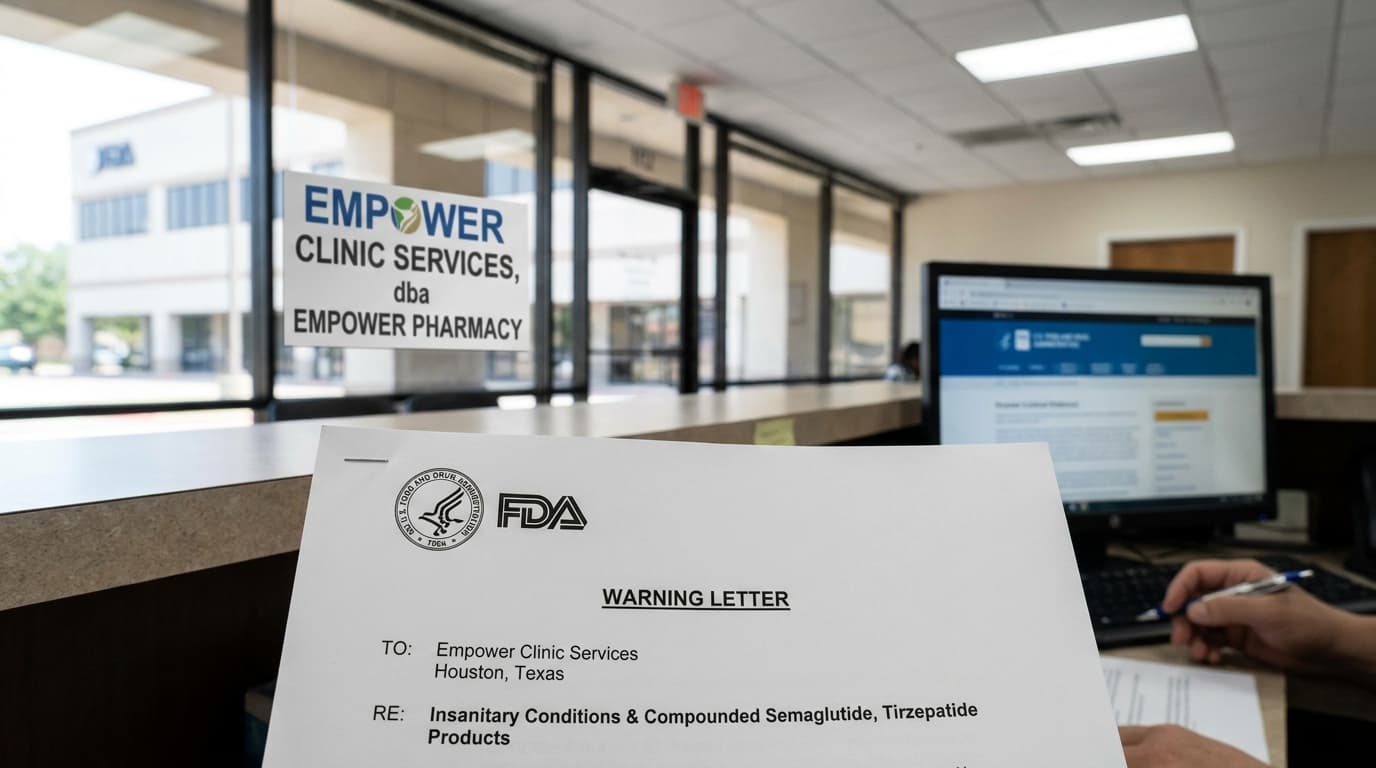
The FDA has sent Empower Clinic Services, which does business as Empower Pharmacy, a warning letter detailing failures to comply with rules on drug compounding after inspectors visited a site in Houston in November 2025.
According to the agency, sterile products at the facility were “prepared, packed or held under insanitary conditions,” creating a risk that they could become “contaminated with filth or rendered injurious to health.” The warning letter is dated Sept. 18, and the FDA said Empower has 15 working days to respond in writing with specific corrective steps and an explanation of how it will prevent recurrence.
What the FDA alleged
The letter goes beyond site conditions. The FDA also said it collected evidence indicating Empower was not meeting the conditions needed to compound drug products under Section 503A of the Federal Food, Drug and Cosmetic Act.
That law bars pharmacists and physicians from compounding copies of commercial products regularly or in inordinate amounts. In this case, the agency said Empower compounded tirzepatide and semaglutide products that “appear to be essentially copies” of FDA-approved products. Eli Lilly markets tirzepatide as Mounjaro and Zepbound, while Novo sells semaglutide as Ozempic and Wegovy.
The FDA said Empower’s manufacturing volumes suggested that differences between the compounded products and the approved drugs were “pretextual.” The agency also cited order records that either lacked a prescriber determination of significant difference from the commercially available product or contained repeated verbatim determinations across many records, which it said suggested those statements may be pre-generated.
Why the letter matters
The FDA said third-party technology platforms that give prescribers pre-selected menu options for choosing a statement of significant difference call “the individualized nature of those determinations into question.” That language points to scrutiny not only of what was compounded, but also of the workflow used to document why a compounded product was supposedly different.
The agency made clear that its concerns about insanitary conditions stand regardless of whether Empower’s drugs meet the conditions of Section 503A. It also said Empower’s response to issues raised in a Form 483 at the end of the inspection did not satisfy the agency because of “gaps and discrepancies” in the paperwork submitted.
As of Sept. 24, Empower continued to list tirzepatide and semaglutide products for sale on its website. The broader policy signal is that FDA enforcement in compounded GLP-1s is not limited to copycat arguments alone; facility conditions and the credibility of prescriber-specific justifications are both in play.