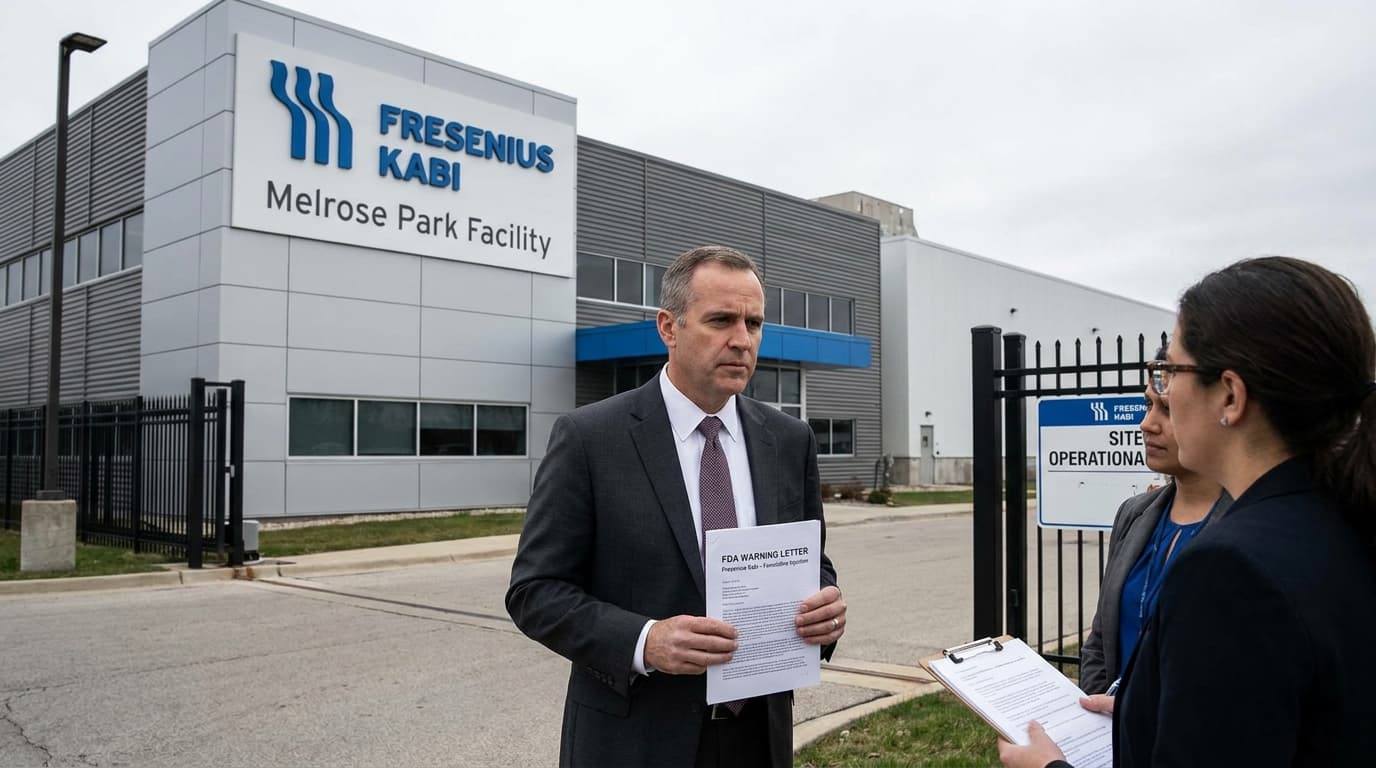
The FDA has sent Fresenius Kabi a warning letter after concluding the company did not sufficiently investigate a critical manufacturing deviation linked to adverse-event reports in patients injected with famotidine at its Melrose Park, Illinois, facility. In the letter, published Tuesday, the agency said the company’s famotidine injection manufacturing surpassed multiple bioburden action limits, yet Fresenius Kabi permitted batch release after passing finished drug product test results.
The adverse-event reports included apparent pyrogenic reactions, which the FDA said can signal contamination risk in injectable products. The agency told the company that pyrogen contamination can lead to significant adverse events such as fever, hypotension, inflammatory reactions, anaphylactic shock or death. Subsequent testing in response to the reports found an endotoxin failure and led to a recall of three famotidine batches.
What Triggered The Warning Letter
FDA inspectors spent three weeks at the Melrose Park site earlier this year. According to the warning letter, Fresenius Kabi’s March response to the agency’s Form 483 acknowledged that bioburden samples showed Gram-negative confluent growth, indicating that bacteria covered the surface of the test medium. The FDA said the company did not treat that excessive bioburden as an elevated endotoxin risk, even though endotoxins are components of bacteria that can activate the immune system and cause adverse events.
The agency deemed Fresenius Kabi’s initial response inadequate. While the company said it would enhance endotoxin sampling and testing, the FDA criticized it for not committing to a comprehensive review of its complaint system to increase vigilance. The letter said the agency expects ongoing, robust upstream control and that any batch testing showing atypical bioburden levels requires prompt attention.
From a regulatory perspective, the letter matters because the FDA is not limiting its critique to the recalled famotidine lots. It is signaling concern with the company’s investigation system itself: how manufacturing deviations are escalated, how complaint signals are connected back to production controls, and how much weight passing end-product tests should carry when upstream contamination indicators are already flashing.
Broader Aseptic Control Concerns
The FDA also cited Fresenius Kabi’s handling of media fill failures and visible particulate contamination. The company had determined that operators’ deficient aseptic techniques could have contributed to media fill failures, but the agency said its investigations did not examine how poor aseptic practices went undetected by the firm’s aseptic observer program during commercial operations.
Starting in May 2022, Fresenius Kabi documented at least nine cases of extrinsic contamination during visible particulate inspection. The FDA identified hair as one example and said the contamination was free-floating and in direct contact with the drug product. The agency added that drug products contaminated with hair can have microbial contamination and are generally considered adulterated, and said the company did not initiate timely investigations in response.
That combination of findings raises the significance of the warning letter beyond one adverse-event cluster. When the FDA links endotoxin risk, aseptic practice failures and delayed investigation of visible contamination in the same letter, the issue becomes one of quality-system reliability rather than an isolated manufacturing excursion.
Fresenius Kabi said in a statement to BioSpace that no patient safety concerns have been identified. A spokesperson also said the facility remains operational and that the company does not anticipate significant disruptions to the supply of products currently on the market. The FDA sent the warning letter on Sept. 22 and gave the company 15 business days to respond, while Fresenius Kabi said remediations are underway at the site.