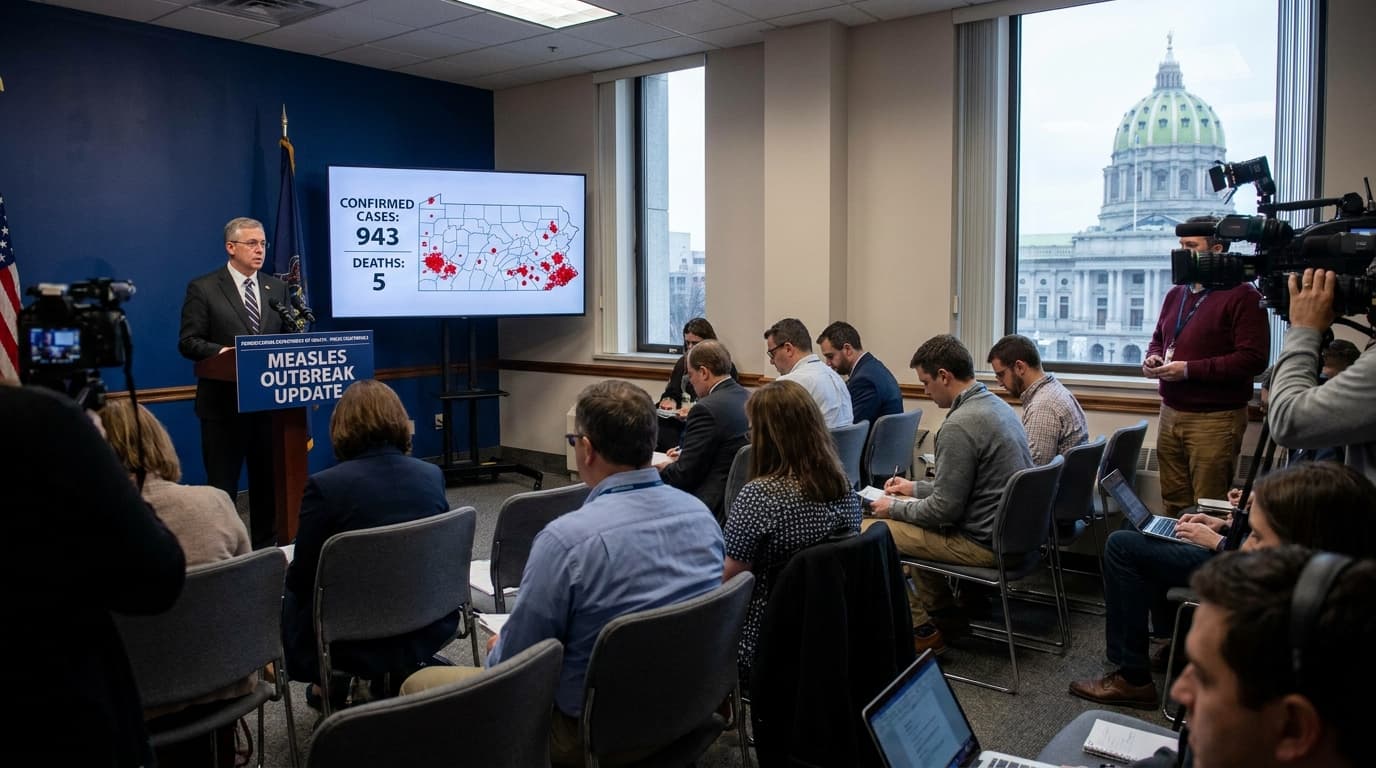
Pennsylvania’s measles outbreak had reached 943 confirmed cases as of Wednesday, according to STAT, with a fifth death now reported in the state. That confirmed total amounts to about a quarter of the 2026 national case count.
The harder issue is that the official number is not the same as the outbreak’s true size. STAT reported that only confirmed cases are counted, while some infected people never come to the attention of public health authorities at all.
Why The Count Is Incomplete
The source describes a familiar measurement problem in measles outbreaks: surveillance captures the cases that are confirmed, not every infection. About 20% of infected people end up needing hospital care and some other portion will see a doctor, but not everyone enters the healthcare system. That means even a large reported total can still be a partial picture.
STAT says this is especially relevant in Pennsylvania because a number of counties have large numbers of Amish people. In those communities, people may interact less with the wider world, measles vaccination rates are low, families are large, and people may not seek care unless illness becomes severe. The article notes a similar dynamic in last year’s outbreak in Mennonite colonies in Texas.
From a policy perspective, that creates a surveillance lag that is more than a statistical footnote. If case detection depends heavily on contact with formal care, outbreaks in communities that seek less medical attention can appear smaller than they are while still spreading efficiently.
What Public Health Knows And Does Not Know
The source is explicit that the full scope of the outbreak in Pennsylvania and in the country is not known or even knowable right now. Researchers may later produce modeling estimates that offer a better sense of total infections, but those estimates are not yet available.
For now, officials and the public are working from confirmed cases only, which the article characterizes as just a portion of the iceberg. Paul Offit, director of the Vaccine Education Center at the Children’s Hospital of Philadelphia, told STAT: “It is much worse than is being claimed. I think we don’t know how bad.”
That uncertainty has practical consequences. Resource needs, outreach efforts, and risk communication all depend on whether the visible outbreak is close to the real one or substantially below it. In an outbreak concentrated partly in communities with lower vaccination and lower healthcare utilization, confirmed counts may be most useful as a floor rather than a full measure of spread.