Sudden cardiac arrest remains one of the hardest emergency-response problems to shift at the population level. In the United States, 350,000 people will experience it outside hospitals this year, and only 1 in 10 survive, according to STAT’s report on a randomized controlled trial presented Sunday at the American Heart Association’s scientific sessions and published in the New England Journal of Medicine the same day.
The trial tested whether a broad community and emergency medical services education effort could change that equation. It did not, at least over the study period. Carolina Malta Hansen, the study’s lead author, said the intervention was efficient, large, and high quality, but survival remained low and unchanged, even though an exploratory analysis in the final year suggested improvement in bystander CPR.
The Data
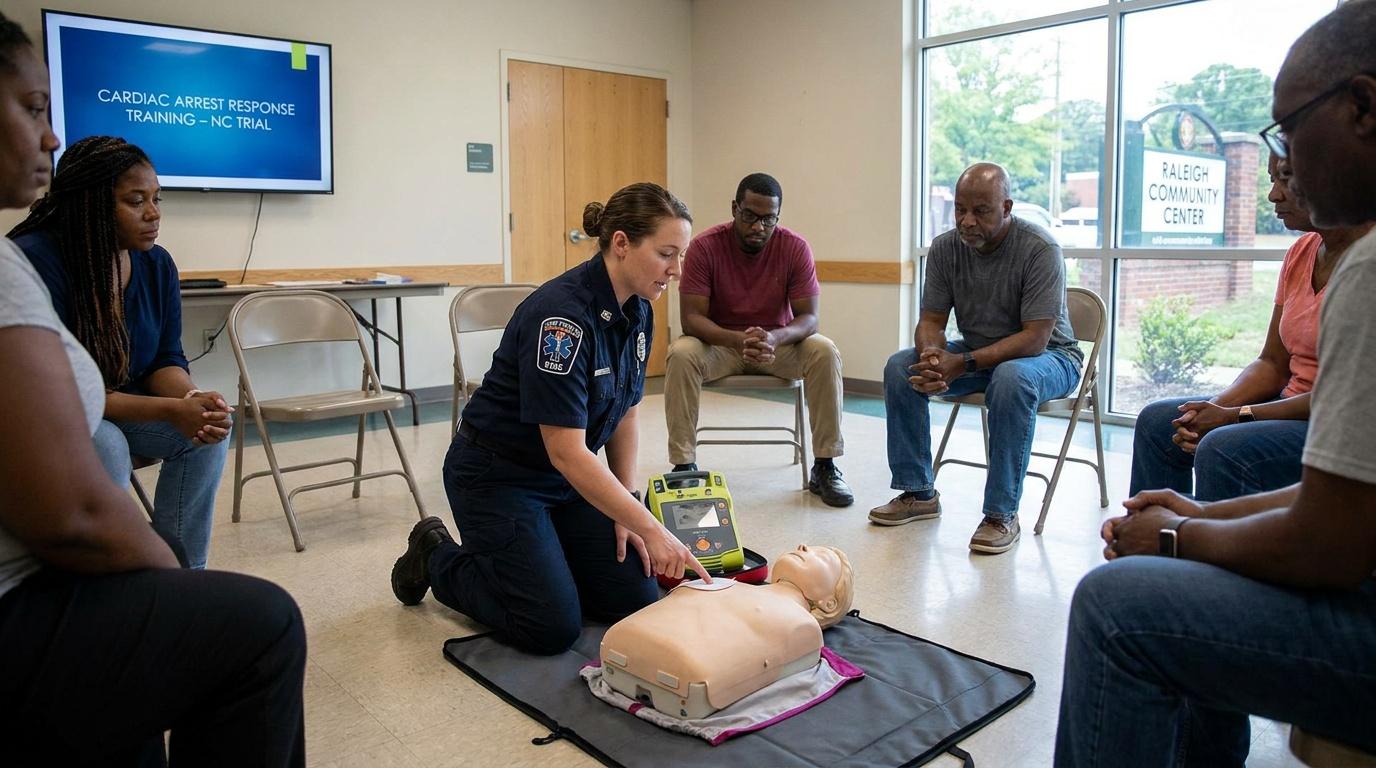
Starting in 2021, researchers randomly assigned 60 counties in North Carolina either to receive intensive education on cardiac-arrest intervention or to continue standard practice. The intervention included training 911 dispatchers to recognize cardiac arrest more quickly and guide bystanders through CPR, educating first responders on automated external defibrillator use before emergency services arrived, and providing CPR training to community members in workplaces, religious groups, government offices, and other settings.
About 8.5 million people live in the study counties. Over five years, 22,459 adult residents experienced cardiac arrest outside the hospital. Their median age was 64; 37% were women, 33% were Black, and 29% lived in rural areas. Of those cases, 11,615 occurred in counties that received the intensive education program and 10,844 occurred in counties that did not.
The primary takeaway was negative: the multifaceted community and EMS implementation strategy did not improve survival with a favorable neurologic outcome for patients with out-of-hospital cardiac arrest. Amrish Deshmukh of the University of Michigan Health Frankel Cardiovascular Center, who was not involved in the study, told STAT the result was disappointing but not surprising because many interventions in out-of-hospital cardiac arrest and post-arrest care have failed to improve survival or neurologic outcomes.
Why The Result Matters
The study challenges a common expectation in emergency medicine that better training across the chain of response should be enough to move hard endpoints within a few years. Deshmukh noted that prior studies have shown mobile phone alerts, volunteer training, and increased AED availability can raise CPR performance and AED use, but not all have translated into survival gains.
That distinction matters commercially and operationally for medical-technology and public-health strategies built around community response. Process metrics such as more CPR or more AED use may still improve before mortality data do. For systems deciding where to invest, this trial suggests training programs cannot be judged only by whether they expand participation; the harder question is whether they can produce treatment quickly enough, broadly enough, and long enough to change outcomes.
Malta Hansen pointed to Denmark as a contrast case. She said the North Carolina study trained almost 5% of the population, which was enough to start seeing a difference in CPR delivery between intervention and control counties, but not enough to alter survival. In Denmark, bystander CPR training has climbed from 20% in the early 2000s to 80% now, about 75% of patients receive high-speed care, defibrillation is 11% versus 2% in the U.S., and survival is about 16% versus 10% in the U.S.
What May Explain The Gap
Two explanations emerge from the report. One is scale. Malta Hansen said the North Carolina effort appears to have reached too little of the population compared with countries that have built much denser training coverage over many years. She cited Denmark’s driver’s-license CPR certification requirement as an efficient way to reach nearly everyone.
The second is timing. Brahmajee Nallamothu, editor in chief of the AHA journal Circulation: Cardiovascular Quality and Outcomes, said starting the trial as Covid-19 was emerging could have affected educational efforts and may help explain delayed effects. He also questioned whether education alone is the right translation strategy, arguing that the field still does not know the best way to train people so they retain the ability to act when cardiac arrest occurs.
Malta Hansen’s team will follow the North Carolina population for at least another year. The main signal from the current readout is not that bystander and dispatcher training lack value, but that a limited-duration, limited-penetration program may be insufficient when the endpoint is survival rather than response behavior.