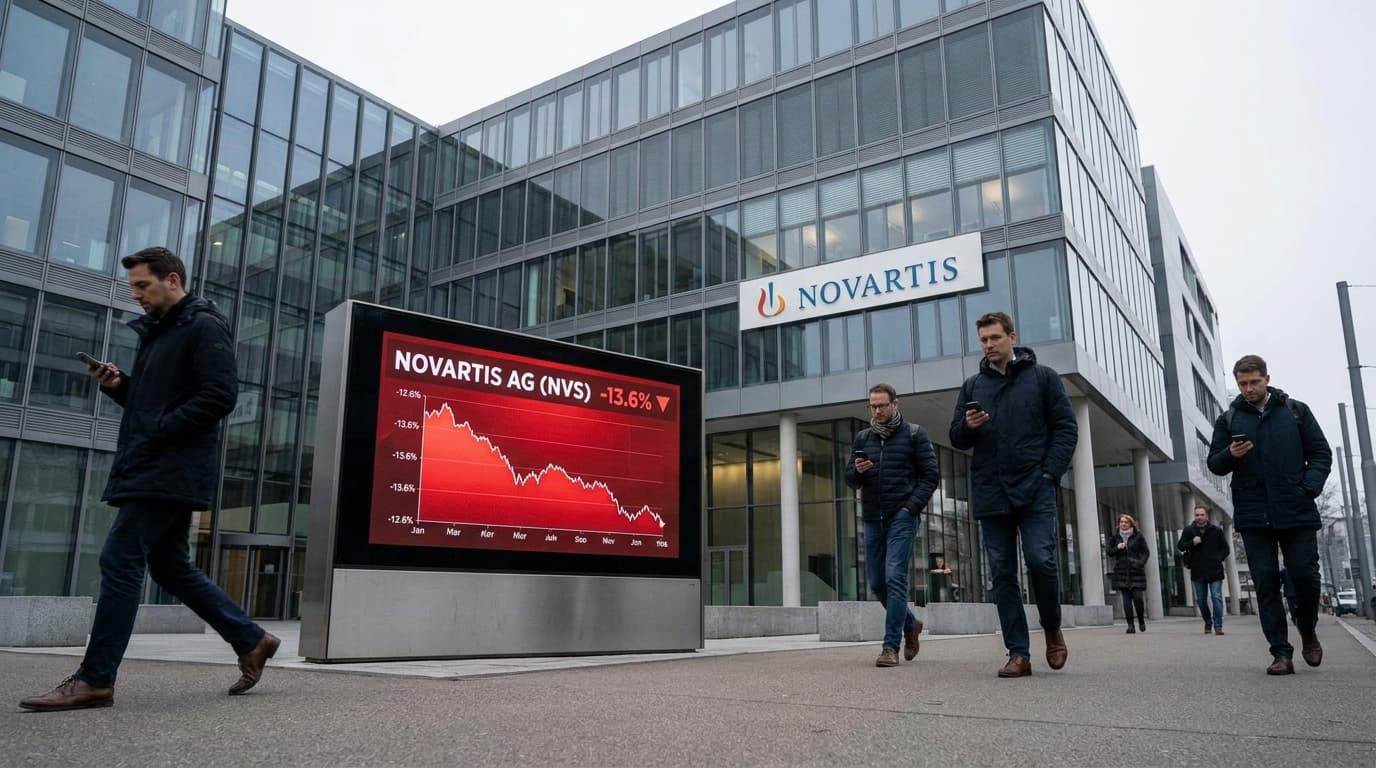

Novartis took a sharp market hit this week after three different pipeline programs ran into trouble, knocking the Swiss drugmaker’s shares down more than 13%. For the sixth largest pharmaceutical company by market cap, with a valuation of $212.2 billion, the scale of the reaction points to investor concern that the problem is not one asset but the durability of the broader late-stage pipeline.
The setbacks span three modalities and development stages. Del-desiran, an antibody-oligonucleotide conjugate, failed a Phase 3 trial in myotonic dystrophy type 1. Pelacarsen, an antisense therapy, lowered lipoprotein(a) levels in a late-stage study but did not show a significant benefit on cardiovascular risk, which was the main goal of the trial. Novartis also paused a group of Phase 2 studies for the CAR T cell therapy rapcabtagene autoleucel after three patient deaths.
The pipeline damage
The del-desiran result was a direct blow to a recently acquired asset. The therapy failed to improve hand opening time in 160 enrolled patients with myotonic dystrophy type 1. BioSpace noted that Novartis obtained the program through its $12 billion acquisition of Avidity Biosciences last year, so the miss lands not only on a clinical candidate but on a major capital allocation decision.
Pelacarsen may carry even wider strategic consequences. Lowering lipoprotein(a) was not enough when the trial’s primary test was whether that translated into reduced cardiovascular risk. The failure leaves a gap between biomarker effect and clinical outcome in a closely watched disease area, which is the type of disconnect investors tend to punish because it can reset expectations for the whole class.
Rapcabtagene autoleucel adds a separate safety concern. Pausing multiple Phase 2 trials after three patient deaths creates a different kind of overhang than an efficacy miss, because it can affect confidence in program management and in the risk profile of a platform area.
Read-through for peers
The damage did not stay contained to Novartis. According to analysts at Dow Jones cited by BioSpace, the company’s problems rippled across the sector. Amgen fell sharply as well because its olpasiran is being tested in the same disease space as pelacarsen, although Amgen’s program is an siRNA therapy rather than an antisense therapy. Eli Lilly, which is also developing the siRNA therapy lepodisiran in lipoprotein(a), was down slightly this week.
That read-through matters because it shows investors are not treating the pelacarsen result as a single-company issue. When one late-stage asset fails on a clinical outcome in a competitive mechanism area, the market often starts discounting whether adjacent programs can clear the same bar.
For Novartis, the immediate problem is concentration of bad news. For the rest of the field, the signal is narrower but important: biomarker reduction alone is not enough to protect valuation when outcome data disappoints.