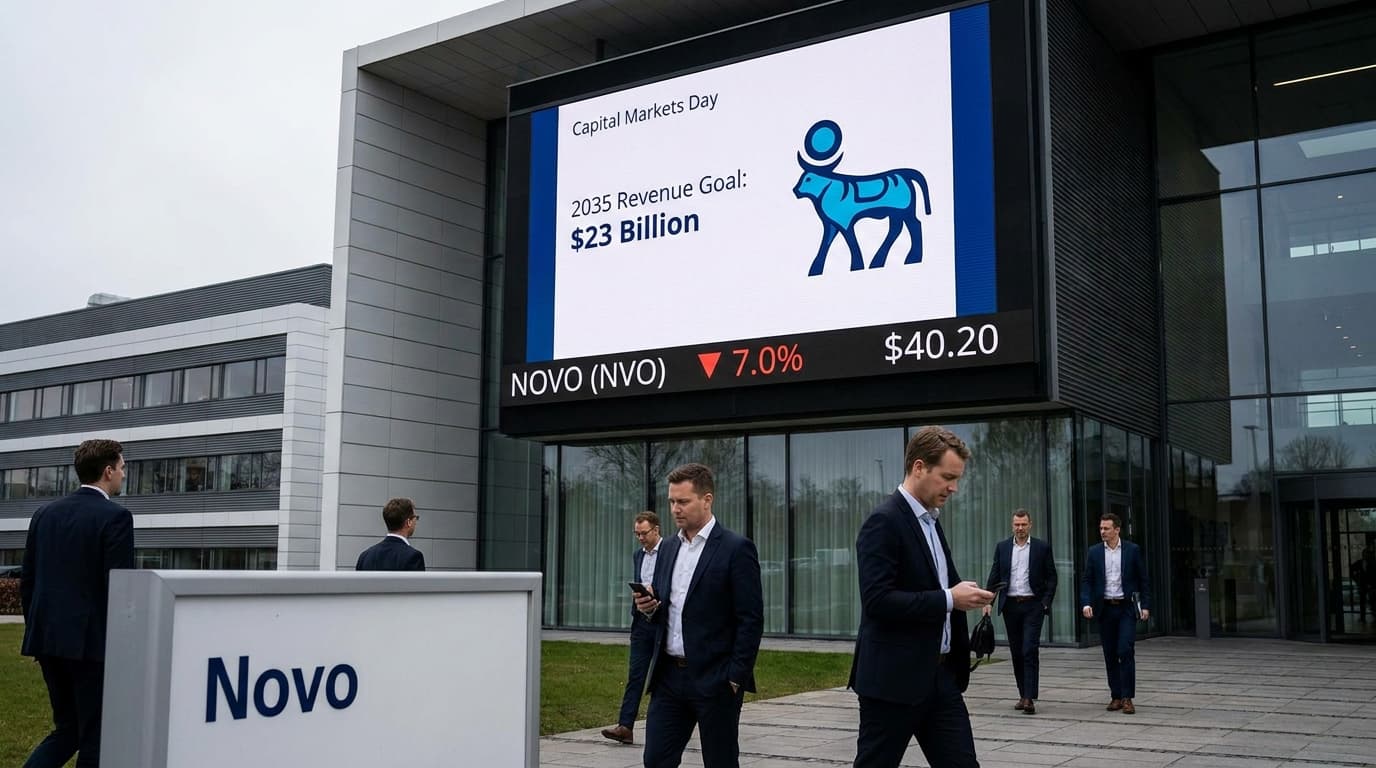
Novo told investors on Monday that it wants to build to $23 billion in sales in 2035, leaning on five planned multi-blockbuster launches by 2030, expansion into newer disease areas and a more active approach to business development. CEO Maziar Mike Doustdar framed the message as an effort to restore confidence after a bruising stretch for the company, saying management had to persuade investors there is still a bright future for Novo.
The first reaction suggested that persuasion job remains unfinished. Novo’s shares fell 7% to $40.20 on Monday morning, while BMO Capital Markets said the broad outline looked similar to what investors had already expected. The firm noted investors had been expecting compound annual growth rate of about 3.65%, versus Novo’s estimate of 3.53%, and said it continues to give Eli Lilly the edge in cardiometabolic markets as tirzepatide keeps taking share from Ozempic and Wegovy.
The Commercial Picture
At the center of Novo’s plan is a post-semaglutide strategy. With an eye on the eventual patent expiration of its bestseller, the company said it plans to launch five multi-blockbusters by 2030, including cagrilintide and CagriSema. Novo recorded 127.7 billion DKK ($19.6 billion) in profit for the full year 2025, so the new target implies continued growth rather than a reset of the business.
Doustdar also used the event to describe a broader operating model. Novo wants to be more active in business development and is looking not only at obesity and diabetes, but also at blood and endocrine disorders, liver diseases and cardiovascular disease. In the FierceBiotech account of the same event, Doustdar also described a planned “Consumer Rx” segment aimed at prescription medicines meeting strong consumer demand, with disease areas under consideration including immune-mediated inflammatory diseases, pain and addiction, women’s health and men’s health. The strategic signal is that Novo is trying to widen the commercial frame beyond pure incretin competition, even if investors are still asking for more concrete M&A direction.
The market’s skepticism appears tied in part to competitive positioning. BMO said Lilly’s Foundayo, while not launching as quickly as the Wegovy pill, is still building momentum. Novo’s answer is scale: Doustdar said the Wegovy pill has reached 7 million prescriptions and called it the best U.S. product launch by volume of all time, and he said Novo plans to expand manufacturing capacity so the pill can serve 10 times the patients being reached today.
The Data
Novo also brought fresh Phase 3 data for CagriSema, the combination of semaglutide and the long-acting amylin cagrilintide that it expects to launch in early 2027. In REIMAGINE 5, a 1.0 mg/1.0 mg dose of CagriSema produced 12.4% weight loss versus 9.1% for 5 mg of tirzepatide in adults with type 2 diabetes at 60 weeks, according to Novo’s release based on efficacy estimands. HbA1c reductions were similar at 1.71% for CagriSema and 1.67% for tirzepatide.
BMO called the results encouraging for positioning in diabetes, but said approval remains more distant and argued the readthrough is limited because tirzepatide had already been shown superior to a higher-strength CagriSema regimen in obesity. That caveat matters because Novo is asking investors to believe the next wave can offset pressure on the current franchise. The source material also notes that in March 2025, CagriSema delivered lower-than-expected weight loss of 15.7% at 68 weeks in patients with overweight or obesity and type 2 diabetes, below the 22.9% reported for a 15-mg dose of tirzepatide.
The Road Here
Novo’s investor day came just after the company rebranded, dropping Nordisk from its name and turning its Apis bull to face the right. Doustdar cast that move as part of a future-focused repositioning, but the operational backdrop is more complicated. Novo’s cardiovascular ambitions were hit in July when the Phase 3 Zeus trial of ziltivekimab failed unexpectedly, and earlier this month the company stopped two more late-stage studies for the IL-6 inhibitor.
Doustdar said those setbacks have not pushed Novo away from cardiovascular disease. Still, the immediate market message from Monday was that a broader pipeline, a more consumer-oriented commercial model and promises of selective dealmaking are not yet enough on their own. Investors appear to want evidence that Novo can do more than defend semaglutide as Lilly keeps pressing the category from both injectable and oral directions.