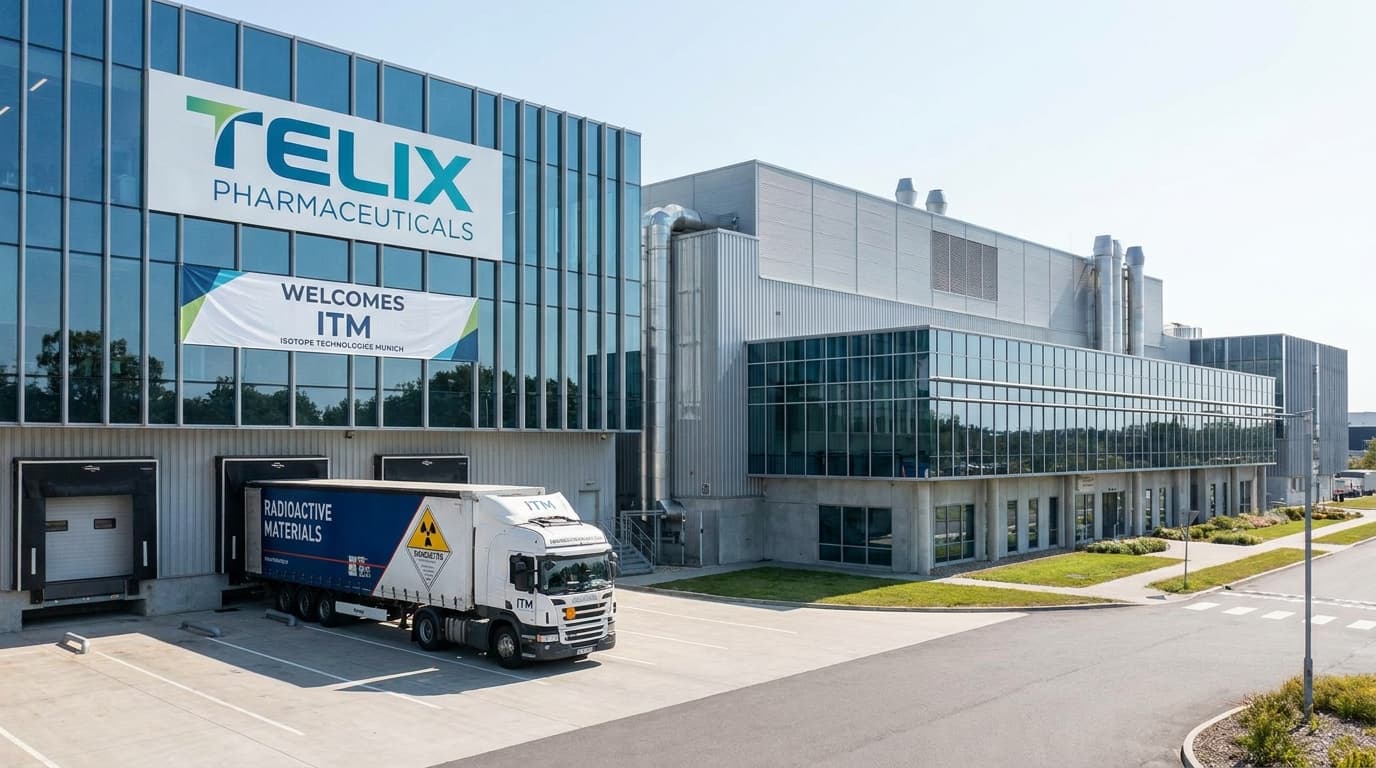
Telix has agreed to buy ITM Isotope Technologies Munich for $1.65 billion upfront, in a deal that adds both a late-stage radioligand therapy pipeline and a radiopharmaceutical supply network. The transaction also includes up to $700 million in milestones tied to ITM-11, a radioligand therapy that the FDA rejected last month on manufacturing grounds.
Strategically, the move does more than add one asset. Telix already markets radioisotopes for imaging prostate and brain cancer and is developing radioligand therapies of its own, so the acquisition extends it further into a part of the market where Novartis already has established products. It also adds infrastructure: ITM supplies lutetium-177 for Pluvicto, and that isotope is also used in Lutathera, ITM-11 and Telix’s phase 3 candidate TLX591.
Deal structure and asset fit
The milestone package shows how central ITM-11 is to the economics. Telix will pay $100 million if the FDA approves ITM-11 in a type of gastroenteropancreatic neuroendocrine tumors by the end of next year, another $100 million for approval in another gastroenteropancreatic neuroendocrine tumors indication by the end of 2030, and a further $50 million for approval in lung NETs by the end of 2031. Those regulatory milestones total up to $250 million.
A further up to $450 million is tied to sales. Telix said the commercial milestone is calculated as three times ITM-11 net global sales in excess of $150 million in 2030.
CEO Christian Behrenbruch said on a conference call that ITM-11 is “not a me-too product,” arguing it has a differentiated clinical and label profile that could support “unique commercial strategies.” That message matters because Telix is not only buying into neuroendocrine tumors; it is also trying to show investors that the asset can compete on more than supply security.
The regulatory overhang
The immediate complication is the FDA rejection. According to the source, the agency cited chemistry, manufacturing and controls issues and items identified during an inspection of a third-party commercial facility. ITM plans to refile, but the timing depends on remediation and talks with the FDA.
That uncertainty is material enough that either a resubmission or an agreement between Telix and ITM on the path forward is a closing condition for the takeover. Behrenbruch said he is confident in the resubmission, pointing to Telix’s own experience with Pixclara and arguing that a complete response letter is “not the end of the road” when the underlying product profile is strong.
Why investors reacted positively
William Blair analysts wrote that they “are extremely bullish on the future growth prospect of the combined Telix-ITM entity.” The rationale is vertical integration: ITM can expand Telix’s manufacturing network while also bringing in development assets.
The commercial base is not trivial. ITM reported $273 million in sales in 2025, and Telix expects the combined company to generate $1.3 billion this year. The broader signal is that radiopharma competition is shifting from single-product bets to integrated control of isotopes, manufacturing and distribution. For Telix, owning more of that chain could matter as much as the eventual label on ITM-11, especially with TLX591 positioned to challenge Novartis’ Pluvicto in prostate cancer.