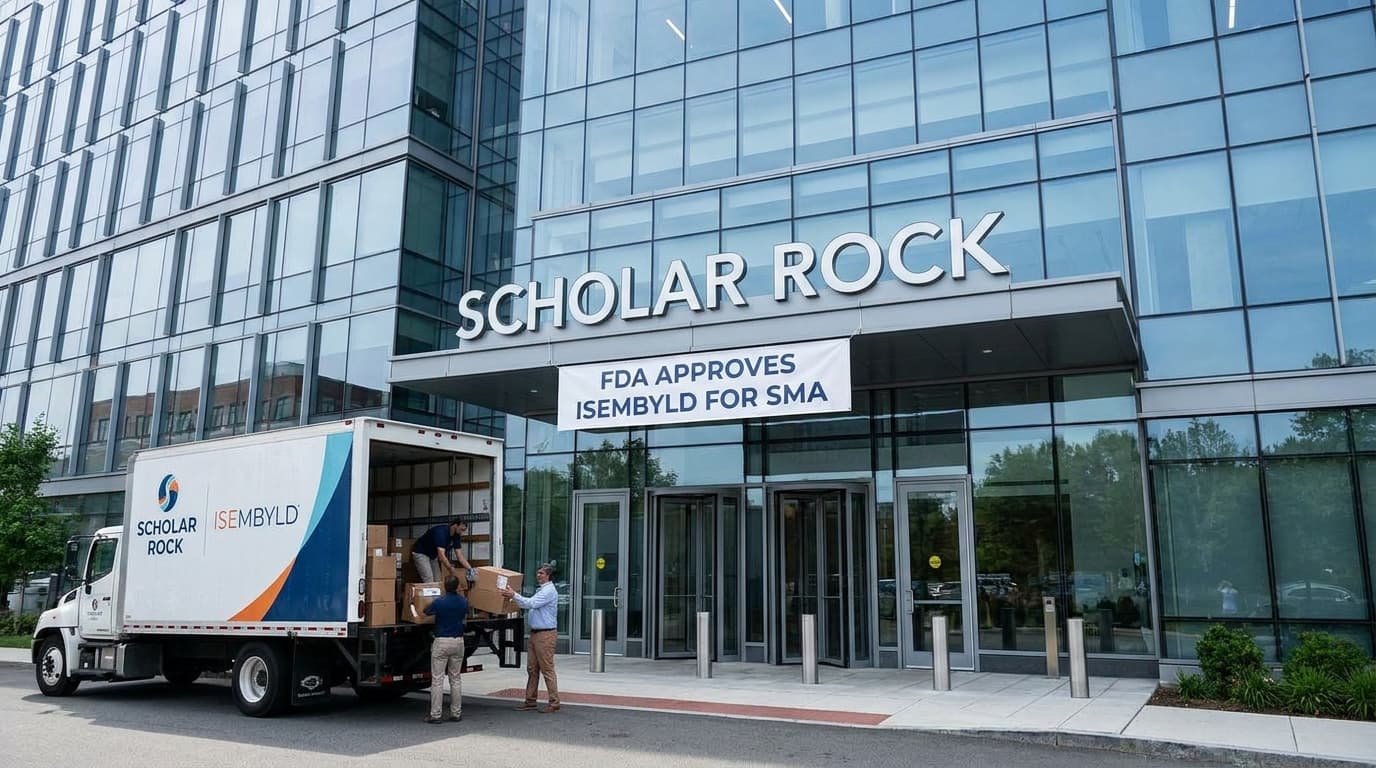

Scholar Rock has secured FDA approval for apitegromab in spinal muscular atrophy, clearing the company’s first product after a regulatory path shaped by manufacturing disruptions rather than an efficacy failure. The monoclonal antibody will ship under the brand name Isembyld in the coming days.
The label covers patients age 2 and older who are also undergoing SMN2-targeted treatment. According to Scholar Rock, Isembyld is the first muscle-targeted therapy that improves motor function in spinal muscular atrophy, and the FDA said other approved SMA medicines do not directly address the muscle loss associated with the disease.
The data
The approval was supported by the phase 3 SAPPHIRE study. Patients treated with Isembyld showed a 2.2-point improvement versus placebo on a scale commonly used to measure motor function, which served as the trial’s primary endpoint.
The most common side effects reported were vomiting, cough and upper respiratory tract infections. Fractures occurred in 9% of patients receiving the lower 10 mg/kg Isembyld dose, compared with 2% in the placebo group. The product does not carry a boxed warning.
The commercial picture
The FDA decision arrived weeks ahead of the original Sept. 30 target action date. BioSpace reported that BMO Capital Markets described the approval as carrying a broad label because it is not restricted to specific SMA types or to patients’ ambulatory status. Truist Securities similarly argued the label should support broad uptake.
Scholar Rock has not yet announced pricing. Truist expects peak sales could reach $2.3 billion, but that remains an external forecast rather than company guidance. The strategic opening for Scholar Rock is differentiation rather than category creation: Biogen’s Spinraza and Novartis’ gene therapy Zolgensma are already approved in SMA, yet Isembyld enters with a mechanism positioned around muscle function rather than SMN restoration alone.
The road here
This approval closes a difficult sequence for the asset. Scholar Rock first filed apitegromab for approval in 2025, but the FDA denied that application because of problems at a Catalent manufacturing site in Indiana.
That site is now owned by Novo Holdings, which bought Catalent for $16.5 billion in 2024. Scholar Rock said this spring that there had been significant progress at the plant, but weeks later the FDA assigned the site an Official Action Indicated classification, under which the agency recommends regulatory or administrative actions. Last month, Scholar Rock removed the location from the apitegromab application entirely.
The signal from the approval is that Scholar Rock was able to preserve the program’s clinical value despite a manufacturing overhang that might have delayed commercialization much longer. For smaller biopharma companies, that distinction matters: fixing supply chain and plant issues can be as decisive as generating registrational data when a first product is at stake.