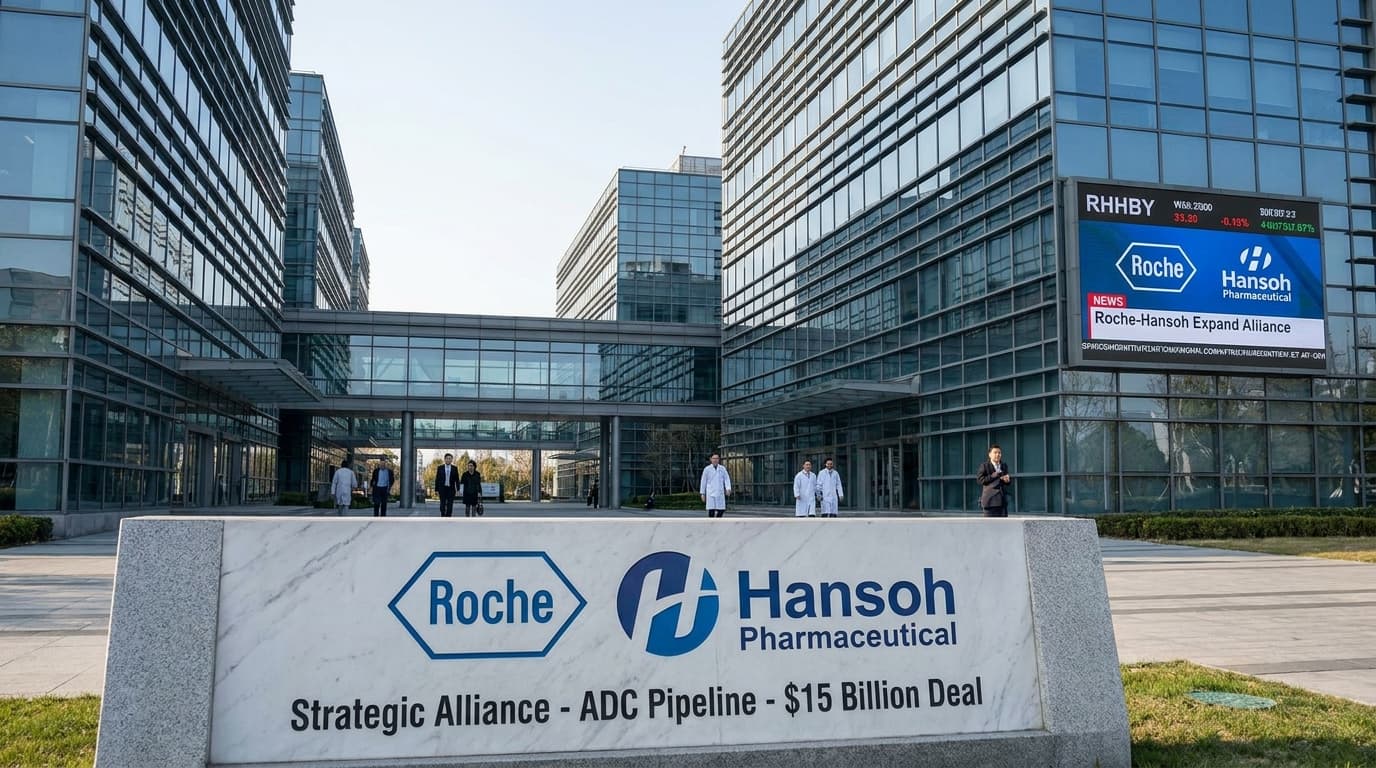
Roche has returned to Hansoh Pharmaceutical for a much larger antibody-drug conjugate deal, extending a relationship that began last year with a single-asset licensing agreement. Under the new pact, Hansoh said the companies will work across a broad portfolio of ADC programs, with economics that include $400 million in upfront cash, another $110 million on the first anniversary of the deal and potentially up to $15 billion in development, regulatory and commercialization milestones.
The agreement covers two ADCs already in preclinical development at Hansoh plus multiple programs against targets suggested by Roche and built with Hansoh’s ADC technology. Hansoh plans to advance the programs through phase 1 trials before Roche takes over worldwide development, excluding Greater China.
Deal structure and strategic meaning
The structure gives Roche access to a larger pool of early oncology programs while leaving the earliest clinical execution with Hansoh. That is a notable feature of the deal: Roche is not only buying rights to one named asset, but also extending into a repeatable model in which Hansoh originates or enables candidates and derisks them through phase 1 before handoff.
Hansoh may also choose to contribute to the global development of two programs from the collaboration. If it does, the company would become eligible for what the release called incremental upside from commercialization of those two programs. In addition to the milestone package, Hansoh is also eligible for tiered royalties on sales if any partnered ADC reaches the market.
The commercial signal is that Roche appears to be treating Chinese ADC capability as a sourcing channel for its oncology pipeline, not simply a valuation arbitrage opportunity. A year ago, Roche paid $80 million upfront and promised $1.45 billion in biobucks for the ex-China license to HS-20110, a CDH17-targeted ADC that was already in phase 1 testing in China and the U.S. for colorectal cancer and other solid tumors. The latest pact moves beyond one asset to a broader portfolio approach.
Why Hansoh matters
Hansoh has become one of the more active Chinese partners for multinational drugmakers building ADC exposure. The source notes collaborations with Merck & Co. and Regeneron, and points to GSK’s work with Hansoh-derived ADCs aimed at B7-H3 and B7-H4.
GSK’s B7-H3 ADC, ris-rez, recently posted a median overall survival of 18.5 months in a phase 3 trial, according to the source, and later showed a 61% overall response rate in a phase 1b trial. Jefferies analysts said those data helped shift ris-rez from an asset story driven by China phase 3 results to one with broader global validation.
That backdrop helps explain why Roche would expand now. The market is increasingly rewarding Chinese biopharma groups that can repeatedly generate exportable oncology programs rather than occasional licensing candidates. Hansoh said in August that China’s innovative biopharma sector is fully transitioning from the follower phase to the frontrunner phase. This year, the company increased R&D spending by 20.7% to 1.7 billion Chinese yuan, or $253 million, in the first half, supporting more than 40 innovative medicine candidates across more than 70 clinical trials.
For Roche, the signal is not just the headline dollar figure. It is the decision to scale a prior ADC relationship into a multiprogram platform alliance, with Hansoh carrying early development work that Roche can later globalize outside Greater China.