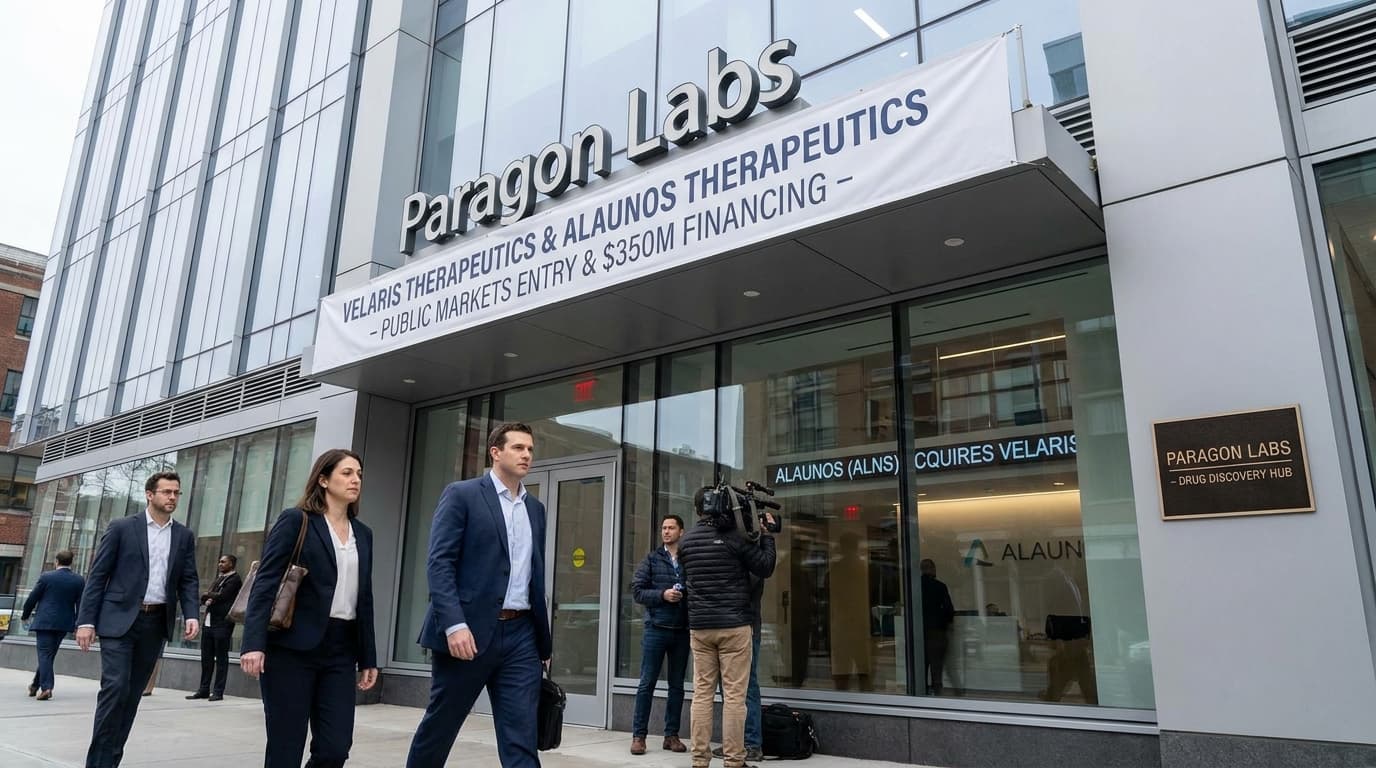
Paragon Labs is remaking its leadership team with executives from Apogee Therapeutics while also pushing another portfolio company, Velaris Therapeutics, into the public markets. The back-to-back moves come four months after AbbVie announced its $10.9 billion deal to buy Apogee for its late-phase eczema drug zumilokibart.
Michael Henderson, M.D., who led Apogee until the sale, will now become CEO of Paragon. He is joined by several former Apogee colleagues: head of R&D Carl Dambkowski, M.D., chief business and financial officer Dan Mulreany, chief legal officer Matt Batters and chief people officer Emily Cox.
Why the leadership move matters
The appointments are not a simple external hiring round. Apogee itself came out of Paragon, and zumilokibart was originally developed at Paragon before the Boston-based drug discovery hub spun the anti-IL-13 antibody into Apogee for further development. That gives the incoming team direct experience with one of Paragon’s clearest examples of value creation.
Henderson said in an Oct. 13 release that the team learned what it takes to translate Paragon-discovered programs into clinical-stage medicines while at Apogee. He said the group now has a chance to apply those lessons earlier, across clinical development, regulatory strategy and execution, as Paragon’s programs take shape.
That is the strategic signal in the reshuffle. Rather than only acting as an engine for early asset creation, Paragon appears to be importing operating knowledge from a successful spinout back into the parent platform. If that works, it could make Paragon less dependent on a one-off scientific hit and more able to systematize how programs are prepared for licensing or company formation.
Velaris Adds A Financing Path
Paragon also said its spinout Velaris Therapeutics has been acquired by Nasdaq-listed Alaunos Therapeutics. The combined company will focus on Velaris’ pipeline of ActRIIA-Fc ligand traps and complementary biologics aimed at signaling imbalances that drive remodeling of blood vessels in the lungs across multiple cardiopulmonary conditions.
Those plans are set to be funded by a $350 million private placement led by Fairmount, which founded Paragon in 2021 and expects the financing to support the combined company into 2029.
Velaris’ lead program is VLR199, an ActRIIA-Fc ligand trap designed to improve on Merck & Co.’s activin signaling inhibitor Winrevair as a treatment for pulmonary arterial hypertension. Henderson, who was also named president of Velaris, said the company aims to transform treatment of pulmonary hypertension, starting with PAH, and described the development plan as capital-efficient and geared toward rapidly reaching proof of concept.
Paragon has already spun out companies including Spyre Therapeutics in inflammatory bowel disease and Oruka Therapeutics, whose long-acting plaque psoriasis candidate could threaten AbbVie’s Skyrizi. Adding Apogee’s former senior team while advancing Velaris through a public-company transaction suggests Paragon is trying to do more than generate assets. It is assembling a reusable operating model: create programs internally, spin them out, recycle experienced management and pair those companies with large financing when a capital window opens.