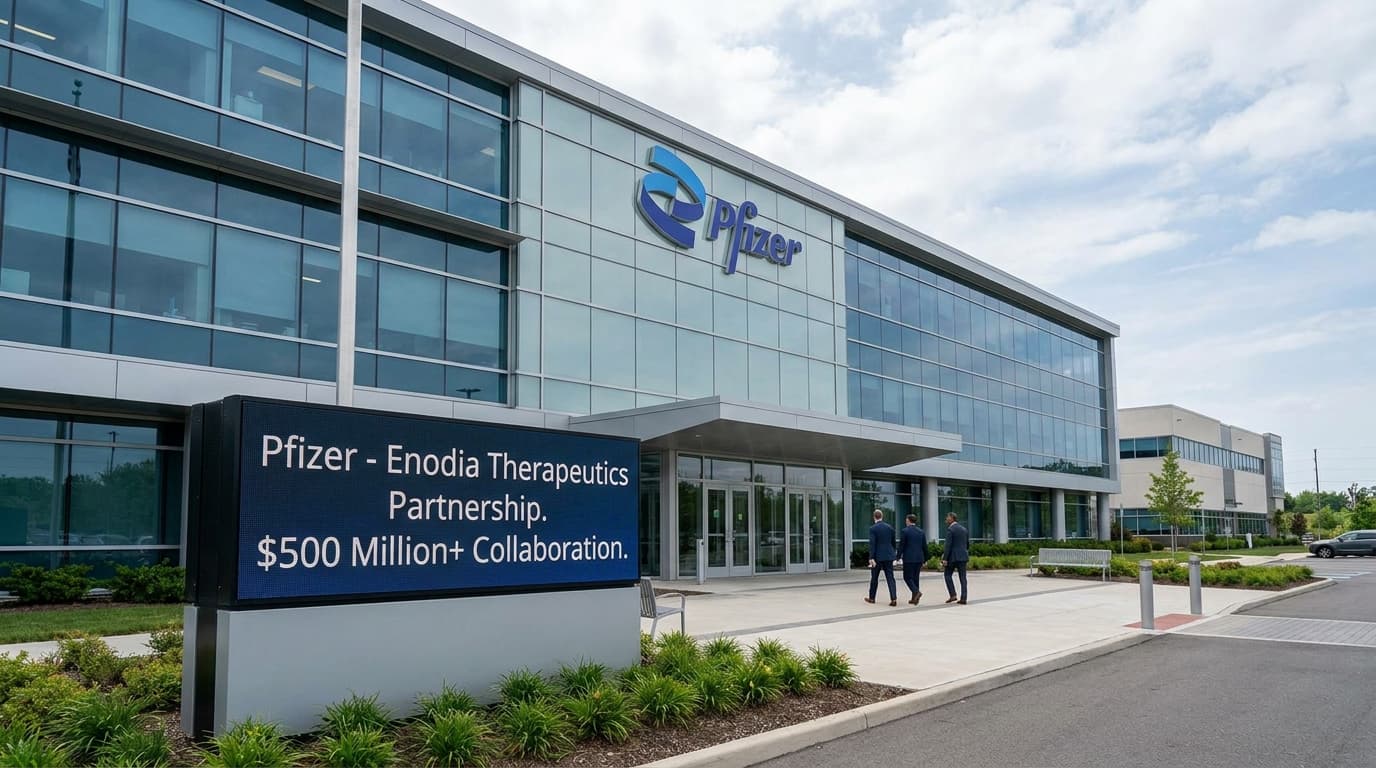
Pfizer has struck a partnership with Paris-based Enodia Therapeutics that could top $500 million, giving the drugmaker access to a platform aimed at destroying pathologic proteins before they manifest as disease. The companies did not disclose detailed economics, but said the package includes an upfront commitment from Pfizer as well as research, development and sales milestones, with Enodia also entitled to certain tiered royalties on net sales.
The agreement focuses on Sec61, a membrane protein complex involved in the processing of newly made proteins and linked in the source report to conditions including kidney and liver diseases, cancer and diabetes. The companies have not specified which diseases they plan to pursue, leaving the deal framed more as a platform access move than a near-term product announcement.
The Deal Structure
Enodia will handle screening, optimization and development of Sec61 inhibitor candidates. Pfizer will take over clinical studies along with manufacturing, regulatory and commercial activities. That split suggests Pfizer is buying into an early discovery engine while preserving control over later-stage execution if candidates advance.
Launched in February 2025 by Argobio and The Institut Pasteur, Enodia says its work combines machine learning-driven design with biological libraries to generate small molecules that trigger destruction of pathologic proteins at the point of synthesis. CEO Yves Ribeill said the approach is intended to inhibit disease-driving proteins while preserving essential physiological functions.
Why It Matters
The transaction gives Pfizer another targeted partnership at a time when it is balancing external innovation with a broad restructuring effort. BioSpace noted that Pfizer launched its cost-cutting program in October 2023 and has continued to raise its savings target, most recently adding $2.5 billion in cuts in August, largely from what the company described during its Q2 report as technology and simplification efforts. Those cuts are slated to run from 2027 through 2029.
Against that backdrop, the Enodia deal looks like a selective platform bet rather than a large-scale acquisition. Pfizer’s venture arm had already co-led Enodia’s seed round in January, helping the biotech raise €20.7 million, or $25 million, alongside Argobio, The Institut Pasteur and other investors. That prior financing means Pfizer is not entering cold; it is extending an earlier conviction into a structured development alliance.
The move also places Pfizer in a competitive pocket that is drawing more attention. Gate Bioscience, cited in the source report as another company working on small molecules that eliminate target proteins by blocking progress through Sec61, last week expanded its deal with Eli Lilly. The signal is that Sec61 is moving from an academic mechanism toward a more contested business-development niche, even if clinical validation still lies ahead.
Enodia has also been building around the mechanism. A few weeks after its seed financing, the company paid $1 million upfront to acquire preclinical Sec61-targeting assets from Kezar Life Sciences, with up to $127 million in development, regulatory and commercialization milestones attached. For Pfizer, that adds to the case that Enodia has been assembling both capital and assets around a single mechanism before this larger partnering step.