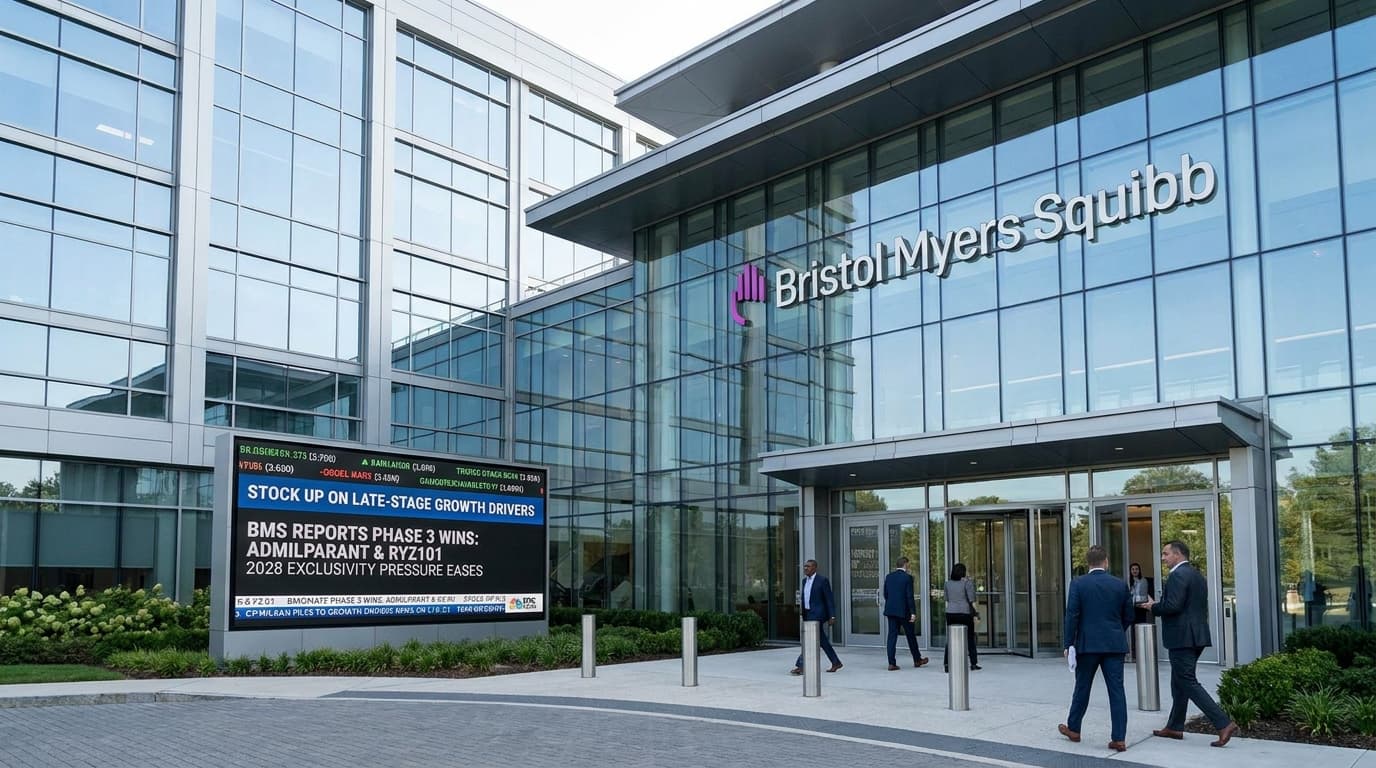
Bristol Myers Squibb has posted phase 3 wins in two separate programs, giving the company fresh late-stage support for its search for post-patent cliff growth. The drugmaker said Aloft-IPF met its primary endpoint in idiopathic pulmonary fibrosis and Action-1 met its primary endpoint in SSTR-positive gastroenteropancreatic neuroendocrine tumors.
The timing matters because Eliquis and Opdivo accounted for more than half of Bristol Myers’ sales in the second quarter, and both drugs could lose market exclusivity in the U.S. in 2028. With Cobenfy, the schizophrenia drug acquired through the $14 billion Karuna Therapeutics buyout, not yet making a significant revenue contribution, Bristol Myers is under pressure to build other growth drivers.
The data
In Aloft-IPF, Bristol Myers tested the LPA1 antagonist admilparant in adults with idiopathic pulmonary fibrosis. The company said the 60 mg dose had a statistically significant effect on forced vital capacity at Week 52, meeting the primary endpoint. However, the 120 mg dose did not reach statistical significance.
Bristol Myers has not yet shared the trial data. The company said the “totality of the findings” supports admilparant’s potential as a clinically meaningful first-in-class treatment, and added that the drug was well tolerated, with discontinuations caused by adverse events low and similar to placebo. That leaves an incomplete picture around safety, because recent concern had been raised by references in a protocol amendment to liver toxicity and a patient death, and Bristol Myers did not mention liver safety in the topline readout.
Action-1 evaluated RYZ101, a radiopharmaceutical therapy, in people with SSTR-positive gastroenteropancreatic neuroendocrine tumors. At a planned interim analysis, the study showed significantly longer progression-free survival for RYZ101 than investigator’s choice of standard of care, according to Bristol Myers. The company said only that the safety results were consistent with RYZ101’s known profile and has not yet released the underlying data.
Why It Matters Commercially
RYZ101 is being positioned for patients who progress on Lu177-based therapy, including after Lutathera, one of Novartis’ Lutetium-177 radiopharmaceuticals. The mechanistic distinction is part of the commercial case: Lu177 is a beta emitter, while RYZ101 delivers an alpha emitter, actinium-225.
On admilparant, Guggenheim Securities analysts said in August that the program could be a $5 billion-plus opportunity for Bristol Myers in idiopathic pulmonary fibrosis and progressive pulmonary fibrosis. But the mixed dose result means regulatory discussions may matter as much as the headline endpoint hit, because Bristol Myers is moving toward approval talks without having fully settled questions about the strength and consistency of the efficacy package.
The combined readouts ease some pressure on Bristol Myers, but they do not remove execution risk. A company facing 2028 exclusivity losses still needs these wins to translate into approvable labels, competitive product profiles and commercial uptake.