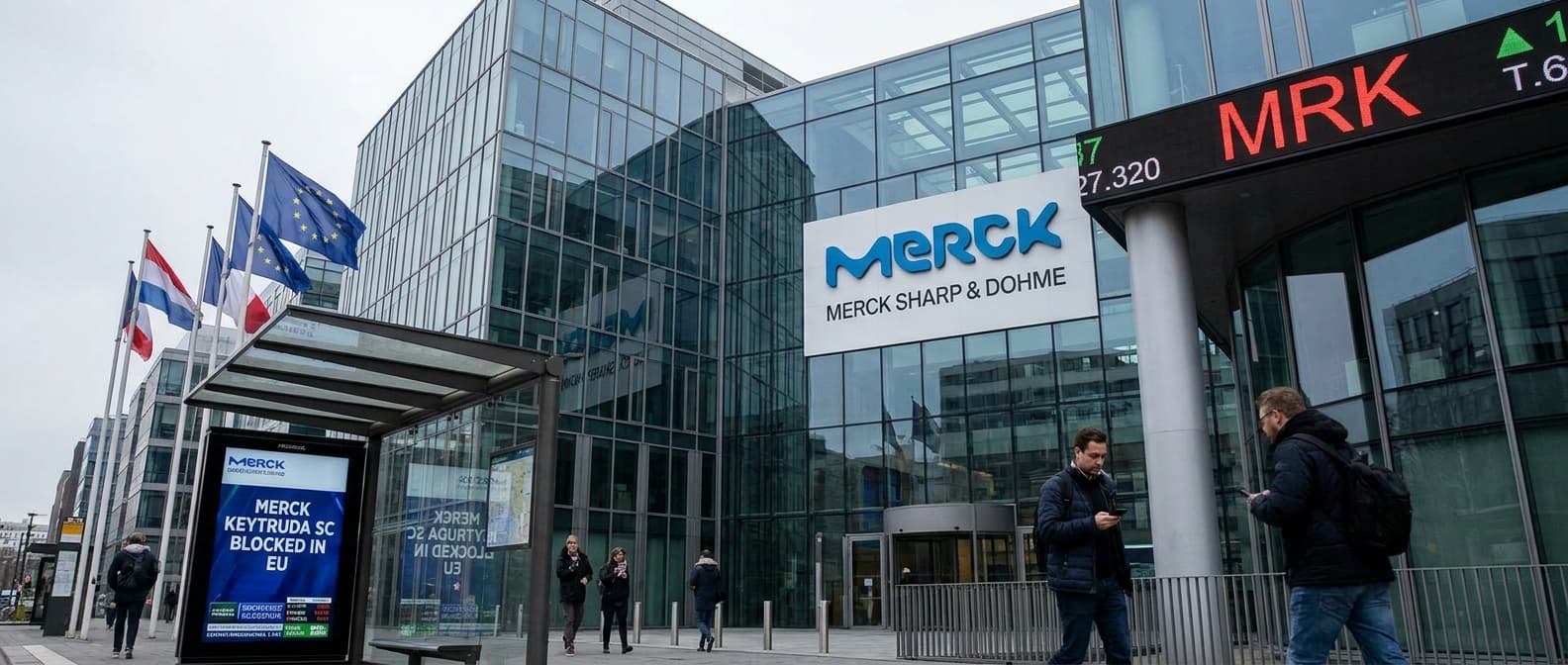
Merck has been blocked by a Dutch court from manufacturing and selling subcutaneous Keytruda in eight European countries, a ruling that cuts into one of the company’s main defenses against the franchise’s coming patent expiry. The court found that Keytruda SC infringes a Halozyme Therapeutics patent covering modified hyaluronidase technology and rejected Merck’s argument that the patent is invalid.
The order prevents Merck from producing, importing, stocking or selling the product in Belgium, Denmark, France, Ireland, Italy, Sweden, Switzerland or the Netherlands. European authorities approved the subcutaneous formulation in November.
The Commercial Picture
The immediate revenue effect appears limited because intravenous Keytruda remains the dominant product. In the second quarter, Merck generated $8.4 billion across the Keytruda franchise, with $7.9 billion coming from the intravenous version and $463 million from the subcutaneous formulation.
The larger issue is strategic. A key Keytruda patent is set to expire in 2028. Merck could delay biosimilar launches until the 2030s, but the company still faces the prospect that its intravenous product will eventually confront off-patent competition. Shifting customers to Keytruda SC, which is covered by other patents, is one way to soften that erosion.
That is why the court loss matters beyond the current subcutaneous sales base. The ruling slows Merck’s effort to convert major European markets before intravenous competition becomes more acute.
The Road Here
The case is part of a broader global dispute between Halozyme and Merck. Halozyme licenses its Enhanze subcutaneous delivery technology to multiple drugmakers, including for Johnson & Johnson’s Darzalex and Roche’s Ocrevus. Merck, by contrast, partnered with South Korea’s Alteogen on technology to deliver Keytruda subcutaneously.
Halozyme has argued that patents in its MDASE portfolio cover an ingredient in the Keytruda SC formulation. Over the past two years, the companies have fought before the Patent Trial and Appeal Board and a district court in the U.S., as well as in European courts.
Europe has moved faster. In December, a German court issued a preliminary injunction barring Keytruda SC sales in Germany. Merck appealed that decision, with a hearing expected next month. BioSpace noted that the Dutch and German rulings now block Merck in three of the four largest markets in Europe, with Germany the largest pharmaceutical market in the region, followed by France, the U.K. and Italy. In May 2026, Halozyme consented to revocation of the disputed patent in the U.K.
Merck’s intravenous Keytruda is unaffected. But the legal setbacks complicate the company’s mid- to long-term plan to use formulation switching as a patent-management tool.