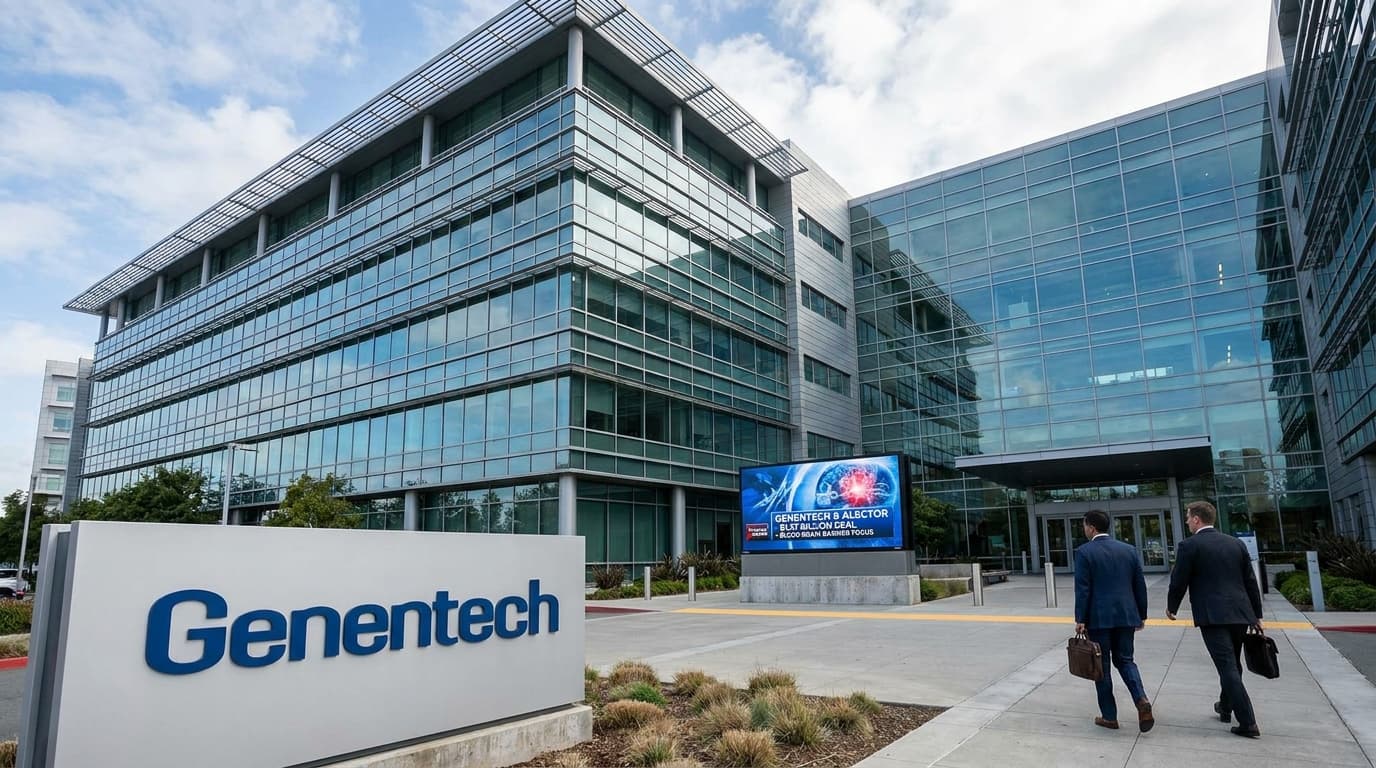
Genentech is paying Alector $100 million upfront for exclusive development and commercialization rights to AL050, a preclinical asset aimed at neurodegenerative disease that is designed to cross the blood-brain barrier. The companies said the deal could bring Alector up to $1.17 billion in additional milestone payments, plus tiered royalties on potential sales; Fierce Biotech also reported the royalty rate ranges from single-digit to double-digit percentages.
AL050 is an investigational engineered glucocerebrosidase, or GCase, enzyme replacement therapy paired with Alector’s blood-brain barrier delivery platform. Genentech will take responsibility for development, regulatory affairs, manufacturing and commercialization across all indications, while Alector keeps ownership of the platform itself.
The transaction matters on two levels. For Genentech, it is another direct investment in the problem of getting therapies into the brain. For Alector, it converts a preclinical program into a large non-dilutive partnership at a time when the company has been rebuilding after clinical failures and workforce reductions.
The Data
The scientific rationale centers on GCase deficiency, which Alector says is a significant risk factor for Parkinson’s disease. Fierce Biotech reported that patients with GBA mutations have low levels of GCase function, and that researchers have linked GCase deficiency to accumulation of alpha-synuclein, a protein that forms toxic clumps in Parkinson’s patients.
Alector has described AL050 as pairing an engineered version of GCase with a delivery system intended to shuttle the therapy into the brain. Fierce Biotech said the company optimized the enzyme to increase enzymatic activity and half-life. Alector CEO Arnon Rosenthal said the development challenge is both engineering an enzyme with optimal activity and durability and delivering it to the brain, positioning AL050 as an attempt to solve both constraints in one construct.
The sources do not report human data. As of February, Fierce Biotech said Alector had been aiming to file to test AL050 in humans in 2027, but dropped that target in May and told investors it was evaluating its timeline to the clinic. That makes this a platform-and-mechanism deal rather than a response to clinical proof of concept.
The Commercial Picture
The economics are unusually large for a preclinical program. BioSpace described the package as $100 million upfront and up to $1.17 billion in biobucks, bringing the total potential value to $1.27 billion. The structure gives Genentech exclusive worldwide control over a candidate in a disease area where brain exposure is a central bottleneck.
The deal also fits Roche’s broader neuroscience strategy. BioSpace noted that Roche already has its own blood-brain barrier technology, Brainshuttle, and is assessing trontinemab in late-stage studies. Fierce Biotech added that Roche is focused on testing drugs that harness transferrin receptors to cross the barrier, and cited Roche’s head of neuroscience early development Luka Kulic as saying in July that the company is “open to exploring different ways to overcome the blood-brain barrier.” The Alector deal suggests Roche is willing to back more than one technical route rather than rely on a single internal platform.
Alector disclosed a related agreement with Spur Therapeutics at the same time. Fierce Biotech reported that, after previously paying $500,000 for an option involving engineered GCase patents, Alector will pay $15 million to exercise it, and Spur will receive “a percentage in the teens of any milestone” Alector receives from sublicensing those patents, including from the Genentech deal.
The Road Here
For Alector, the agreement changes the narrative from retrenchment to platform monetization. Rosenthal said the Genentech deal extends the company’s cash runway into 2029. BioSpace said Alector previously reported $172.8 million on hand and had said that cash would last at least through 2027 in its most recent 10-Q SEC filing, while Fierce Biotech said the company ended September with $138.7 million in the bank and had previously guided to runway at least through 2027. The cash figures differ between the two reports, but both describe the same before-and-after effect: the Genentech payment pushes Alector’s funding horizon further out.
The company needed that reset. BioSpace said GSK terminated its 2021 neurodegeneration partnership with Alector in July after both antibodies in the collaboration failed to show significant clinical benefit. One of those candidates, latozinemab, had failed to slow disease progression in a Phase 3 study in frontotemporal dementia in October 2025, leading the partners to end the program. BioSpace also reported that Alector cut 49% of its workforce, affecting around 116 employees, and that its AbbVie-partnered antibody AL002 failed to slow Alzheimer’s progression in a midstage study, triggering a separate 17% layoff wave and the eventual end of that alliance.
Those setbacks help explain why this deal carries more strategic weight than a typical preclinical licensing transaction. Alector was founded around an immune-neurology thesis, but BioSpace said it has since rebuilt around its blood-brain-barrier delivery programs. Genentech’s willingness to commit $100 million upfront is an external validation of that repositioning, even before AL050 reaches the clinic.
The immediate consequence is that Alector now has capital to keep advancing other programs from the same platform, including AL137 in Alzheimer’s disease and siRNA programs through preclinical development, according to BioSpace.