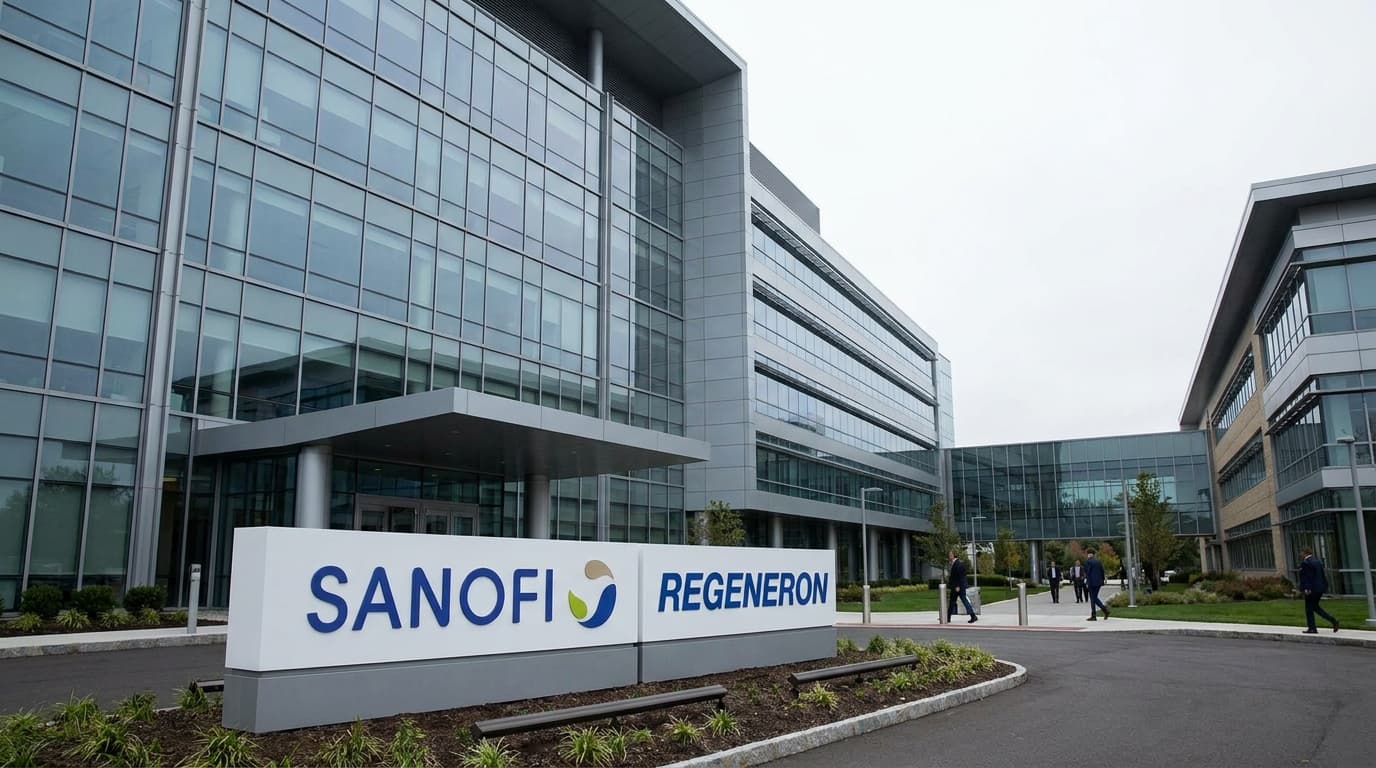
Sanofi has agreed to pay Regeneron $1 billion upfront to expand their long-running immunology partnership around four early-stage antibody programs, with up to $7 billion more available in development, regulatory and commercial milestones. The companies said they will co-develop and co-commercialize the assets, with profits split 50-50 if they reach market.
The transaction is strategically larger than the stage of the pipeline might suggest. Sanofi is returning to its most productive external innovation relationship as exclusivity concerns build around Dupixent, which surged 26% last year to $17.8 billion worldwide and remains, as FierceBiotech put it, the cornerstone of the French pharma’s business after contributing 5.2 billion euros in the second quarter.
The Assets
The lead program in the new agreement is REGN20423, a long-acting IL-13 monoclonal antibody that is in Phase 1 development for atopic dermatitis. FierceBiotech reported that Regeneron began a first-in-human trial in May in healthy volunteers and eczema patients.
The other three Regeneron-discovered assets are preclinical: an IL-4xIL-13 bispecific, an anti-IL-4 therapy and a molecule designed to target IL-4R-alpha. The companies expect all three to enter human studies next year.
Regeneron will lead R&D for its four assets, while Sanofi will lead global commercialization. That division keeps discovery and early development close to the source of the programs while giving Sanofi the lead commercial role it already holds across much of the broader immunology franchise.
The collaboration may also expand. Regeneron has an option to include Sanofi’s TSLPxIL-13 bispecific lunsekimig once the molecule clears Phase 3 testing for chronic obstructive pulmonary disease. Lunsekimig is in two Phase 3 COPD trials, with initial readouts expected in 2029.
The Road Here
The agreement lands after a period of tension between the partners. BioSpace cited BMO Capital Markets describing the move as an extension of a productive partnership that had also been contentious at points. Last year, Regeneron sued Sanofi, alleging that the French pharma did not provide “full access to material information” about Dupixent sales, and BioSpace reported that Sanofi had resisted efforts by Regeneron to audit records related to the drug.
FierceBiotech said the new deal also settles that litigation. It added that when the companies disclosed in July that they were discussing a new partnership, Sanofi CEO Belén Garijo said on an earnings call that her main objective in the Regeneron relationship was “to rebuild trust.”
That repair effort matters because Sanofi’s internal search for a Dupixent successor has recently narrowed. The company in July ended development of amlitelimab in atopic dermatitis, saying that the totality of efficacy and safety evidence did not support further development in that indication. The same month, Sanofi dropped itepekimab after mixed late-stage COPD data. BioSpace noted that neither asset still appears on Sanofi’s pipeline page.
The Commercial Picture
Dupixent’s U.S. patent is set to expire in 2031, even as Sanofi general counsel Roy Papatheodorou said during the company’s first quarter call in April that the product has a web of patents extending as far as 2045. That combination helps explain why Sanofi is paying heavily for assets that are mostly preclinical: the company is buying time, optionality and continuity in a therapeutic area where it already knows the commercial model.
The structure also limits strategic drift. Rather than making a broad acquisition or spreading bets across unrelated mechanisms, Sanofi is concentrating capital on IL-4, IL-13 and IL-4R-alpha biology that sits close to Dupixent’s validated axis. For Regeneron, the deal monetizes early pipeline work without giving up a 50-50 profit share.
BMO said the renewed arrangement positions both companies for continued leadership in type 2 inflammation-driven disease. The more immediate signal is narrower: Sanofi’s next immunology growth cycle is still being built through the Regeneron alliance, not outside it.