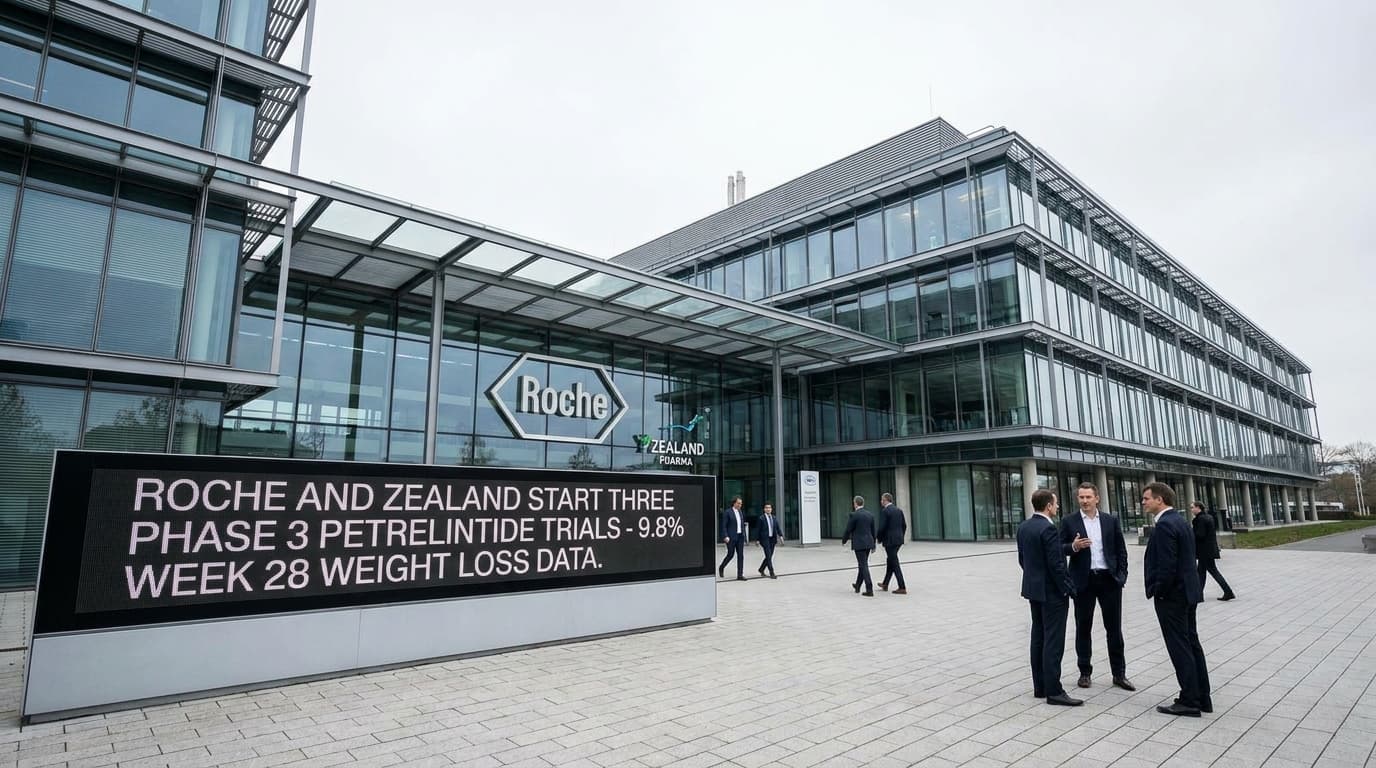
Roche and Zealand Pharma have released a fuller look at phase 2 data for petrelintide, showing the amylin analog’s highest Week 28 mean weight loss came at the 5 mg dose, where participants lost 9.8% of body weight.
The result fills in a missing piece from earlier updates. In March, the partners shared topline findings from the Zupreme 1 trial, and in June they highlighted up to 10.7% mean weight loss at Week 42 without detailing the Week 28 primary endpoint analysis or the performance of each dose cohort. The new breakdown, published in The Lancet Diabetes & Endocrinology, suggests higher dosing did not add meaningfully to efficacy.
The Data
At Week 28, mean weight loss was 7.9% in both the 1 mg and 2.5 mg arms. Efficacy increased to 9.8% at 5 mg, then flattened, with mean weight loss of 9.3% at 7 mg and 9.4% at 9 mg. Placebo patients lost 1.7% at Week 28, putting the control-adjusted reduction at 8.1% for the 5 mg cohort.
Those figures are from efficacy estimand analyses. Using the treatment policy estimand, which handles discontinuations differently, Zealand reported mean reductions in body weight from baseline to Week 42 of up to 10.2% versus 1.4% for placebo.
On safety, nausea was more common with petrelintide than placebo, affecting 20% of participants compared with 6% in the control arm. Constipation was also higher on petrelintide, at 7% versus 4% on placebo. Rates of vomiting and diarrhea were the same or lower on petrelintide than on placebo.
The Commercial Picture
The new data clarify where petrelintide may fit in the amylin race. Cross-trial comparisons cited by Fierce Biotech suggest the drug is unlikely to lead the field on efficacy alone. Eli Lilly reported up to 11.3% weight loss at Week 12 in a phase 1 trial of eloralintide and up to 20.1% at Week 48 in a phase 2 study.
That leaves tolerability as a central part of Roche and Zealand’s thesis. BMO Capital Markets analysts wrote in a June 6 note to investors that the risk-benefit profile of amylin agonists could support a future treatment paradigm in which physicians try amylin agents first, with combination treatments reserved for patients who need higher efficacy or are refractory.
Roche signaled its commitment to that positioning in 2025 by paying $1.65 billion upfront for petrelintide.
What To Watch
Roche is scheduled to start three phase 3 studies of petrelintide Wednesday, according to the federal trials database. The monotherapy trials target obesity or overweight; obesity or overweight plus Type 2 diabetes; and obesity or overweight plus cardiovascular disease. The obesity and diabetes studies have primary completion dates in late 2028.
The signal from the phase 2 dataset is that dose escalation alone may not unlock a stronger efficacy profile. If petrelintide succeeds commercially, it may do so by offering a different trade-off on tolerability rather than by posting the biggest weight-loss number in class.