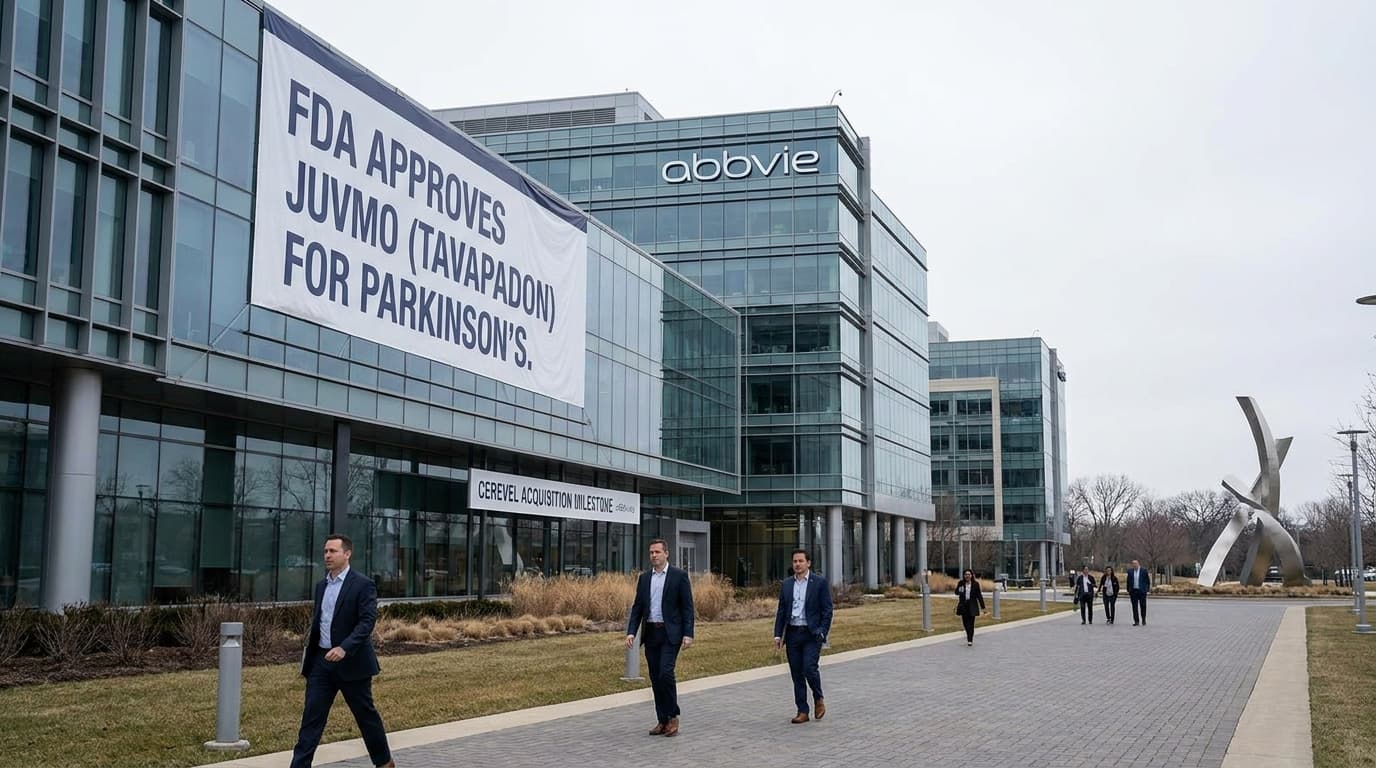
AbbVie has secured FDA approval for tavapadon in adults with Parkinson’s disease, according to the agency’s website, and the drug will be sold as Juvmo. The clearance gives AbbVie its first marketed product from the Cerevel Therapeutics acquisition it announced in December 2023 and closed in August 2024.
That matters because the deal’s star asset, emraclidine, failed a mid-stage schizophrenia study in November 2024, sending AbbVie’s shares down 12% at the time. Juvmo’s approval does not erase that setback, but it does show that the Cerevel transaction can still produce a commercial product in a difficult neurology market.
The Data
Juvmo’s approval was backed by the Phase 3 TEMPO program. In late-stage TEMPO-2, reported just weeks after emraclidine’s failure, patients on Juvmo showed significant improvements in motor and daily living complications versus placebo on the trial’s primary endpoint.
The asset had already cleared two other studies in the same program. In April 2024, before the Cerevel acquisition closed, TEMPO-3 showed significantly better total “on” time in treated patients versus placebo on the primary endpoint. In Parkinson’s disease, “on” time refers to periods of good symptom control and patient function. TEMPO-1, which read out in September 2024, also met its primary endpoint by improving motor function versus placebo.
After those three trial wins, AbbVie filed for approval in September 2025.
The Commercial Picture
AbbVie has not yet detailed pricing or launch plans. BioSpace said it reached out to the company on both points.
Even without those details, the approval opens a clearer commercial path in a category AbbVie sees as meaningful. During the company’s Q2 earnings call in July, Chief Commercial Officer Jeffrey Stewart said Juvmo could give AbbVie access to a $5 billion market opportunity. He also argued that “there’s nothing else like it in the marketplace,” adding that unlike other Parkinson’s medicines, including levodopa, Juvmo is less likely to cause sedation, or what he called “sleep attacks.”
The Road Here
The approval arrives against a tougher backdrop for Parkinson’s drug development more broadly. Jefferies equity analyst Alyna Shamsi told BioSpace earlier this month that the field has been hard for pharma to approach because of late diagnosis, slow progression and differing biology across patients.
Recent setbacks support that view. BioVie reported a murky mid-stage readout last month based on an alternative endpoint and its stock fell 50% at the time, while Biogen and Denali Therapeutics discontinued BIIB112 back in May after a Phase 2b failure to slow disease progression. In that context, AbbVie’s approval gives the company a rare late-stage success in a field where technical progress has been inconsistent.