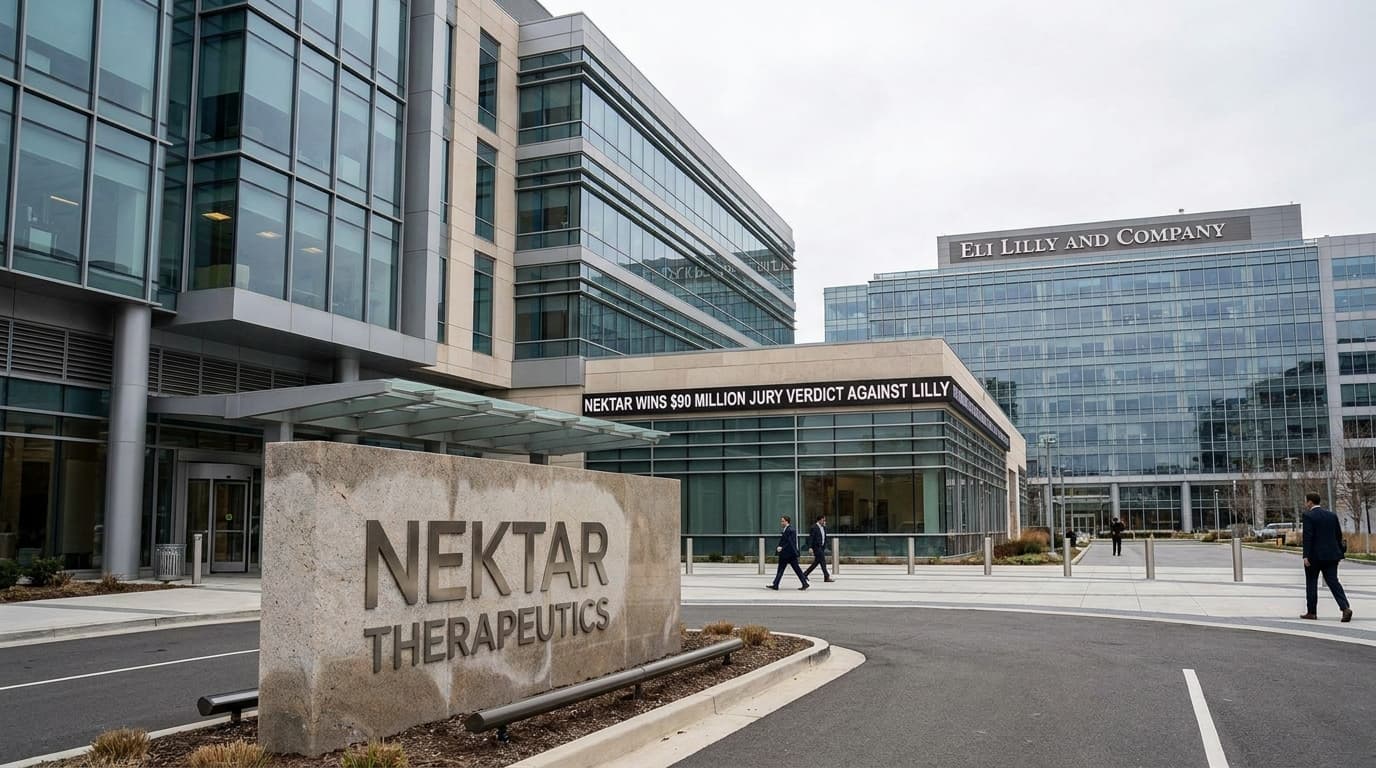
Nektar Therapeutics won a jury verdict ordering Eli Lilly to pay $90 million in damages over the companies’ failed rezpegaldesleukin partnership, ending one phase of a dispute that has hung over the biotech since 2023. The award is materially below the $1 billion Nektar had sought, and Lilly has already said it intends to appeal.
The case centered on rezpegaldesleukin, or rezpeg, Nektar’s lead medicine for autoimmune and inflammatory diseases. The companies entered their partnership in 2017 to develop the asset across multiple indications, with eczema as the primary focus. According to BioSpace, the relationship deteriorated in 2020 after Lilly agreed to acquire Dermira for $1.1 billion, bringing in a chronic skin disease asset that would compete directly with rezpeg.
Nektar accused Lilly of undermining rezpeg’s progress and mishandling analysis from early-stage trials before ultimately terminating its role in development and returning the asset. In a Thursday SEC filing, Nektar said the jury sided with the company, finding that Lilly had “breached the implied covenant of good faith and fair dealing” in the licensing deal.
What the verdict does and does not settle
The $90 million award is meaningful for Nektar, but the size of the verdict also sets limits on how much legal relief the company secured. BioSpace noted that the result was only a small fraction of the damages Nektar had pursued.
Lilly’s public response highlighted that narrower reading. A spokesperson told BioSpace that the company believes “the correct amount is zero” and that it intends to seek reversal. The spokesperson also argued that the court confirmed Lilly developed the drug in accordance with the contract and said the jury found Lilly used commercially reasonable efforts to develop rezpeg as required, while awarding damages only on what the company described as a secondary claim.
That leaves the case in an unusual position strategically. Nektar can point to a jury finding that Lilly breached the implied covenant of good faith and fair dealing. Lilly can point to the limited damages and to its interpretation that core development obligations were upheld. With an appeal coming, the legal overhang has narrowed but not disappeared.
The business context around rezpeg
The verdict lands as rezpeg has produced more supportive clinical data, giving Nektar a clearer operating story than it had during the worst period after the breakup. In February, the company reported that rezpeg maintained disease control in the phase 2b REZOLVE-AD study in atopic dermatitis and showed a deepening response to monthly and quarterly dosing over a year.
Those results helped shift outside sentiment. BioSpace said William Blair, which had previously brushed off rezpeg, later concluded that the findings showed differentiation in a crowded disease space. Nektar has since moved rezpeg into a pivotal study in atopic dermatitis, and a phase 3 trial called ZENITH-AA in alopecia areata is expected to start in early 2027, according to the company’s second-quarter earnings report in August.
The company also had $1 billion in cash at the end of the second quarter, which William Blair estimated would fund operations into the third quarter of 2028. That means the verdict arrives at a moment when Nektar is not relying on the award to keep rezpeg moving. Instead, the more important consequence may be that the legal outcome removes some uncertainty while the company tries to rebuild value around an asset that survived the partnership collapse.
That rebuilding job remains incomplete. BioSpace reported that Nektar’s stock has fallen nearly 80% in five years, with shares at $58.39 as of 10 a.m. EST Friday. The jury win helps validate Nektar’s long-held complaint about how the alliance unraveled, but the commercial task is still to prove that rezpeg can earn a durable position on its own in atopic dermatitis, alopecia areata and other autoimmune settings.