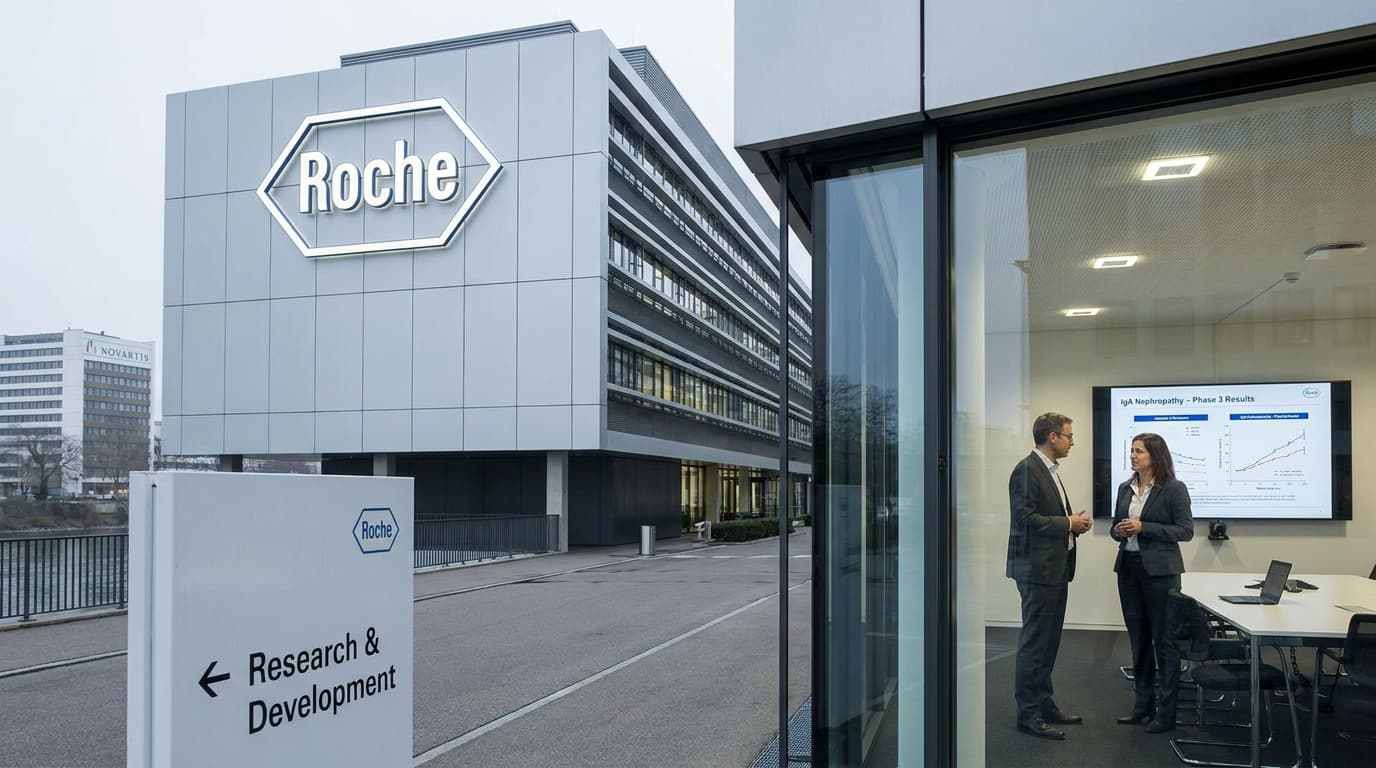
Roche reported a phase 3 win for sefaxersen in primary IgA nephropathy, clearing an important hurdle for a kidney disease program partnered with Ionis Pharmaceuticals. In a prespecified interim analysis of the Imagination study, patients receiving monthly injections showed a statistically significant reduction in proteinuria versus placebo, allowing the trial to meet its primary endpoint at Week 37.
The company said safety and tolerability were consistent with earlier trials. Roche plans to talk with regulators about next steps for the candidate, previously called IONIS-FB-LRx, rather than wait for the study’s final kidney-function readout.
The data
The phase 3 result was based on changes in 24-hour protein-to-creatinine ratio, or UPCR, a measure of protein in urine used as a marker for kidney health. The Imagination study will remain blinded through Week 105 to evaluate change in kidney function.
Roche’s regulatory argument rests on evidence from other research linking reductions in UPCR to preservation of long-term kidney function. At Roche’s immunology event in March, Jay Garg, M.D., the company’s global head of nephrology, rheumatology and cardiovascular, said the Week 37 proteinuria data would “hopefully lead to accelerated approval.”
Sefaxersen is an antisense oligonucleotide designed to inhibit production of complement factor B, a protein found at high levels in IgA nephropathy patients. The theory is that lowering factor B could reduce complement-driven kidney-cell damage.
The commercial picture
The readout positions Roche against Novartis’ Fabhalta, which also inhibits factor B. Fabhalta received accelerated approval in IgA nephropathy in 2024, and the FDA converted that into a full authorization this year.
The competitive split is not only mechanistic. Fabhalta is taken orally twice daily, while sefaxersen is administered subcutaneously once monthly. Roche also pointed to a differentiation angle from phase 2, where sefaxersen had no observed effect on cholesterol, while Fabhalta can increase cholesterol.
Commercial expectations vary. Bruno Eschli, Roche’s head of investor relations, said in March that most analyst models included sales of 400 million euros, or $457 million, by 2030. Roche has been more bullish, putting peak sales at 1 billion to 2 billion euros. Those forecasts were made before the phase 3 data.
That range matters because Roche is not entering an empty market; it is trying to claim share in one already validated by Novartis while betting the IgA nephropathy market will grow quickly through 2030. The phase 3 result gives Roche a chance to compete on dosing convenience and biomarker differentiation rather than on a first-to-market advantage.
The road here
Roche paid Ionis $55 million upfront in 2022 to license sefaxersen in IgA nephropathy, building on a 2018 agreement in which Roche paid $75 million upfront for an option on the asset. GSK previously held rights to the program but exited in 2017.