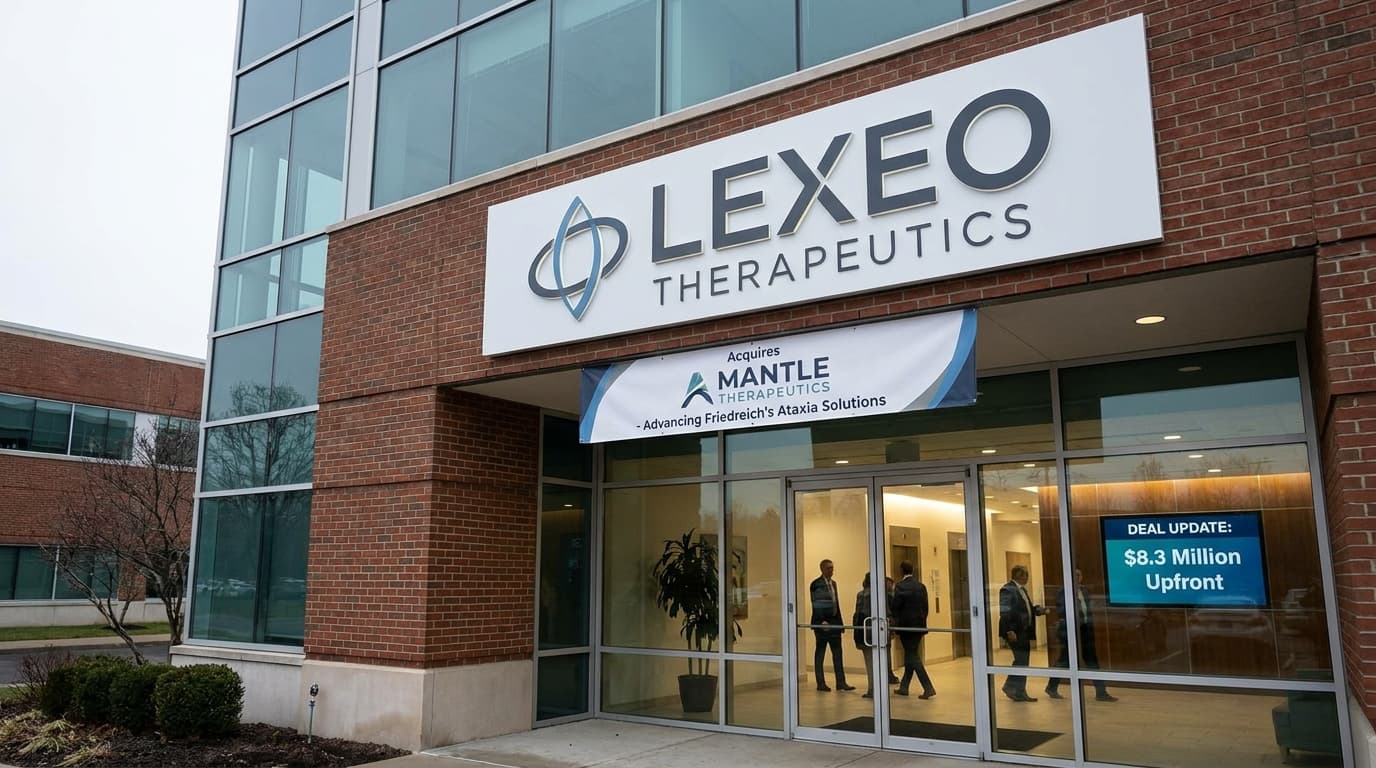
Lexeo Therapeutics is buying Mantle Therapeutics for an upfront payment of $8.3 million, with another $13 million in potential milestone payments available, in a move to deepen its presence in Friedreich’s ataxia while adding new tools around its lead gene therapy program.
The deal brings Lexeo’s potential outlay to $21.3 million and adds four Friedreich’s ataxia assets. It also comes with three strategic collaborations tied to sequential dosing of CNS-targeted Friedreich’s ataxia gene therapy, showing that Lexeo is trying to build a broader platform in the disease rather than rely on a single asset.
The assets
The acquired portfolio is led by LX3010, formerly MTL-104, a clinical-stage oral combination therapy for Friedreich’s ataxia patients. Lexeo said early clinical data across 11 patients showed a 6-point improvement in the modified Friedreich Ataxia Rating Scale score, which is measured on a 0-to-93 scale.
The acquisition also includes three preclinical programs: LX3030, formerly MTL-707; LX3050, formerly MTL-501; and LX3070, formerly MTL-801. Lexeo said all three are focused on Friedreich’s ataxia patients and target frataxin protein, which is needed for normal cellular energy production and iron balance in the cell’s mitochondria.
Lexeo described Friedreich’s ataxia as a genetic, degenerative multisystem disorder that causes loss of balance and coordination. According to the company, the disease is present in one in 50,000 people in the U.S., and 80% of people with Friedreich’s ataxia develop cardiomyopathy. The condition is caused by an expanded GAA trinucleotide repeat on the FXN gene, which leads to under-expression of the gene and a shortage of frataxin protein.
Strategy around LX2006
The Mantle assets add to Lexeo’s existing focus on Friedreich’s ataxia, led by AAV-based gene therapy LX2006. That program has received Breakthrough Therapy and Orphan Drug designations from the FDA. Earlier this year, Lexeo published phase 1/2 data in the Journal of the American Medical Association that the company said showed clinically meaningful improvements across cardiac and neurologic measures.
In August, Lexeo said it had initiated a study in Friedreich ataxia cardiomyopathy and remains on track to provide a topline data readout in the second half of 2027. Even with the Mantle acquisition and the new collaborations, CEO R. Nolan Townsend said LX2006 remains the company’s highest priority.
The three new collaborations are designed to support that program’s future flexibility. Lexeo signed a research agreement with Weill Cornell Medicine to evaluate intracisternal administration of LX2006, an option agreement with Vivet Therapeutics for VTX-PID to support immune-suppression strategies that may expand the treatable population with immunization against AAV and facilitate repeat administration, and an option agreement with Apertura Gene Therapy for a blood-brain barrier-crossing capsid expected to enable a less invasive route to the CNS after initial systemic administration.
What comes next
After closing, Lexeo said it will continue evaluating the acquired programs and, with cash runway through 2028, plans to advance one of the Mantle programs through clinical development. The company expects to provide a program prioritization early next year and submit an IND for its next Friedreich’s ataxia development candidate in 2027.
The signal in the transaction is less the size of the upfront payment than the structure around it: Lexeo is trying to assemble multiple complementary approaches to restore frataxin while keeping capital focused on the asset it sees as most important commercially and clinically.