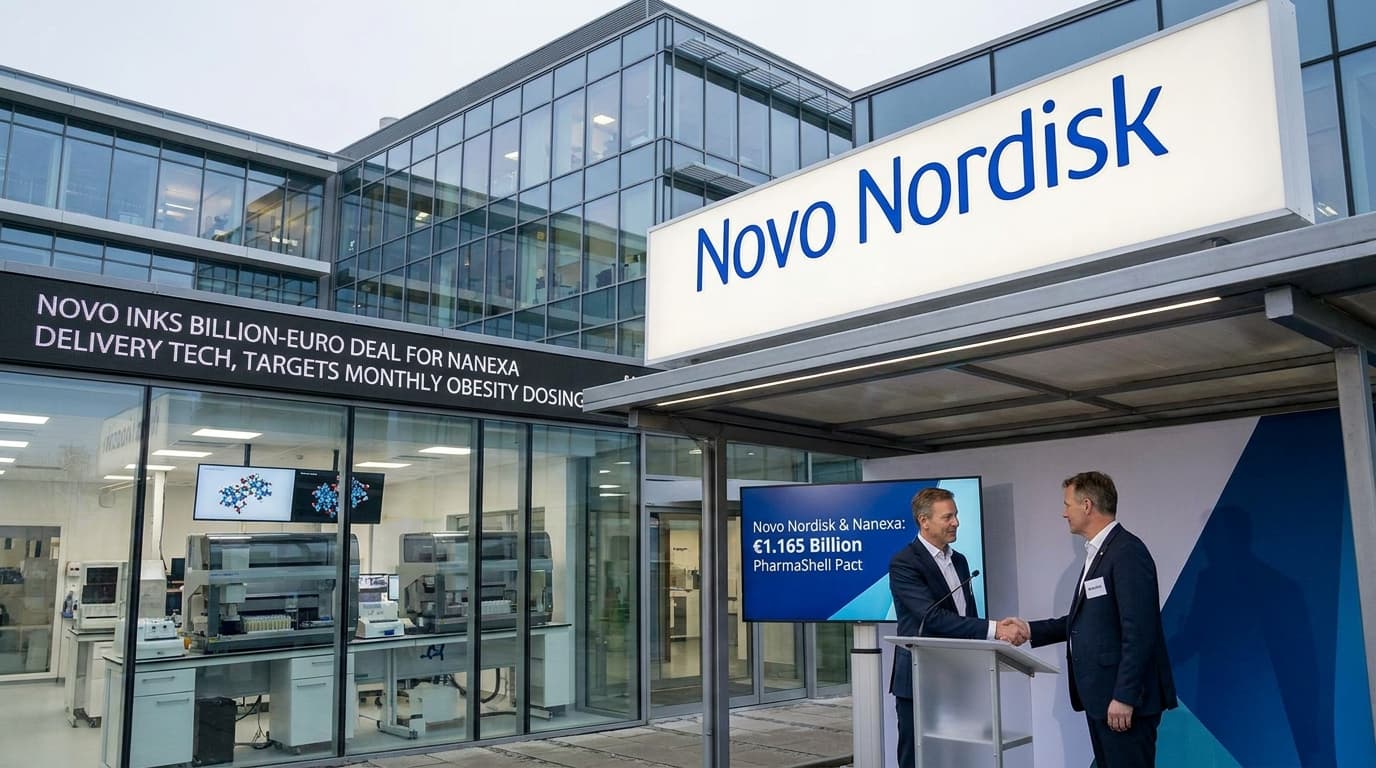
Novo has signed a 1.165 billion euro ($1.33 billion) agreement with Nanexa to pair the Swedish company’s PharmaShell drug-delivery platform with certain peptides in obesity, Type 2 diabetes and other cardiometabolic diseases. The deal gives Novo an exclusive global license to use the technology across up to five programs.
The companies framed the partnership around one of the clearest next battlegrounds in obesity medicines: extending dosing windows without giving up the tolerability and efficacy needed for chronic use. Novo is targeting monthly and quarterly administration frequencies, using a platform that coats drug particles with an inorganic layer so they form depots at the injection site and release into the bloodstream as the coating dissolves.
What Novo Is Buying
Under the agreement, up to 615 million euros ($700 million) is tied to the upfront payment plus development and regulatory milestones. The remaining 550 million euros ($626 million) depends on sales milestones. Neither company disclosed the size of the upfront payment.
The strategic value is less about adding a new metabolic mechanism than about changing how existing or future peptides might be delivered. Novo has identified PharmaShell as a potential fit for efforts to differentiate its medicines by extending dosing intervals, a commercial goal that matters as obesity competition moves beyond simple weekly convenience.
Why Timing Matters
The deal landed days after Novo used its Capital Markets Day to discuss long-acting injectable ambitions. According to Fierce Biotech, chief scientific officer Martin Holst Lange said Novo expects at least three or four first human doses with once-monthly GLP-1 programs over the next one year because the company cannot assume the first candidate will be the best. He also said half-life remains something Novo needs to fully understand.
That comment helps explain why a delivery-platform partnership is attractive now. If molecule half-life alone does not fully support a once-monthly product, formulation and depot technologies become another lever for reaching that schedule.
The Competitive Readthrough
The agreement also sits in a more crowded race. Fierce noted that Pfizer reported data on its once-monthly GLP-1 candidate in February after acquiring the molecule through its $10 billion takeover of Metsera, a company Novo also tried to buy. Lange said in June that he was not sure Pfizer’s data were as compelling as hoped, particularly on tolerability and somewhat on efficacy, and added that a once-monthly therapy needs a very attractive tolerability profile.
Eli Lilly is also pursuing long-acting molecules and last year signed an $870 million deal for access to Camurus’ technology, later extending that pact to amylin receptor agonists in June.
Against that backdrop, Novo’s Nanexa deal shows that long-acting obesity competition is no longer only a molecule contest. Delivery technology is becoming part of product strategy, especially when companies are trying to move from weekly injections toward monthly or quarterly schedules. For platform suppliers, that raises the value of technologies that can help established peptide franchises compete on convenience without forcing a complete change in underlying biology.