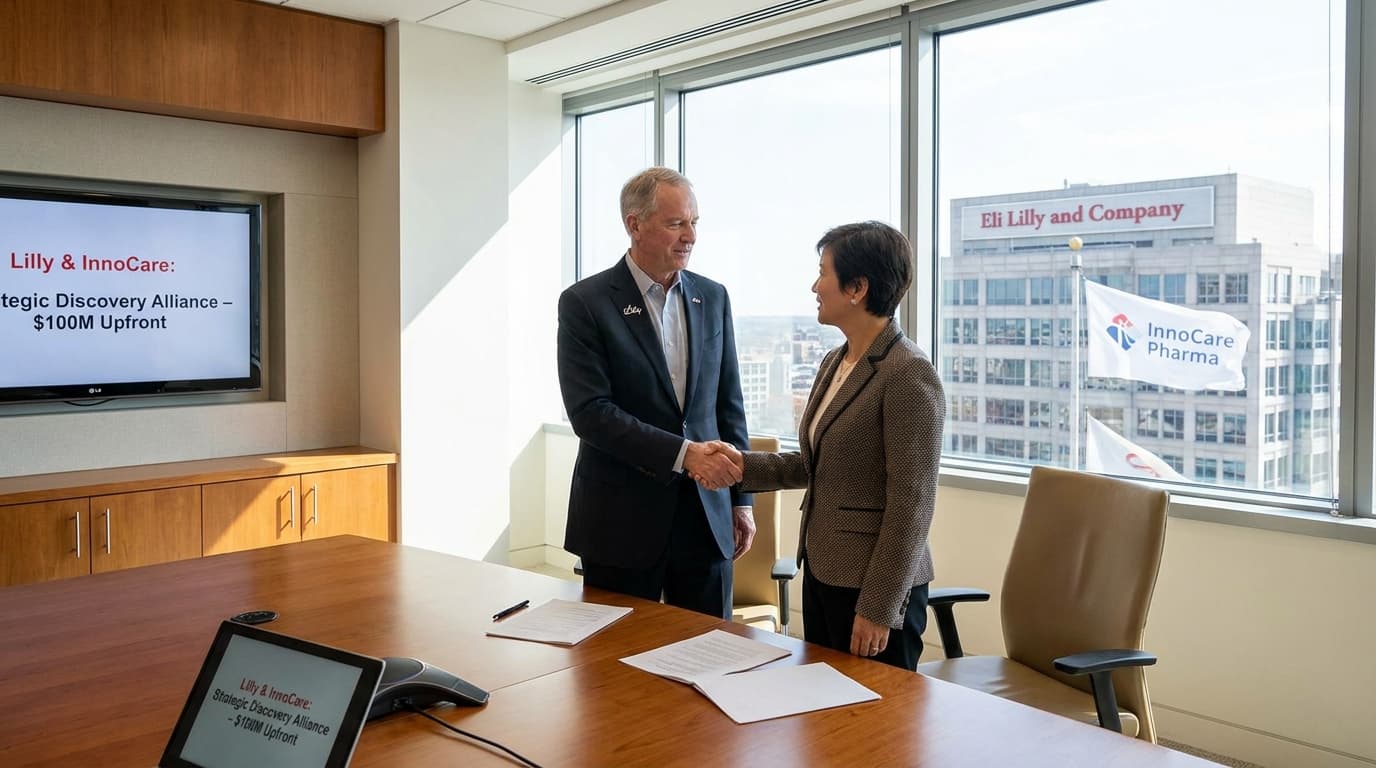
Eli Lilly has agreed to pay InnoCare Pharma $100 million in upfront and near-term payments to form a five-target drug discovery collaboration, with up to $3.25 billion in potential development and commercial milestones available on the backend. InnoCare would also be eligible for single-digit tiered royalties based on annual net product sales.
The companies did not disclose the targets or therapeutic areas, saying only that the programs are intended to address critical unmet medical needs. Under the arrangement, Beijing-based InnoCare will apply its drug discovery platform and research experience to develop candidates against up to five targets.
For Lilly, the deal continues a year of aggressive external business development. Both sources frame the agreement as part of a broader spree supported by the company’s financial strength. BioSpace pointed to recent acquisitions including Merida Biosciences, AtaiBeckley, Kelonia Therapeutics and Centessa Pharmaceuticals, while Fierce Biotech described Lilly as using its GLP-1 cash position to secure assets, R&D programs and technologies through both takeovers and licensing deals.
Why This Deal Matters
The main strategic signal is not in the undisclosed biology but in the structure. Lilly is again buying optionality at the research stage, committing meaningful near-term cash while leaving the bulk of value contingent on future progress. That approach lets Lilly widen its shot count without forcing immediate therapeutic concentration in publicly identified areas.
The pact also adds to a rising pattern of Western pharmas sourcing discovery capabilities from Chinese biotech companies even when the specific programs are not yet named. InnoCare is best known for work spanning hemato-oncology, autoimmune diseases and solid tumors, and Fierce Biotech noted that its pipeline includes assets across several modalities rather than only kinase inhibitors. That breadth may help explain Lilly’s willingness to sign a multi-target arrangement without publicly anchoring it to a single mechanism.
InnoCare’s Partnering Position
InnoCare entered the deal from a position that, by its own telling, was not driven by urgent financing needs. Fierce Biotech cited CEO Jasmine Cui saying on an August earnings call that the company had cash, a globalization strategy and a selective approach to choosing partners. At the time, Cui discussed U.S. business development activity around early- and late-stage programs including a VAV1 degrader and a TYK2 inhibitor, while saying the company was not in a rush to transact for cash.
That context makes the Lilly agreement look less like a defensive out-licensing move and more like a deliberate attempt to place parts of InnoCare’s discovery engine with a partner that can fund and develop multiple programs at scale.
The company has worked with Western drugmakers before. In 2021, Biogen paid $125 million upfront to license InnoCare’s oral BTK inhibitor orelabrutinib for multiple sclerosis, a deal that included up to $812.5 million in milestones before Biogen terminated the agreement in February 2023 and returned the asset. BioSpace reported that Zenas BioSciences then committed $100 million in October last year to acquire orelabrutinib and other autoimmune candidates, in a transaction that could exceed $2 billion including milestones.
Lilly’s new five-target pact therefore looks less like a one-off and more like another example of InnoCare converting its discovery base into cross-border partnering value while Lilly keeps widening the set of external programs feeding its pipeline.