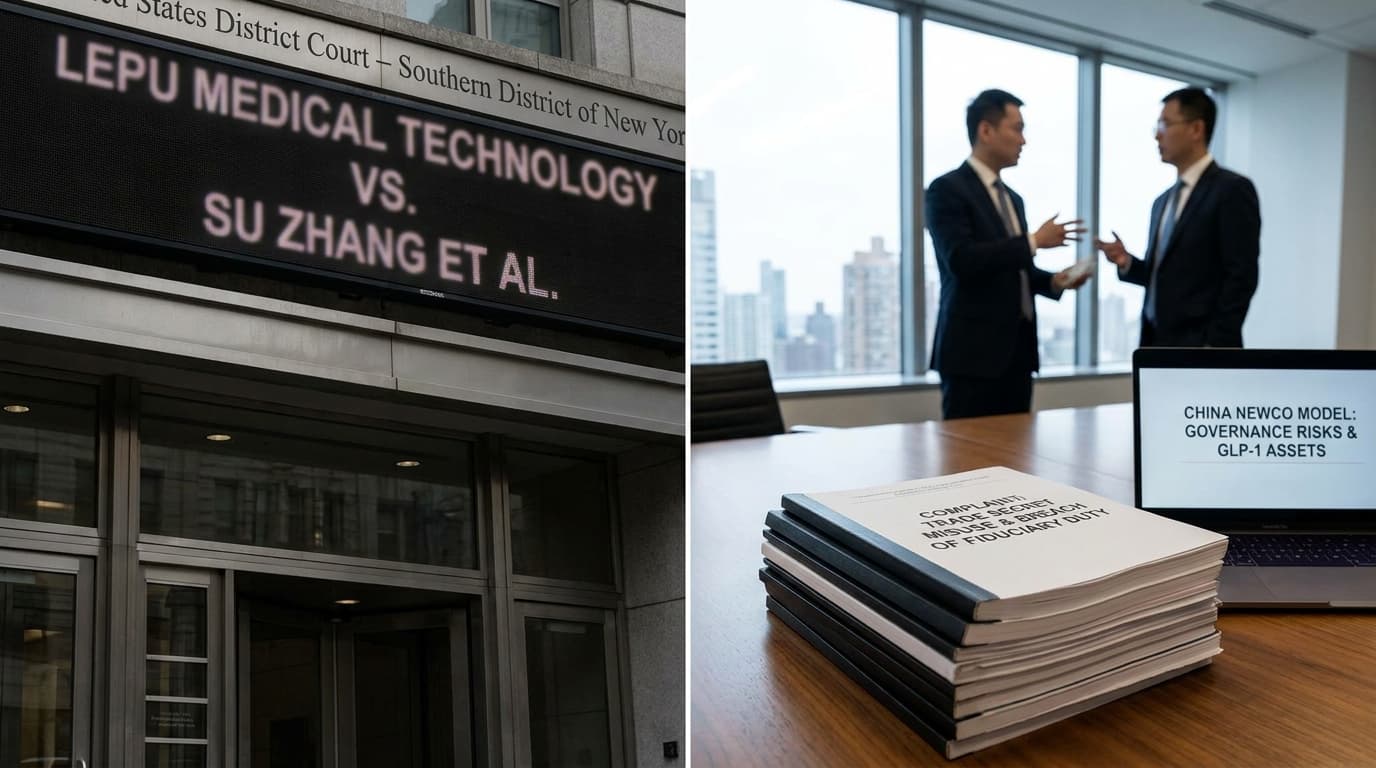
A lawsuit involving Lepu Medical Technology and business development consultant Su Zhang is drawing attention to a governance risk behind one of biopharma’s most active cross-border deal structures: the China NewCo model. In a complaint originally filed in New York state court and recently moved to federal court, Lepu alleges that Zhang, hired to help find Western partners for its GLP-1 weight-loss candidates, engaged in corporate double-dealing and trade secret leaks while also serving a direct competitor.
According to the complaint, Zhang was acting as Lepu’s primary dealmaking liaison for a group of obesity and metabolic disease drug candidates while secretly also serving as the acting chief business officer for BrightGene Pharmaceutical. Lepu alleges she “never adequately disclosed the role, never sought Lepu’s consent, and never proposed any safeguard.” Zhang’s consulting firm, CoDevCo, had already sought certain transaction-based success fees from Lepu through an arbitration process in Singapore before Lepu filed suit in July.
The immediate legal asks are concrete. Lepu has asked Zhang to repay its $500,000 retainer, disgorge all benefits she received during the alleged breaches of fiduciary duty, and face other damages and relief. The company also wants injunctions to protect what it says are its trade secrets.
Why This Case Reaches Beyond One Dispute
Zhang is credited with helping pioneer the China NewCo model during a prior stint as global head of business development at Hengrui Pharmaceuticals. During her tenure there, Hengrui signed a landmark transaction granting exclusive rights for a portfolio of GLP-1 assets to Hercules, a newly established company created by private equity and venture capital firms. In addition to upfront and milestone payments, Hengrui received an equity stake in Hercules, which later became Kailera Therapeutics.
That structure helped popularize a model in which a Chinese biopharma company spins off selected early-stage assets to investors for further development through a newly created company abroad. The appeal is straightforward: Western investors gain early access to Chinese-origin assets, while the Chinese licensor can keep upside through equity in the NewCo.
The model’s financial appeal was reinforced when Kailera completed a record-breaking $625 million Nasdaq IPO this April, merely two years after the Hengrui deal. That success helps explain why Lepu turned to Zhang as it sought to internationalize its own cardiometabolic portfolio.
The strategic implication is that the NewCo model depends heavily on trust in intermediaries. When a single adviser controls introductions, partner conversations and confidential information across multiple Chinese companies pursuing similar Western tie-ups, conflict management becomes central to the model’s durability.
What Lepu Alleges
Lepu says the partnership with CoDevCo began in December 2024, when it appointed the firm as its “exclusive business development mechanism” to identify collaborators for its drug candidates. According to the complaint, Zhang personally negotiated and signed the agreement as managing director for CoDevCo, which used her home address.
Lepu says it had little knowledge of U.S. laws, customs or business practices in business development and therefore “needed to rely entirely” on Zhang and her team as its first U.S.-based BD consultant. The company argues that Zhang’s influence extended deeply into strategy because she personally controlled business-development communications with potential partners on Lepu’s behalf.
After the arrangement began, Zhang introduced Lepu to four associates. Lepu alleges that these individuals were employed at different times in similar roles at other Chinese companies Lepu considered competitors while still having access to Lepu’s confidential information. In the complaint, Lepu describes Zhang’s group as “a roster of individuals whose primary professional loyalty, by virtue of their concurrent full-time employment, ran to Lepu’s competitors.”
The complaint says the shock came on June 25, 2025, when a news article about phase 2 data for BrightGene’s GLP-1/GIP receptor agonist BGM0504 identified Zhang as acting chief business officer of BrightGene. Lepu says it was blindsided, confronted Zhang in July 2025 and was told there was nothing to worry about, but that she never followed through with an explanation. Lepu argues that Zhang had both motive and opportunity to steer prospective partners toward BrightGene or other rivals.
The Deal Context Around Lepu’s Assets
Lepu’s complaint frames the dispute around a commercially important window for its obesity and metabolic disease portfolio, which includes candidates for obesity, Type 2 diabetes, fatty liver disease and muscle preservation during weight loss treatment. The company argues that the pipeline is highly valuable only if it can secure the right international partner during that available commercial window.
The record cited by Fierce Biotech suggests Zhang may have been involved in at least one transaction during the relationship. Through its subsidiary Shanghai Minwei Biotechnology, Lepu out-licensed its GLP-1/GIP/FGF21 agonist MWN105 to a NewCo called Sidera Bio in the fall of 2025. That deal included an upfront and near-term payment of $35 million, up to $1.01 billion in milestones, and a 9.99% stake in the Danish startup. Fierce Biotech noted that Zhang’s involvement appears likely because Lepu had described CoDevCo as its exclusive business development mechanism.
That detail matters because it shows the dispute is not just about an advisory contract gone wrong. It sits directly in a market where Chinese obesity assets, Western investor appetite and NewCo structures are converging around large potential payouts.
If Lepu’s allegations hold up, the case could pressure participants in future China-to-West licensing and NewCo deals to tighten exclusivity terms, disclosures and information barriers. The commercial promise of the model remains clear, but this lawsuit suggests the next phase may require more formal governance than relationship-driven dealmaking has tolerated so far.