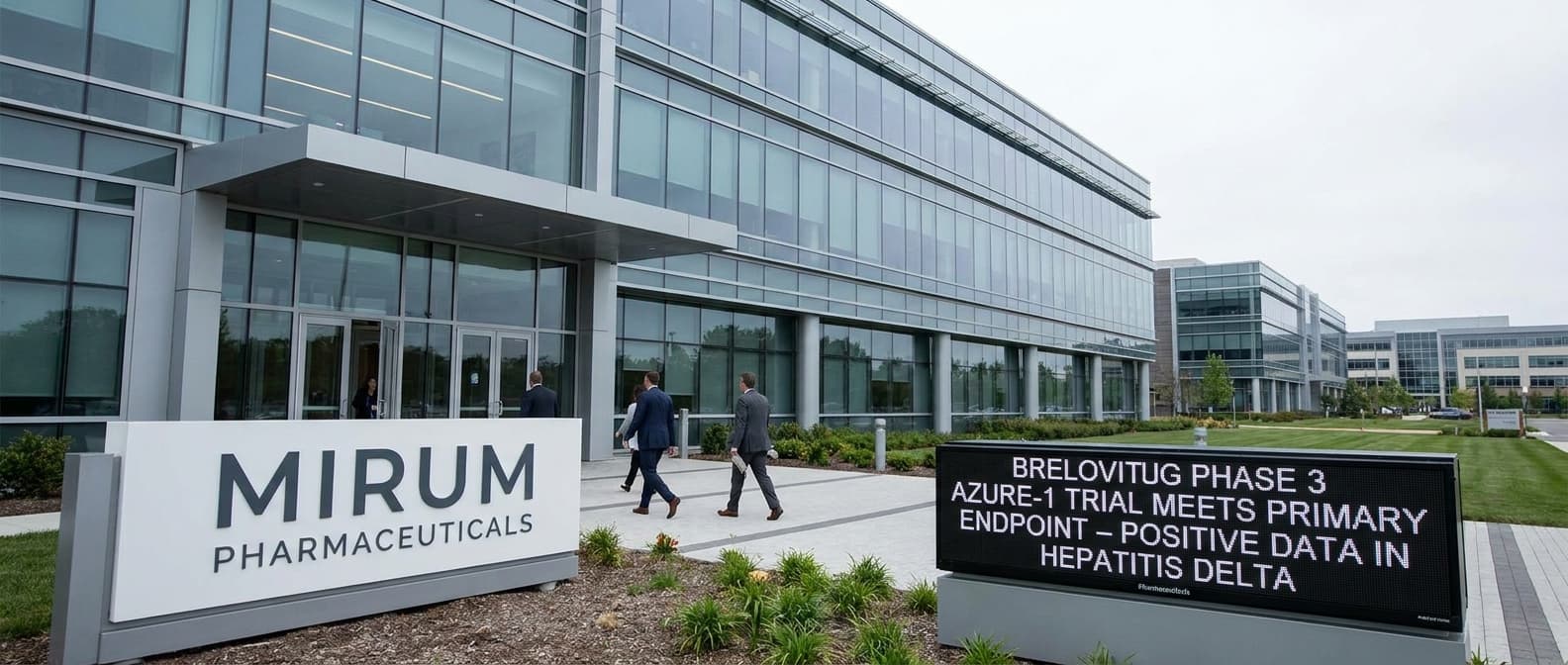
Mirum Pharmaceuticals reported that the phase 3 portion of its Azure-1 trial met the primary endpoint for brelovitug in chronic hepatitis delta virus, advancing the company toward a market that Gilead Sciences only recently entered. The candidate is an antibody that binds to a hepatitis surface antigen and was tested as subcutaneous injections of 300 mg once weekly or 900 mg every four weeks.
At Week 24, both regimens outperformed the delayed-treatment control arm on a composite endpoint that combined virologic response with normalization of ALT, a marker of liver inflammation. Mirum reported primary endpoint response rates of 56% in the 300-mg arm, 45% in the 900-mg arm and 0% in the delayed-treatment arm.
The data
About 85% of patients on brelovitug had a virologic response. ALT normalized in 63% of people in the 300-mg arm and 54% of patients in the 900-mg cohort. Nancy Shulman, M.D., executive vice president of clinical development at Mirum, said on a conference call with analysts that the company chose the composite endpoint because “a virologic response alone does not necessarily mean that liver inflammation has resolved.” She added that liver inflammation is the key driver for progression to fibrosis, cirrhosis and cancer.
The phase 3 results also improved on the phase 2b data Mirum shared in April. The phase 2b portion included the first 53 patients enrolled in Azure-1, and at Week 24 the primary endpoint was met by 45% of people in the 300-mg arm and 35% in the 900-mg cohort. Mirum also reported Week 48 phase 2b data, where response rates rose to 55% in both cohorts as ALT normalization increased in both arms and the 900-mg group also posted a higher virologic response rate.
The commercial picture
Leerink Partners analysts said in a note to investors that the new data set brelovitug up to be “commercially differentiated in a nascent market, which we expect will grow over time as testing rates improve.” That framing matters because the first approved products may still be defining the market as much as competing within it.
Gilead recently won FDA approval for its daily injectable Hepcludex based on a 48% response rate on the combined efficacy endpoint. Mirum is also trying to separate itself from Vir Biotechnology’s phase 3 combination of elebsiran and tobevibart. Leerink analysts cited Mirum’s enrollment of severe patients as “a key point of differentiation” versus Vir’s combination and said low rates of flu-like symptoms are another edge.
What to watch
Mirum expects to share phase 3 data from another trial, Azure-4, in the fourth quarter. If that trial hits, the biotech could seek FDA approval for brelovitug in the first half of next year and bring it to market by the end of 2027. The program came to Mirum through the $620 million Bluejay Therapeutics buyout struck late last year, so the next catalyst is whether a second late-stage success turns that acquisition into a filing-ready hepatitis franchise.