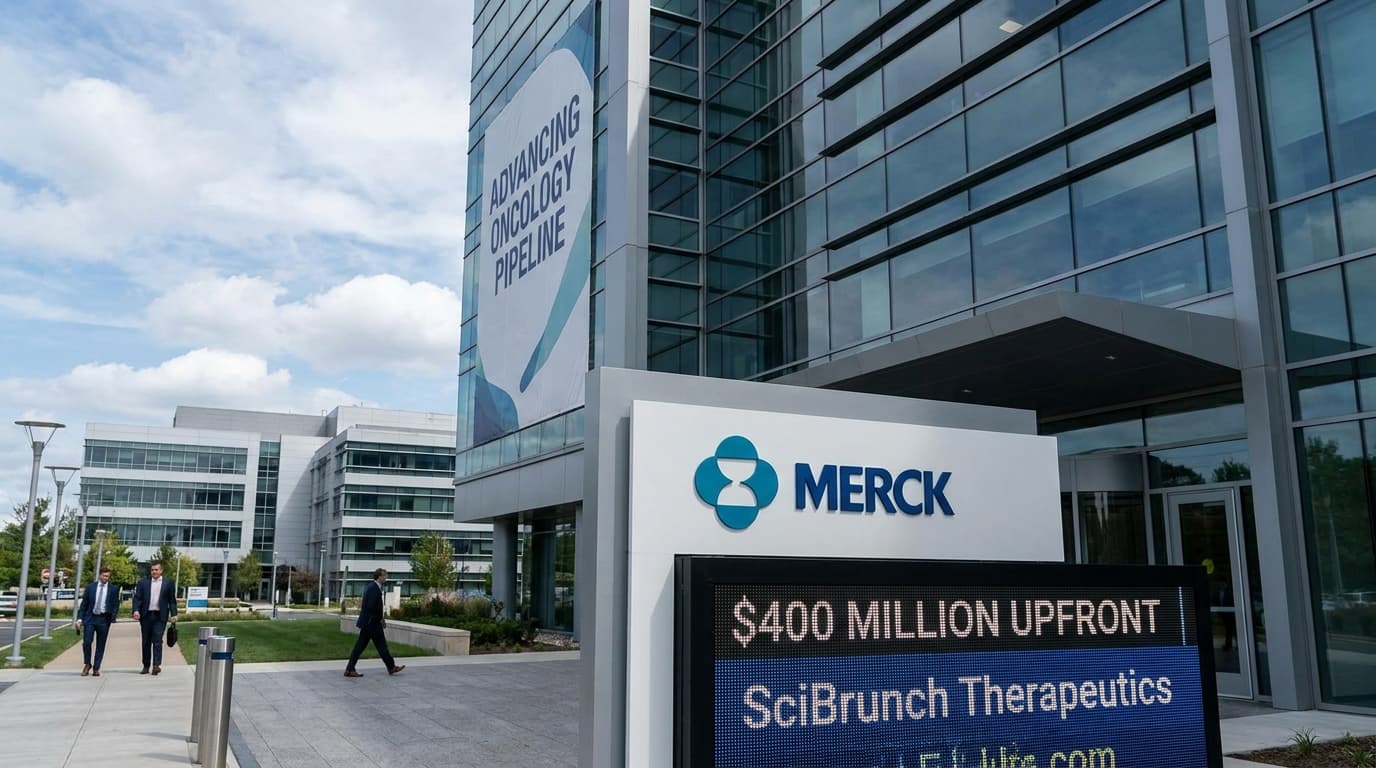
Merck has agreed to pay $400 million upfront for exclusive worldwide rights to SciBrunch Therapeutics’ SPR2015, a preclinical oral KRAS inhibitor, with milestone payments that could bring the total value of the deal to as much as $2.13 billion. The companies said the transaction has already closed, and Merck expects to record a pre-tax charge of $400 million, or about 13 cents per share, in the third quarter of this year.
The asset gives Merck a new position in KRAS G12D, a mutation that has become a focal point for the next wave of KRAS drug development after earlier commercial proof that KRAS G12C can be targeted. Strategically, the deal expands Merck’s precision oncology portfolio with a mechanism still in preclinical development, showing the company is willing to pay heavily for earlier-stage access where target demand is rising.
The Asset
Under the agreement, Merck gains exclusive global rights to develop, manufacture and commercialize SPR2015. The companies describe the program as a potent and selective molecular glue that inhibits KRAS G12D (ON), and Merck called it a potent engineered inhibitor for one of the most prevalent mutant forms of KRAS found in human cancers.
The sources provide slightly different descriptions of the preclinical package. BioSpace reported that in preclinical models the molecular glue demonstrated compelling antitumor efficacy as a monotherapy. Fierce Biotech added that Merck said SPR2015 showed nanomolar antiproliferative activities in various KRAS G12D-mutant cell lines while maintaining good selectivity over KRAS wildtype cells. Taken together, the disclosed evidence is still preclinical, but it is strong enough for Merck to commit meaningful upfront capital before human proof of concept.
SPR2015 is expected to enter human trials by the end of this year, according to a poster presentation shared in April at the 2026 American Association for Cancer Research Annual Meeting.
Why KRAS G12D Matters For Merck
KRAS has long been a high-value oncology target, but drugging it was historically difficult because the proteins lacked well-defined binding pockets. That changed when KRAS G12C inhibitors reached the market, and attention has since shifted to additional KRAS variants.
Fierce Biotech noted that KRAS G12D is found in about 38% of pancreatic cancer patients. BioSpace separately described KRAS G12D as a common KRAS mutation seen in fast-growing cancers including colorectal cancer. Those details help explain the size of the opportunity Merck is pursuing: the company is not entering a niche mutation space, but one tied to multiple major solid tumor settings.
The move also broadens Merck’s KRAS exposure rather than replacing an existing bet. Merck already has the KRAS G12C inhibitor calderasib in phase 3 trials for colorectal cancer and non-small cell lung cancer, according to Fierce Biotech. Adding SPR2015 means Merck is now building across two distinct KRAS mutation classes at different stages of development. The signal is that large oncology companies increasingly see KRAS as a platform area, not a single-asset opportunity.
The Partner And The Competitive Context
SciBrunch is a Shanghai-based biotech founded in late 2024, although one source described the company as having been founded two years ago. Across the sources, the named founders are entrepreneur Tao Hu, Ph.D., and medicinal chemist or professor and chemist Yang Zhang, Ph.D. BioSpace reported that the company has raised $65 million to date, is running a phase 1/2 trial of the PARP1 inhibitor SPR1020, and had not previously announced a partnership publicly.
For SciBrunch, the economics are striking relative to its age and disclosed funding base. For Merck, the willingness to pay $400 million upfront for a preclinical asset fits a broader trend in which Western drugmakers license China-originated oncology programs earlier, before clinical de-risking pushes valuations higher.
The competitive backdrop is also heating up. Fierce Biotech cited Bayer’s $1.3 billion biobucks deal with Kumquat Biosciences for another preclinical KRAS G12D asset, illustrating that Merck is entering an increasingly contested field. The implication is less about being first than about securing enough shots on a target class where commercial relevance is becoming clearer.
The announcement arrived the same day BioSpace reported that Merck and Daiichi Sankyo withdrew an accelerated approval request for ifinatamab deruxtecan after the FDA said the data package did not meet the criteria to support such a filing. The two events are unrelated operationally, but together they show a common pattern in large-cap oncology strategy: setbacks in nearer-term programs do not stop companies from continuing to spend aggressively on earlier pipeline replenishment.