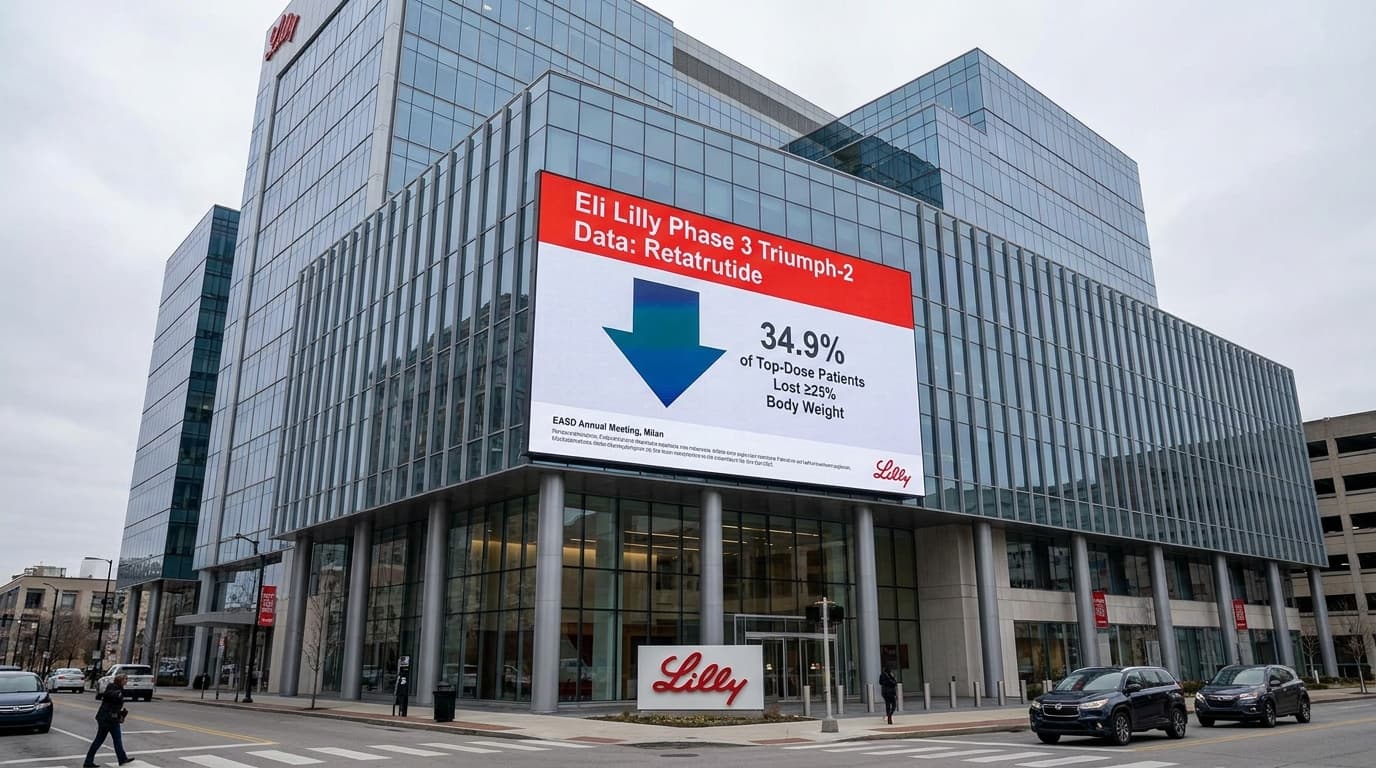
Eli Lilly has released the full phase 3 dataset for retatrutide in adults with obesity and Type 2 diabetes, adding a key distribution metric to the topline it reported in July: 34.9% of patients on the 12 mg dose lost at least 25% of their body weight.
That detail matters because mean weight loss alone does not show how many patients reached the deepest responses. In Triumph-2, Lilly is now showing both. The company reported mean weight loss of 20.8% at Week 80 on the top dose versus a 4% decline on placebo, and more than half of patients on 12 mg no longer met the BMI criteria for obesity.
The data
The expanded analysis covers 1,152 adults with obesity and Type 2 diabetes and was presented at the Annual Meeting of the European Association for the Study of Diabetes in Milan and in The Lancet. Retatrutide is an agonist of GIP, GLP-1 and glucagon receptors.
The previously reported core results held up in the fuller readout. From a baseline A1C of 7.7%, Lilly recorded reductions of 1.4% to 1.6% across the three retatrutide doses, compared with 0.2% for placebo. Lilly said there was no dose-dependent effect on A1C.
The added granularity came in categorical weight-loss outcomes. In the 12 mg arm, 52% of patients lost at least 20% of their body weight and 34.9% lost at least 25%. Those analyses cover patients who stayed on treatment without starting prohibited weight-management drugs.
Lilly also reported cardiovascular risk-factor changes at the top dose, including average reductions of 39.5% in triglycerides, 19.6% in non-HDL cholesterol, 10.8 mmHg in systolic blood pressure, 6.7 inches in waist circumference and 58.3% in high-sensitivity C-reactive protein.
The company reiterated what Fierce Biotech described as a GLP-1-like safety and tolerability profile.
The commercial picture
The strategic message from the update is clearer than the scientific one: Lilly is trying to widen the efficacy gap in obesity before competitors can close it.
Fierce Biotech noted that at Week 72 of a phase 3 trial, 34% of people receiving tirzepatide lost at least 20% of body weight. Lilly did not include a 25% weight-loss figure in that tirzepatide readout, so the comparison is not one-to-one, but retatrutide’s latest data still raise the bar on extreme weight-loss outcomes within Lilly’s own cardiometabolic portfolio.
The tradeoff is that blood-sugar control looks less dominant. On the middle and top retatrutide doses, 40% and 39.3% of patients got A1C below 5.7%. Fierce cited an earlier tirzepatide trial in which up to 55.3% of patients reached that level.
That leaves Lilly with a candidate that appears strongest when positioned around weight loss first, rather than as a clear across-the-board successor to tirzepatide in diabetes-related endpoints.
What to watch
Lilly plans to file for FDA approval of retatrutide in the first quarter of next year. After the July topline readout, Guggenheim Securities analysts said they had high confidence in a timely approval.
Competitive pressure is not standing still. Fierce reported that researchers at EASD also presented phase 1 Week 12 data on Hengrui Pharma and Kailera Therapeutics’ triple-G agonist that TD Cowen analysts said “looks better” than retatrutide. Lilly’s latest dataset therefore does two jobs at once: it supports an upcoming filing and sets a tougher benchmark for the next wave of obesity contenders.