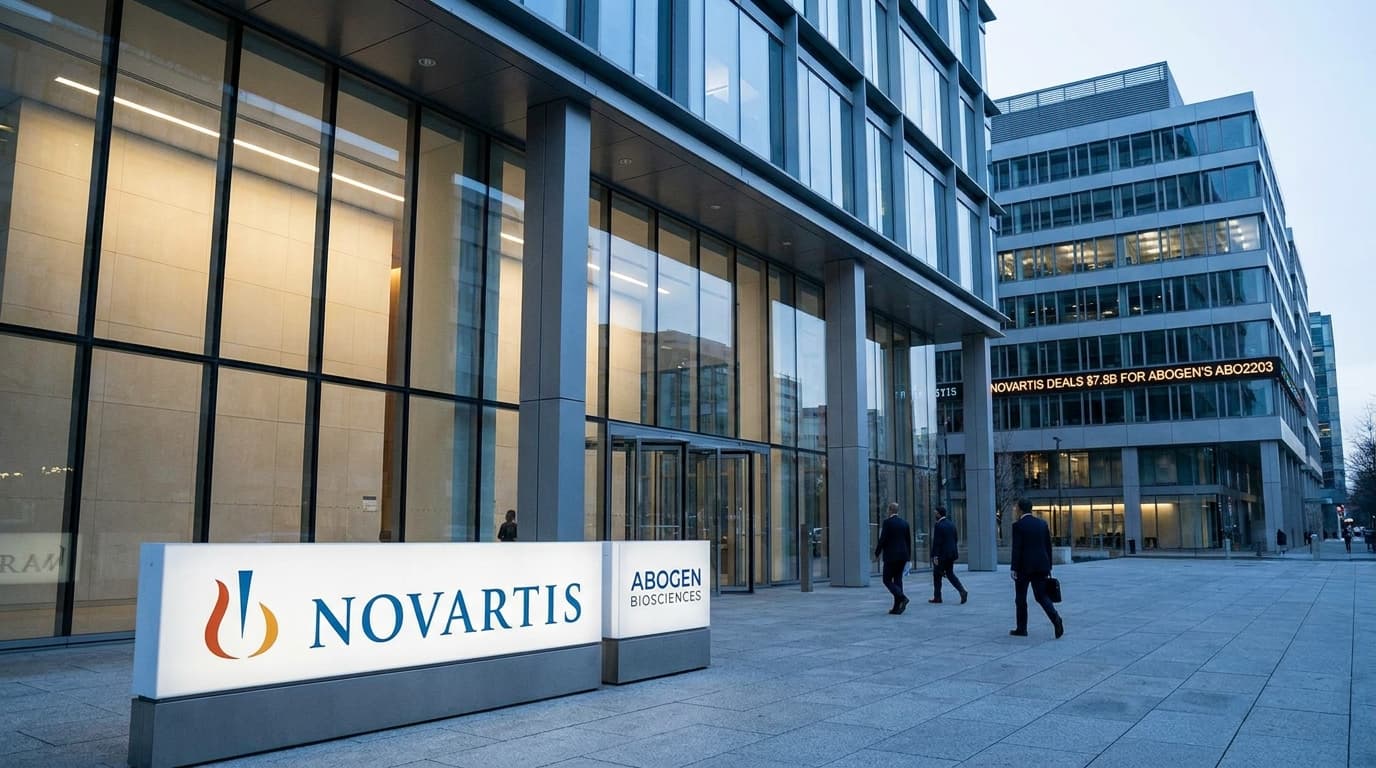
Novartis has struck a deal worth up to $7.8 billion with Suzhou, China-based Abogen Biosciences for ABO2203, an mRNA drug candidate that encodes a CD19xCD3 T cell engager. The companies said the agreement includes a $575 million upfront payment, plus up to around $7.2 billion in potential development, regulatory and commercial milestones, with royalties on future sales also available to Abogen.
The asset gives Novartis a position in an in vivo approach to B-cell depletion that sits adjacent to the autoimmune CAR-T work drawing attention across the sector. The timing is notable because the agreement arrives weeks after Novartis paused an autoimmune CAR-T program over three deaths, and because the company has continued sourcing external innovation from China this year.
The Data
ABO2203 is a lipid nanoparticle-formulated mRNA encoding a CD19xCD3 T cell engager. After injection, the mRNA is intended to direct a patient’s cells to produce the engager in vivo rather than relying on a factory-manufactured recombinant protein.
Both sources describe the strategic rationale in safety terms. Abogen has argued that gradual systemic exposure from making the T cell engager in the body could reduce toxicities tied to high drug concentrations, particularly cytokine release syndrome, or CRS. That matters because CRS is a common and often severe safety issue for T cell engagers, and BioSpace noted that many FDA-approved products in the class carry boxed warnings, including Roche’s Columvi, J&J’s Tecvayli and Amgen’s Blincyto.
The clinical record cited in the coverage is early but directionally encouraging. BioSpace reported that first-in-human data presented in April included nine patients with relapsed or refractory B-cell non-Hodgkin lymphoma; Abogen said at that time there were no cases of CRS, dose-limiting toxicities or neurological complications typically linked to immunotherapies, and that dose-dependent objective response rates reached 100% at the highest dose level. Fierce Biotech separately reported data in three immune thrombocytopenia, or ITP, patients showing B-cell depletion without CRS, along with complete platelet responses and rapid, complete depletion of CD19-positive B cells in peripheral blood and bone marrow.
That leaves Novartis buying into a platform concept as much as a single data package. The oncology dataset is very small, and the autoimmune dataset cited is smaller still, but both support the core claim that Abogen’s delivery method may widen the therapeutic window for a CD19xCD3 approach.
The Strategic Fit
The companies said ABO2203 has the potential to transform treatment for autoimmune diseases, and Fierce Biotech reported that the press materials emphasize autoimmune disease. BioSpace, however, said the partners did not explicitly say they would focus development efforts in that space, and a Novartis spokesperson declined to disclose specific target indications.
That distinction matters commercially. CD19-directed cell depletion already has a clearer proof-of-concept in hard-to-treat autoimmune disease because of emerging CAR-T evidence, while CD19xCD3 is also a proven blood cancer mechanism through Blincyto. Novartis appears to be paying for optionality across both biology and modality: a mechanism the market already understands, delivered in a format that could be easier to use if the safety profile holds up.
Fierce Biotech reported that researchers who published the ITP data said ABO2203 could potentially be administered in outpatient settings as a subcutaneous injection without lymphodepletion or premedication and could cost less than in vivo CAR-T. If those advantages persist in larger studies, the asset could appeal not simply as another autoimmune program, but as a lower-complexity way to access B-cell depletion.
The deal structure also reaches beyond one molecule. Novartis gets an exclusive option to license a certain number, or in Fierce’s wording “a number,” of next-generation therapeutic assets developed on Abogen’s RNA platform. Abogen describes that platform as AI-centric across mRNA design, drug formulation and manufacturing, and a Novartis spokesperson said the company was attracted to Abogen’s proprietary RNA platform and work in mRNA-encoded T cell engagers and other RNA-encoded therapeutic modalities.
The Road Here
The agreement adds to a run of China-linked transactions by Novartis. BioSpace noted that just last month the company licensed a radioligand asset from Suzhou’s BoomRay Pharmaceuticals for up to $900 million, and in January it paid $150 million upfront to partner with SciNeuro Pharmaceuticals on an anti-amyloid therapy for Alzheimer’s disease in a deal that included up to $1.5 billion in milestones.
On Novartis’ Q2 call in July, CEO Vas Narasimhan said the company is “geography-agnostic” in dealmaking and will go “wherever the leading science is in a given therapeutic area or in a given technology area.” This agreement is a concrete example of that strategy: Novartis is paying heavily for a program that is early, but differentiated in delivery approach and supported by initial human data in both cancer and autoimmune settings.
Abogen partner Ruijin Hospital began a phase 1 autoimmune disease trial of ABO2203 in 2024, according to Fierce Biotech, and the hospital started testing the asset in B-cell non-Hodgkin lymphoma patients last year. The next inflection point is less about whether Novartis can advance the program and more about whether larger datasets can preserve the early safety signal while confirming that in vivo mRNA expression translates into durable, clinically meaningful B-cell depletion.