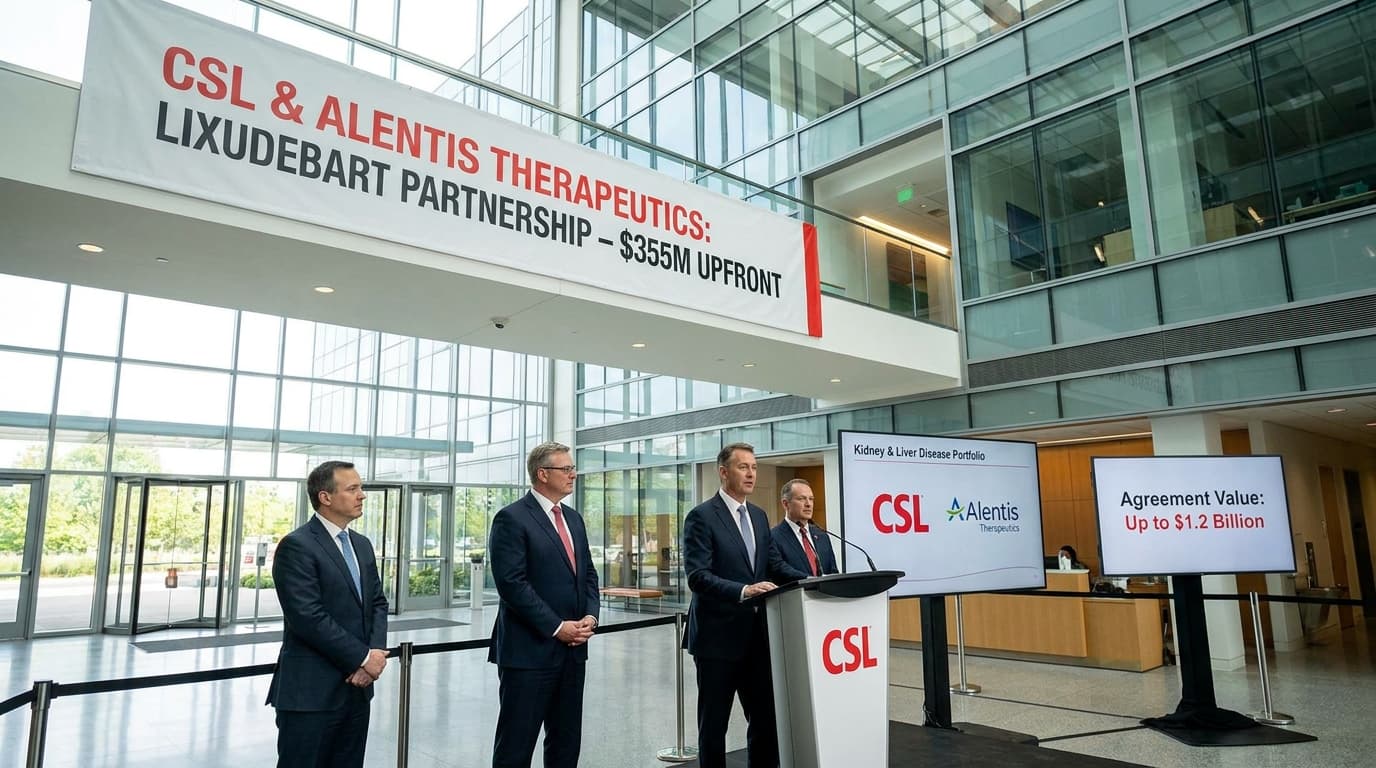
CSL has agreed to pay $355 million upfront for rights to co-develop and co-commercialize Alentis Therapeutics’ phase 2-stage fibrosis drug lixudebart, adding a midstage asset that the companies are positioning first in a rare autoimmune kidney indication.
Under the agreement, CSL has also committed up to $1.2 billion in commercial milestones if the anti-Claudin-1 therapy reaches market. Overall profits would be split 55% to CSL and 45% to Alentis, according to the companies’ release. For CSL, the structure goes beyond a standard option on an early program: it brings development funding, commercial economics and a direct fit with an existing kidney disease portfolio.
The Development Plan
CSL will fund completion of Alentis’ ongoing phase 2 study of lixudebart in patients with antineutrophil cytoplasmic antibodies-associated vasculitis who experience rapidly progressive glomerulonephritis, or AAV-RPGN. The companies said an interim analysis of 26 patients in that mid-stage trial showed “promising improvement in kidney function” at 24 weeks as measured by eGFR and proteinuria.
CSL has also agreed to bankroll a phase 3 trial in AAV-RPGN, along with planned phase 2 studies in focal segmental glomerulosclerosis and primary sclerosing cholangitis. That matters because the partnership is not confined to one orphan setting; it is built around running several indication paths in parallel rather than waiting for one proof point before expanding.
Alentis has argued that Claudin-1 is present in the more advanced stage of liver fibrosis, and lixudebart is designed to reverse organ damage from fibrosis by targeting that protein. The broader signal from the CSL deal is that a target framed initially around fibrosis biology is being financed through a kidney-disease commercial lens, with liver disease still part of the upside.
The Strategic Fit
CSL’s head of R&D Bill Mezzanotte said the agreement reflects the company’s commitment to building a leading global nephrology franchise. The company already markets kidney disease medicines including the anemia drugs Mircera and Retacrit, as well as Velphoro and Korsuva.
That existing footprint helps explain why CSL was willing to pay a sizeable upfront sum before phase 3 data. Rather than buying a platform, CSL is attaching external innovation to a commercial area it already serves. If lixudebart can hold up in AAV-RPGN and move into focal segmental glomerulosclerosis, the asset could broaden that franchise with a therapy aimed at preserving kidney function and slowing progression to end-stage kidney disease.
For Alentis, the main benefit is speed. The company said the partnership allows it to accelerate development of lixudebart across several indications at once, while also adding outside validation for Claudin-1 as a therapeutic target.