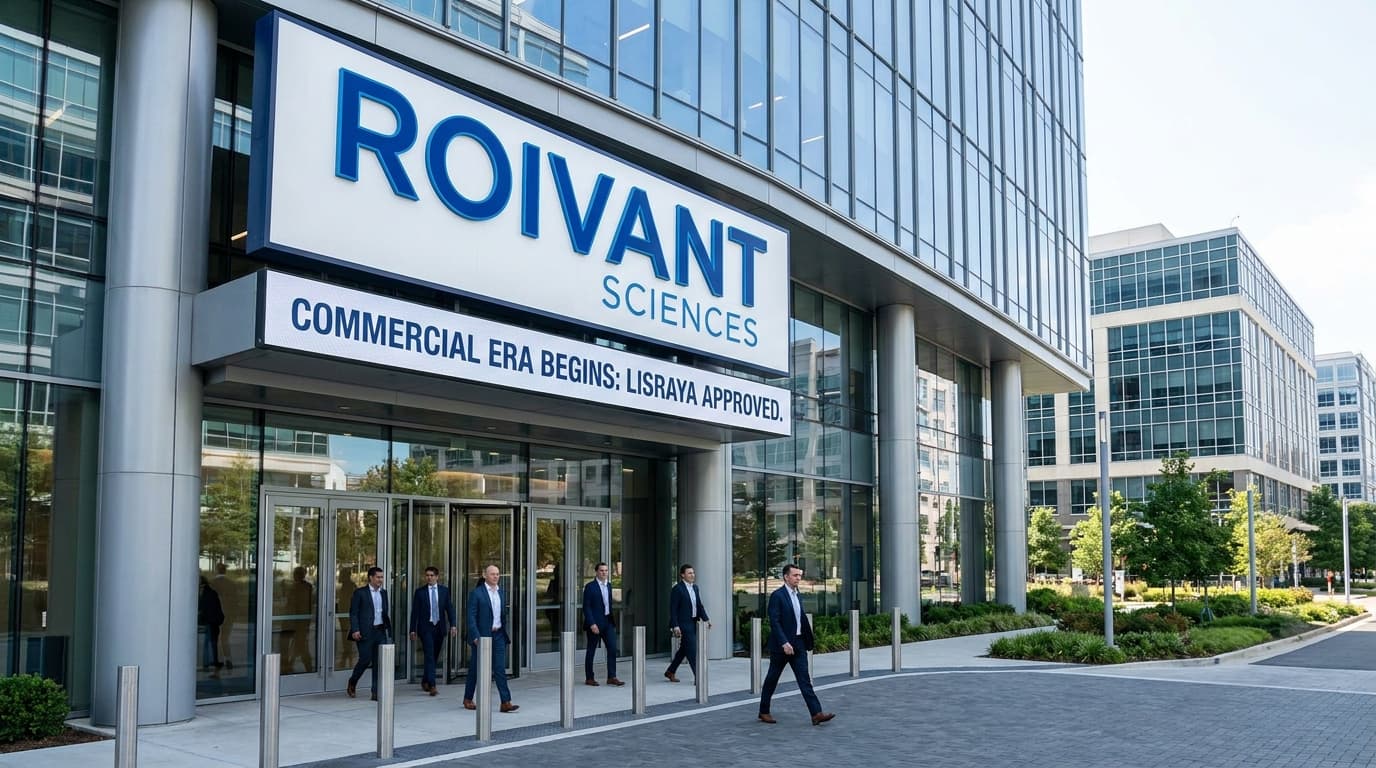
Roivant Sciences is entering a different stage of its corporate life after the August approval of oral TYK2/JAK inhibitor Lisraya for dermatomyositis, an approval handed to subsidiary Priovant. CEO Matt Gline described the period as the busiest in the company’s history and framed the launch as the first real test of whether Roivant can convert its development model into a commercial portfolio.
That matters because Roivant has spent much of its history looking unlike a traditional drugmaker. Founded in 2014 by entrepreneur and 2024 U.S. presidential candidate Vivek Ramaswamy, the company built itself around a hub-and-spoke structure of focused “vant” subsidiaries, using that model to acquire and advance drug candidates that larger companies had left underused. The question now is whether that approach can produce sustained product revenue, not only asset sales.
The Commercial Picture
Gline has described Roivant’s current strategy as a three-legged stool. Lisraya is one leg. The other two are Pulmovant’s pulmonary hypertension candidate mosliciguat, which exceeded expectations in a Phase 2 trial last month and is now in a late-stage study, and Immunovant’s IMVT-1402, which is in mid- to late-stage development across multiple inflammatory indications.
Leerink Partners analyst David Risinger said those three products are the most critical assets for parent Roivant and called them “three multi-billion-dollar pipeline candidates, each of which is a pipeline within a product.” Leerink estimates Lisraya could bring in $7.9 billion by 2035. After mosliciguat’s recent mid-stage readout, the firm raised total 2035 unadjusted sales expectations for that asset to $9.8 billion. The signal for investors is that Roivant’s valuation case is increasingly concentrated in a small number of late and mid-stage assets that now need operating follow-through.
That operating follow-through is especially important because Roivant already has one cautionary commercial example in its history. Before Dermavant was acquired, Roivant secured its first approved medicine, Vtama, for plaque psoriasis in 2022. But over less than two years, the launch was described by Risinger as lackluster, with slow uptake and missed expectations, before Dermavant was sold to Organon for up to $1.2 billion in 2024.
The Road Here
Roivant’s model has produced cash and strategic optionality through divestments. The company sold Telavant in 2023 to Roche for more than $7 billion, then sold Dermavant in 2024 to Organon for up to $1.2 billion. Risinger said the “vant” structure has worked because Roivant has been able to recruit strong executives to lead individual subsidiaries while offering pay-for-performance incentives.
That history helps explain why the market may be willing to give Roivant another shot on commercialization, but not a free pass. Lisraya itself came into Roivant through a 2022 licensing arrangement from Pfizer as part of the joint spinoff of Priovant. In other words, the company is still following its familiar asset-hunting playbook; what is new is the decision to hold and build around approved products rather than mainly monetizing programs through sales.
Gline argued that Roivant is materially different from its earlier form, saying the company has matured from a “motley crew of outsiders” into a more established biopharma business. He also pointed to an industry environment that has become more supportive of launches outside the largest pharmaceutical companies, citing Horizon Therapeutics, Argenx and Alnylam Pharmaceuticals as examples of companies that have shown smaller organizations can launch effectively.
What To Watch
For Lisraya, the key execution issue identified by Risinger is physician education. Roivant has experience working with key opinion leaders through clinical trial execution, but commercial uptake will require broader outreach to physicians beyond that group and clearer communication that the drug offers a distinct treatment option.
The broader implication is that Roivant’s next phase will be judged less on the creativity of the “vant” model than on whether it can repeatedly translate differentiated assets into uptake. If Lisraya performs and the two follow-on programs keep advancing, Roivant has a path toward the kind of multi-asset commercial portfolio Gline is targeting. If execution slips again, the company’s long-standing reputation for finding diamonds in the rough may not be enough to support the next valuation step.