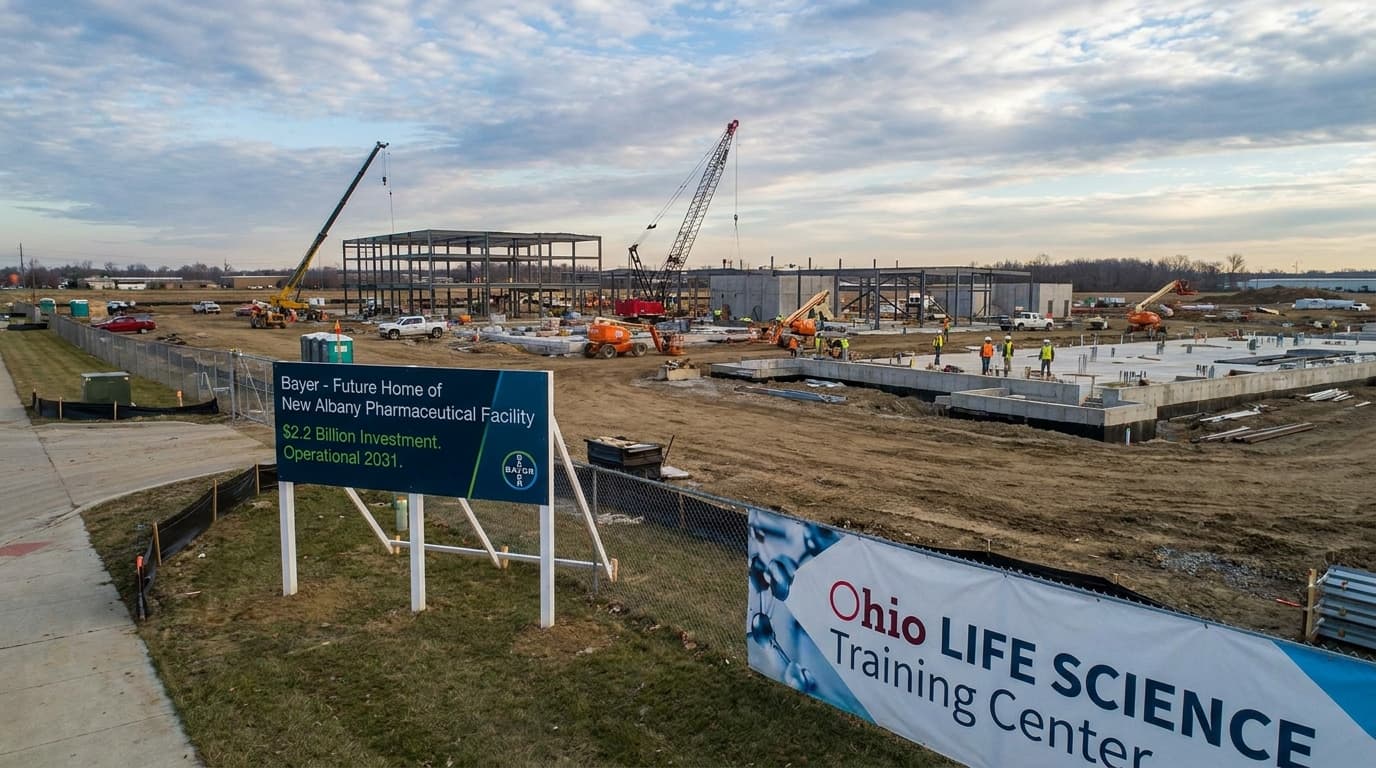
Bayer said it will invest $2.2 billion to build a pharmaceutical manufacturing facility in New Albany, Ohio, expanding its production network with a site designed to make both drug substances and drug products. The company said the plant will serve U.S. and global markets and will initially support products in oncology, cardiovascular disease and renal care.
The timeline is long by design. Bayer expects one drug substance module to become operational in 2031, followed by a second module in 2034. The company also plans to install digital and automation technologies at the site, signaling that the investment is not just about adding square footage but about building newer manufacturing capability into its network.
Why the Ohio site matters
Ohio officials expect the project to create about 600 high-value jobs tied to the facility, in addition to around 1,500 construction roles. For the state, the announcement is also a workforce story. The Ohio Life Science Training Center, which is set to open next summer, is expected to support Bayer’s hiring plans by training biomanufacturing operators and technicians.
JobsOhio is investing up to $30 million in that center and has framed workforce readiness as a factor in Bayer’s decision. JobsOhio CEO J.P. Nauseef said in a video about the site that “talent readiness and speed were probably the key difference makers amongst many,” adding that biopharma companies need specialized talent prepared and ready to work.
That detail is the clearest strategic signal in the announcement. For large manufacturers, site selection is increasingly tied to whether a region can supply trained labor at scale, not only whether it can offer land or incentives. Ohio is trying to position itself as a biomanufacturing workforce hub, and Bayer’s investment gives that pitch a high-profile test case.
How it fits Bayer's manufacturing footprint
Bayer’s U.S. pharmaceuticals headquarters is in New Jersey, and the company already has sites in Pennsylvania, Massachusetts, North Carolina and California. It also carries out biologics development and manufacturing at its campus in Berkeley, California.
Even so, Germany remains central to Bayer’s manufacturing network. In its 2025 annual report, Bayer listed three German plants in Bergkamen, Berlin and Leverkusen as “selected” drug production facilities, and it named the same three sites in its 2023 and 2024 annual reports.
That context makes the Ohio decision notable because it adds capacity without replacing Germany’s role. Back in May 2025, CEO Bill Anderson said on a media call that Bayer had “no immediate plans to revisit our manufacturing footprint” because the company was roughly balanced around the globe and benefited from focusing production of some products in Germany and others in the U.S. before shipping between regions. The Ohio project suggests Bayer now sees value in expanding U.S. production inside that broader global model.
The industry context
Bayer’s move follows similar commitments by peers to invest in U.S. drug production. BioSpace reported that drugmakers vowed to invest more than $150 billion in the U.S. in the early months of the second Trump administration as political pressure to reshore manufacturing intensified.
Within that setting, Bayer’s announcement looks less like an isolated plant build and more like a calibrated response to a policy and supply-chain environment that increasingly rewards domestic capacity. The company is not describing the site as a retreat from global manufacturing, but it is placing a substantial new asset in the U.S. and giving itself additional flexibility in categories it identified as initial priorities.