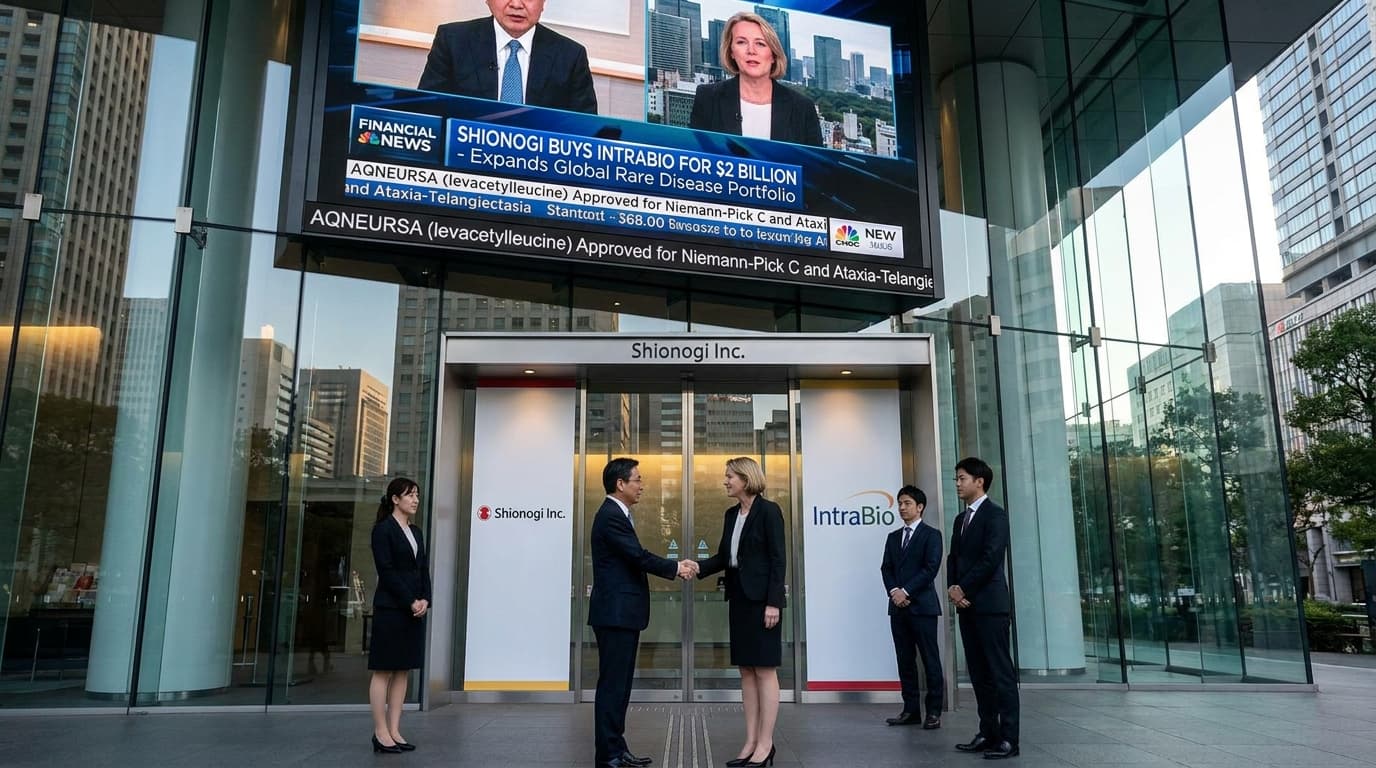
Shionogi is adding a marketed rare neurology drug to its portfolio through a $2 billion acquisition of IntraBio, a move that continues the Japanese company’s push to build a global rare disease business outside its historical base. The transaction, announced Monday, still needs regulatory clearances, and Shionogi said it expects it to close by the end of this year.
The strategic value is more specific than simple scale. IntraBio brings Aqneursa, the brand name for levacetylleucine, plus operating experience in rare neurological disease. For Shionogi, that fills in a portfolio that has already been assembled largely through deals, but until now has leaned heavily on acquired rights and development-stage assets.
The asset Shionogi is buying
Aqneursa was initially approved by the FDA in 2024 to treat the neurological manifestations of Niemann-Pick disease type C, a rare inherited enzyme deficiency. The source describes it as one of just two FDA-approved therapies for that disorder. Last month, the FDA expanded the label to include ataxia-telangiectasia, making Aqneursa the first approved therapy for that rare neurodegenerative disorder.
Beyond the U.S., the drug also received European Commission approval early this year for Niemann Pick disease type C, while a separate European regulatory review in A-T is ongoing.
Levacetylleucine is a modified form of L-leucine, an essential amino acid. IntraBio’s version is designed to help it cross membranes, including the blood-brain barrier. Even so, Aqneursa’s label states that its mechanism of action in Niemann Pick and A-T is unknown. That matters because it leaves Shionogi with a commercial product in hand, but not yet with a mechanistically de-risked platform story.
According to Shionogi, Aqneursa generated $67.8 million in revenue in fiscal 2025. That gives the buyer an immediate rare disease revenue stream, which is a different profile from its mid-stage partnered programs.
The road here
Shionogi established a commercial presence in rare disease earlier this year through the $2.5 billion acquisition of global rights to Radicava, an amyotrophic lateral sclerosis drug developed by Tanabe Pharma. Its other rare disease candidates also came through business development.
S-606001, now in mid-stage clinical development for Pompe disease, was licensed from Maze Therapeutics in 2024. Zatolmilast came from Shionogi’s 2020 acquisition of Tetra Therapeutics. In May, Shionogi said that oral small molecule failed two Phase 3 tests in Fragile X syndrome, although a separate mid-stage study continues in Jordan syndrome.
That backdrop helps explain why IntraBio stands out. Rather than another pre-approval neurology bet, Shionogi is paying for an approved product with recent label expansion and ex-U.S. regulatory momentum.
Shionogi’s largest source of revenue remains royalties from HIV drugs marketed by ViiV Healthcare, which is majority owned by GSK. Earlier this year, Shionogi increased its minority ownership stake in ViiV from 10% to 21.7%. Those HIV medicines are part of a broader business strategy with a 2030 target date for growth goals, and one of those goals is entering the rare disease business overseas. On that measure, the IntraBio acquisition looks less like a standalone bolt-on and more like execution against a stated portfolio shift.