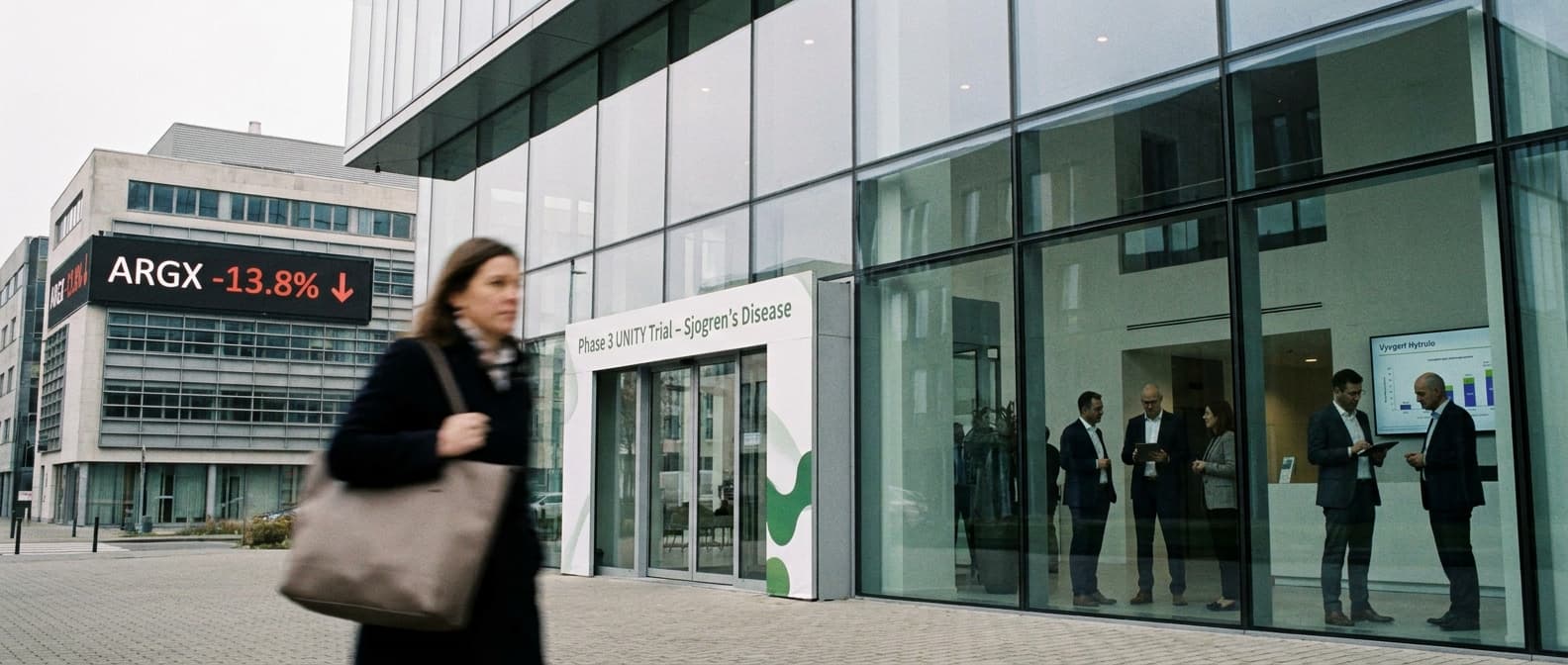
Argenx is ending its Phase 3 UNITY study of Vyvgart Hytrulo in Sjogren’s disease after an independent data committee determined the trial would not meet its primary endpoint of improving systemic disease activity. The decision is a late-stage setback for a program that William Blair had described as the next potential blockbuster expansion opportunity for the drug.
The market reaction was immediate. As of market open, argenx shares had fallen nearly 14%, or about $130 per share, to around $797 as of 11 a.m. ET.
Vyvgart Hytrulo is already approved for generalized myasthenia gravis and chronic inflammatory demyelinating polyneuropathy, and the product recently recorded a late-stage win in autoimmune myositis. That made Sjogren’s one of the more meaningful remaining expansion shots for the franchise.
What Failed In UNITY
UNITY was evaluating Vyvgart Hytrulo injection in Sjogren’s disease, an autoimmune disorder that most often affects moisture glands, with dry eyes and dry mouth the most common symptoms.
William Blair said the futility call was surprising because trial results were not expected until the second half of 2027. Argenx told the firm that the futility analysis included data from more than 500 patients, compared with the 630 enrolled, suggesting the review may have happened earlier than the primary endpoint assessment expected at week 48.
The result also fits a pattern in the indication. William Blair said Sjogren’s disease drug development has been bogged down by high placebo response rates, making it difficult to achieve robust separation versus placebo.
That difficulty had already shown up in argenx’s Phase 2 RHO study. In that trial, the asset appeared differentiated from placebo at week 24, but William Blair wrote that the study was underpowered and showed no difference versus placebo in the percentage of patients achieving at least a three-point improvement on an industry scale measuring disease activity.
The Commercial Reset
William Blair had previously estimated peak sales of $1.4 billion for Vyvgart in Sjogren’s. With UNITY ending for futility, that opportunity falls away.
The competitive backdrop may now matter more. William Blair pointed to Novartis’ investigational monoclonal antibody ianalumab and Amgen’s CD40L antagonist fusion protein dazodalibep, both of which have recorded Phase 3 wins. Argenx is therefore losing ground in an indication where rivals have already produced stronger late-stage evidence.
The company did, however, pair the Sjogren’s setback with a separate mid-stage celiac disease update. Its Phase 2 study of investigational CD122 inhibitor FB102 met its primary endpoint, with treated patients showing a statistically significant change from baseline in a health measure of the small intestine. Argenx said it plans to move the asset into late-stage development.
That means the broader pipeline is not standing still, but the signal from UNITY is that even established immunology franchises can struggle to convert early hints into registrational proof in complex autoimmune diseases. For argenx, the near-term task is replacing a lost Vyvgart growth leg while advancing newer assets such as FB102 and awaiting Phase 3 findings for empasiprubart in multifocal motor neuropathy.