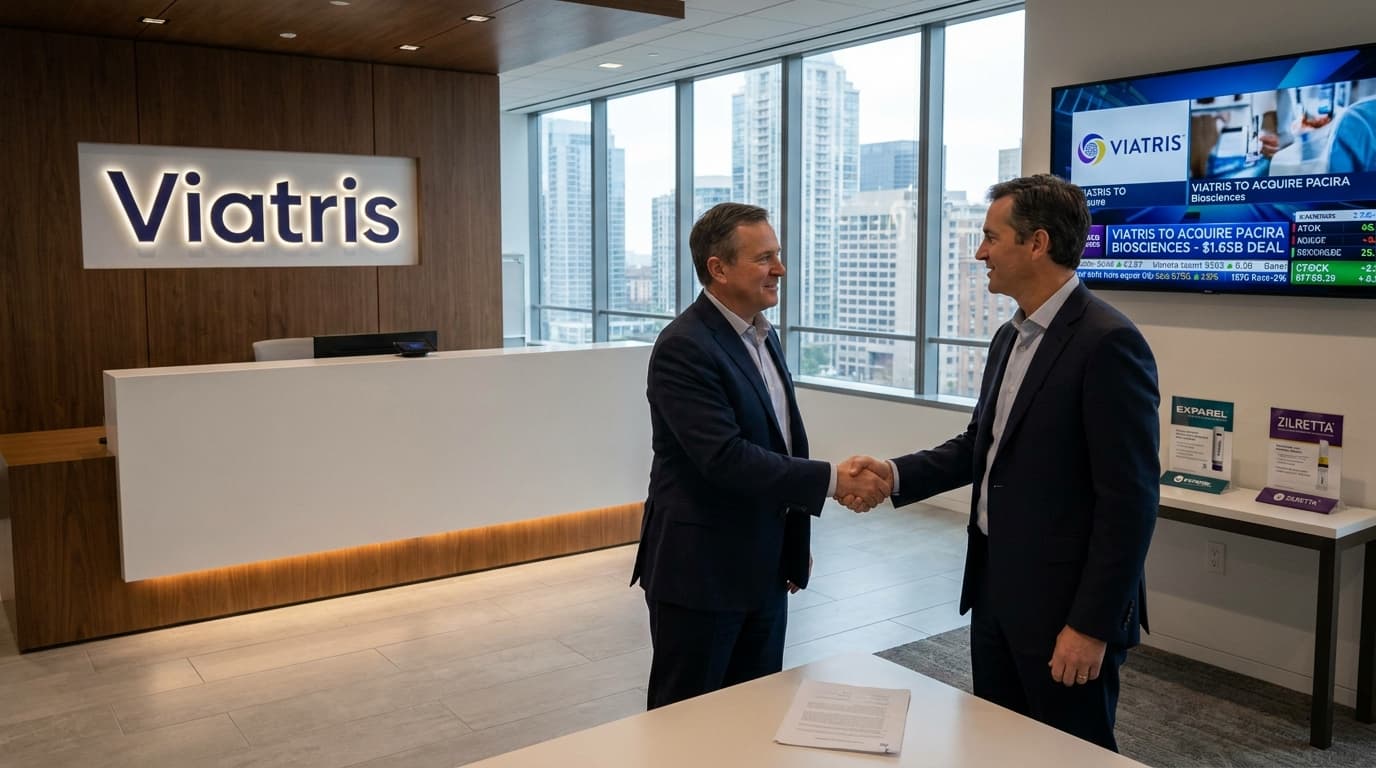
Viatris has agreed to buy Pacira BioSciences for $1.65 billion in cash, a move aimed at accelerating its expansion into non-opioid pain therapy. The company is paying $36.50 per share, compared with Pacira’s $25.20 closing price the day before the deal was announced, and expects to close the takeover by the end of the year.
The acquisition gives Viatris two marketed products, Exparel and Zilretta, plus the 340-person team Pacira built to commercialize them. For Viatris, the deal is less about entering pain from scratch than about assembling a broader franchise before a near-term regulatory decision on its own candidate.
The commercial fit
Pacira’s products generated sales of $587 million and $121 million, respectively, in the second half of 2025 and the first half of this year. Exparel, approved in 2011, is an injectable bupivacaine formulation for post-surgical pain. Zilretta, which reached the market in 2017, is an injectable corticosteroid indicated for management of osteoarthritis pain of the knee.
Viatris has also filed for FDA approval of a non-opioid treatment for moderate-to-severe acute pain. The FDA is scheduled to rule on that filing by Dec. 27. Viatris sees its fast-acting meloxicam, or FAM, serving the at-home market, while Exparel and Zilretta are positioned for inpatients and outpatients, respectively. The company said the same post-surgical and high-volume acute pain specialists will prescribe all three drugs.
That prescriber overlap is the main strategic logic of the deal. Viatris said it is aiming for revenue synergies for FAM while also targeting more than $50 million in cost synergies by the end of 2028. Oppenheimer wrote that it viewed the transaction as strategically sound and fairly priced, and said Exparel during surgery and FAM after surgery could be offered as one opioid-sparing package if FAM’s label allows it.
The competitive and patent backdrop
The acquisition also brings assets with meaningful revenue but visible lifecycle pressure. Pacira settled litigation with three companies last year, agreeing to allow some U.S. production of generic Exparel starting in early 2030, and it remains in litigation with two other drugmakers seeking to launch generic copies. Zilretta’s composition of matter patent expires in 2031.
Pacira argued in its 2025 annual report that its extensive know-how and trade secrets represent a meaningful entry barrier. Viatris said this week that it plans to use its intellectual property expertise and proven ability to extend product lifecycles and sustain meaningful sales after the entry of competition. That means the deal is not simply a bet on current sales; it is also a bet that commercial execution and IP management can slow erosion long enough to make the broader pain franchise work.
What this adds for Viatris
Pacira currently generates 100% of its sales in the U.S., though it has started global expansion efforts including a partnership with LG Chem to bring Exparel to the Asia-Pacific markets. Viatris said it plans to expand into select international markets.
The larger signal is that Viatris is using M&A to buy a commercial platform, not just product revenue. If FAM wins approval on Dec. 27, the company would have an established U.S. pain sales organization and two marketed products already calling on overlapping specialists. If FAM does not, Viatris still acquires a sizable non-opioid pain business, but the upside case for the deal becomes narrower and more dependent on protecting Exparel and Zilretta against future competition.