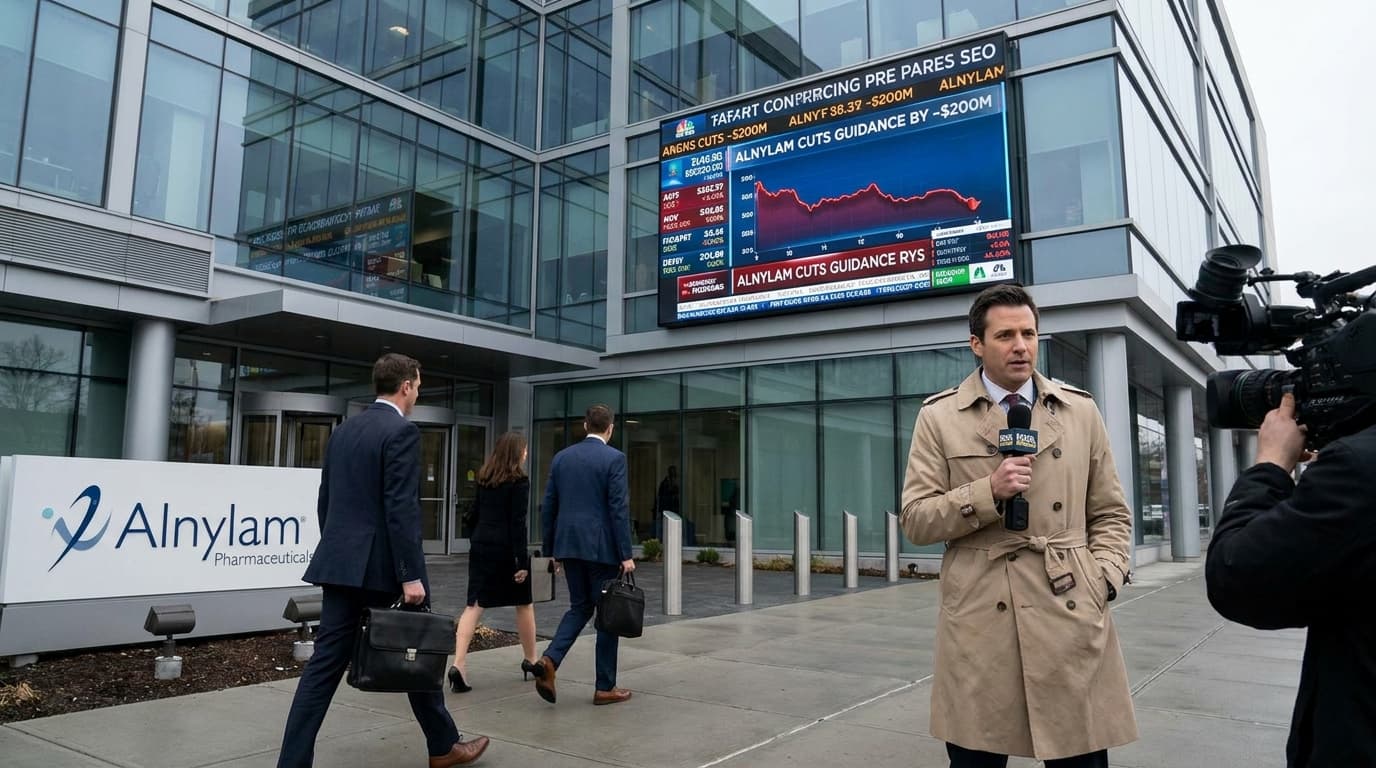
Alnylam’s reset has become one of biotech’s sharper arguments about whether a commercial stumble changes a market thesis or exposes it. The company’s stock, which was rising ever closer to $500 apiece one year ago, has fallen to around $250 after management lowered full-year guidance in July following weaker-than-expected second-quarter sales of TTR silencer Amvuttra.
That reduction, by about $200 million, landed especially hard because Amvuttra holds a March 2025 FDA nod in ATTR cardiomyopathy and was described by Guggenheim Securities as the “sole, differentiated modality” in ATTR-CM. Instead of clarifying leadership, the cut opened three competing readings: that the commercial opportunity is smaller than expected, that the drug is mispriced, or that TTR stabilizers from BridgeBio Pharma and Pfizer are becoming the preferred modality.
The Commercial Picture
The central dispute is whether Alnylam has a market-size problem or a sequencing problem. BMO Capital Markets laid out the bullish version in August, arguing that the patients Amvuttra most urgently served were those for whom stabilizers had not worked, and that this second-line population "exhausted sooner than expected.” On that reading, the guidance cut changes the shape of the sales ramp, not the size of the franchise.
BMO’s formulation matters because it pushes the commercial burden back to first-line prescribing and diagnosis expansion. As the firm put it, the path to more than $10 billion in franchise sales was not through second-line use but through front-line starts and a broader diagnosed population.
The bearish interpretation is less forgiving. Cutting sales guidance two quarters into the ATTR-CM launch can also be read as an early signal that the available pool is more limited than expected. It also leaves Alnylam with a harder competitive task: moving from patients who have already failed stabilizers to competing directly for first-line patients against Pfizer’s Vyndamax and BridgeBio’s Attruby.
That split helps explain why Alnylam’s stock has not recovered even though some firms have held their targets. TD Cowen reiterated its $482 price target last month despite the shares trading below $250, while BMO initiated coverage in August with a $318 target. Guggenheim, by contrast, had already been “on the sidelines on the stock” before the guidance cut.
The Pipeline Debate
The second major question is whether Alnylam’s next-generation RNAi candidate nucresiran can restore confidence in the franchise. The company is running Phase 3 trials in both ATTR-CM and ATTR with polyneuropathy, the indication in which Amvuttra was first approved in 2022.
Nucresiran came under a cloud in July when AstraZeneca and Ionis’ Wainua failed late-stage development in ATTR-CM. That result initially raised readthrough concerns, but several analysts later narrowed the implications. In a Sept. 3 note, Stifel said endpoint selection and patient enrollment drove Wainua’s failure, a view BMO echoed. If that interpretation is right, Alnylam’s event-driven study design and enrichment for earlier-stage patients leave nucresiran “positioned for success,” in Stifel’s phrasing.
This is more than a single-asset debate. If nucresiran works, it would support the argument that Alnylam’s July setback was commercial execution and market development noise rather than evidence of a modality limit in ATTR.
Beyond ATTR
The third debate reaches past amyloidosis and into whether gene silencing becomes a major drug modality across chronic disease. BMO compared gene silencing today with monoclonal antibodies in the late 1990s, arguing that if the field follows a similar trajectory, Alnylam will capture more of that upside than any other company.
The near-term test of that thesis is zilebesiran, Alnylam’s blood pressure prospect in a Phase 3 cardiovascular outcomes trial. BMO said the study tests whether RNAi can be delivered to a population-scale chronic indication and argued that a successful readout could unlock a significant commercial opportunity while highlighting the value of the company’s ex-ATTR franchise.
Stifel is more skeptical here, saying it remains cautious on safety and questions whether the modest blood pressure reductions seen in Phase 2 are sufficient to produce a meaningful cardiovascular outcomes benefit. Alnylam is effectively betting that consistent, modest reductions will cut cardiovascular events strongly enough to matter.
The company still has strategic flexibility while those arguments play out. Stifel said Alnylam’s first-mover advantage has produced a $3.3 billion cash cushion, and that management is considering deals for drug candidates and technologies that could deliver therapies to new tissues. Internally, Alnylam also expects Phase 2 data this year for a bleeding disorder candidate and Phase 1 results for Huntington’s disease and obesity programs, with five or more key readouts targeted in 2027 and in 2028.
The signal from the guidance cut is not simply that one launch disappointed. It is that Alnylam is now being priced less as the uncontested RNAi pioneer and more as a company that must prove its leadership in frontline ATTR, validate its next wave with nucresiran and zilebesiran, and show that its platform can expand beyond the franchise that built it.