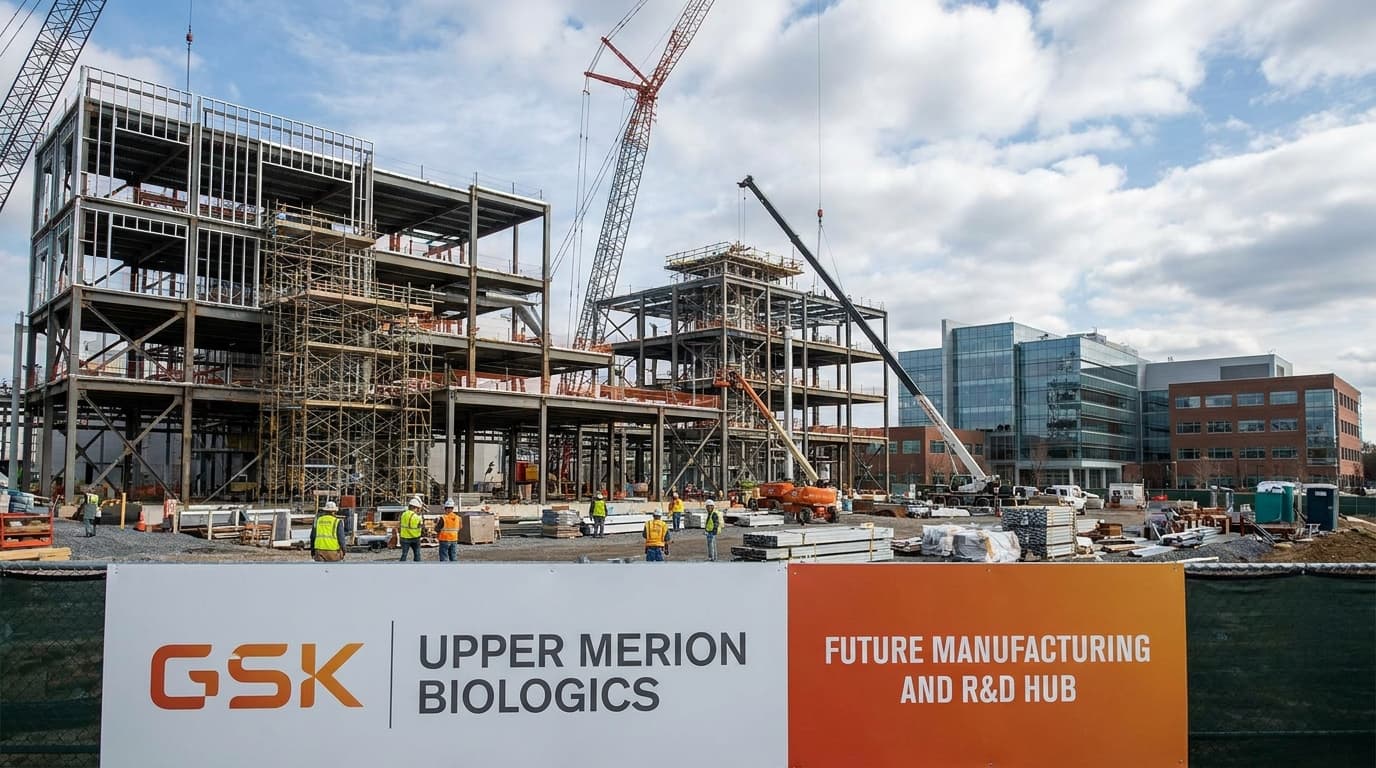
GSK is investing more than $800 million to expand its operations in Upper Merion Township, outside Philadelphia, adding biologics production and related R&D infrastructure to a site where it already has drug discovery and development capabilities.
According to the announcement from Pennsylvania Governor Josh Shapiro and Department of Community and Economic Development Secretary Rick Siger, construction will start next year after demolition of existing buildings. The planned additions include a biologics production facility for clinical and commercial supply, a co-located R&D pilot plant intended to accelerate tech transfer and process development, a centralized quality control lab, and a manufacturing science and technology hub.
For GSK, the significance is less the headline dollar figure than the function mix. Co-locating commercial manufacturing with pilot-scale R&D and process development can shorten handoffs between development and supply, which matters when companies are trying to move biologics programs faster without adding avoidable transfer risk. Regis Simard, president of GSK global supply chain, said the site will include advanced digital capabilities, though the company has not yet provided further detail on those plans.
What GSK Is Building
The Upper Merion project expands a Pennsylvania footprint that GSK has already been deepening. News of the investment comes 13 months after the company outlined plans for an additional biologics flex factory at the same site to make medicines for respiratory disease and cancer as part of a broader $1.2 billion investment plan. GSK designs those flex factories for quick switches between different types of medicines, often using modular equipment and standardized processes.
The company had also committed $800 million two years ago to expand its Marietta, Pennsylvania campus, where that spending supported construction of an R&D pilot plant and vaccines drug substance facility. Taken together, the latest project suggests GSK is concentrating a larger share of U.S. manufacturing and development infrastructure in Pennsylvania rather than distributing incremental capacity more broadly.
The Strategic Context
State officials said the Upper Merion investment is eligible for tax benefits through the Qualified Manufacturing Innovation and Reinvestment Deduction program and the Manufacturing Tax Credit initiative. Those incentives are part of Pennsylvania's broader effort to attract pharma investment, including from Eli Lilly and Johnson & Johnson.
The new spending also arrives as GSK has been reducing or reworking manufacturing elsewhere. Over the past two years, the company has transferred facilities in China, Singapore and Maryland to outsourcing partners, closed an antibiotic plant in the U.K., and ended manufacturing operations at a site in Cambridge, Massachusetts, converting that location into a dedicated R&D operation. In that context, the Upper Merion buildout looks like selective capacity expansion rather than a simple global manufacturing increase.
Pennsylvania officials expect the project to create more than 300 new jobs over the next five years while retaining about 4,500 existing full-time jobs across the state. That local employment impact matters politically, but for industry observers the bigger signal is that biologics capacity, pilot development capability, and digital manufacturing are being built together as one operating model.