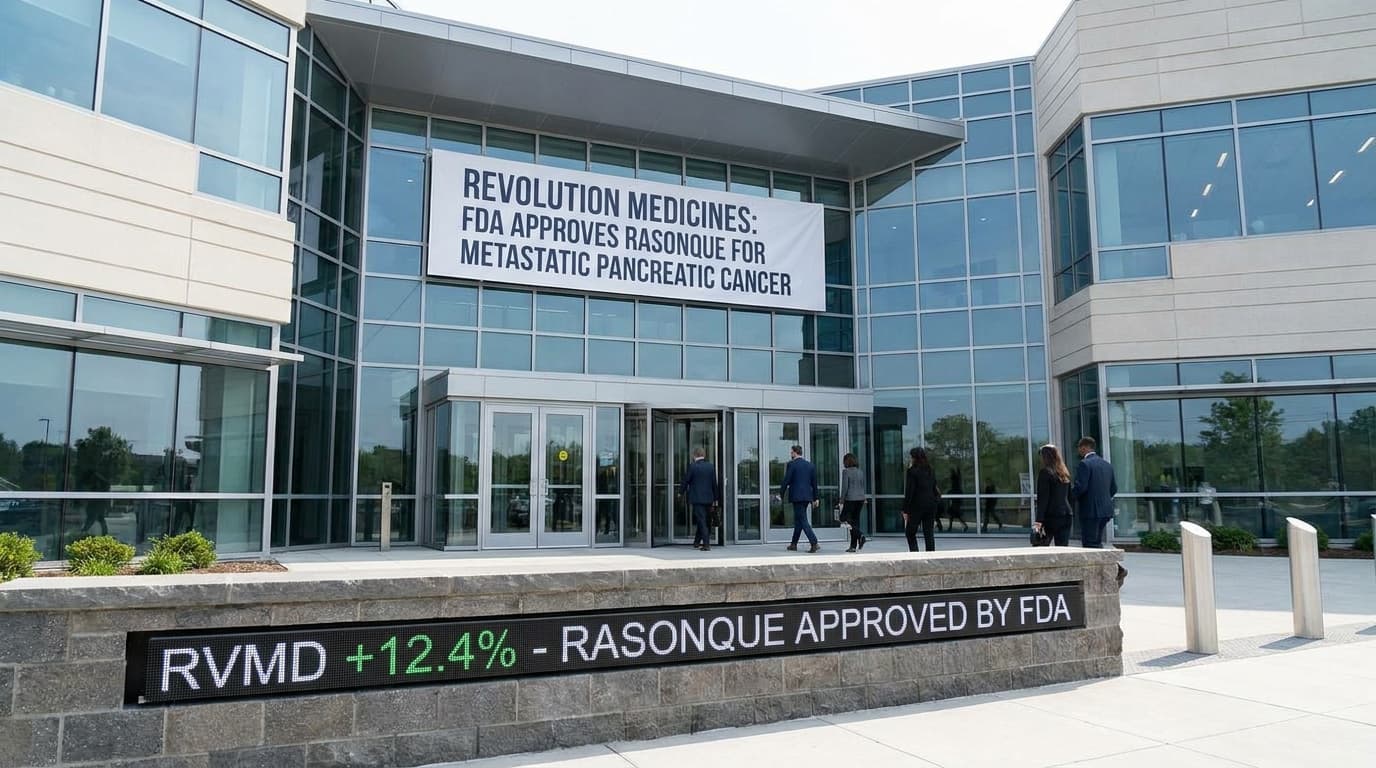
Revolution Medicines has moved pan-RAS inhibition into a new regulatory phase after the US Food and Drug Administration approved Rasonque, or daraxonrasib, in August for metastatic pancreatic adenocarcinoma. Nature Biotechnology described the medicine as a first-in-class drug for the most common form of pancreatic cancer, giving the company an approved foothold in a tumor type where treatment progress has been limited.
The approval matters beyond a single label because Rasonque was designed to hit a broader swath of RAS biology than earlier targeted drugs. According to the source, the drug blocks mutated KRAS and other RAS proteins present in over 90% of pancreatic tumors. That broader coverage is part of why the program is being watched as a test of whether RAS inhibitors can expand beyond niche mutation-defined settings into larger solid-tumor populations.
The Mechanism
Rasonque’s positioning rests on a different approach from KRAS G12C inhibitors such as Lumakras and Krazati. Those drugs bind the protein’s “off” state. Rasonque instead binds the RAS GTPase in its GTP-bound “on” conformation, the state that drives oncogenic signaling.
The source says the drug works through a molecular glue mechanism, binding both cyclophilin A, an abundant cellular protein, and RAS. That interaction prevents RAS from engaging its signaling partners. Commercially, that distinction is important because it suggests Revolution Medicines is not simply following the first KRAS wave with another mutation-restricted entrant; it is trying to establish a platform around a broader and historically difficult target class.
What Comes Next
The pancreatic approval was followed by an early-stage trial result in September that, according to the source, showed promise in lung cancer. Nature Biotechnology said those data bolster hopes that RAS inhibitors such as Rasonque could help address other hard-to-treat cancers including pancreatic, lung and colorectal tumors.
That does not establish efficacy across those settings, but it does sharpen the strategic point: the first approval may be less important as an endpoint than as proof that Revolution Medicines has converted a complex RAS mechanism into a marketable drug. If subsequent studies continue to show activity outside pancreatic cancer, Rasonque could become a broader test case for how far pan-RAS inhibition can reach across solid tumors.