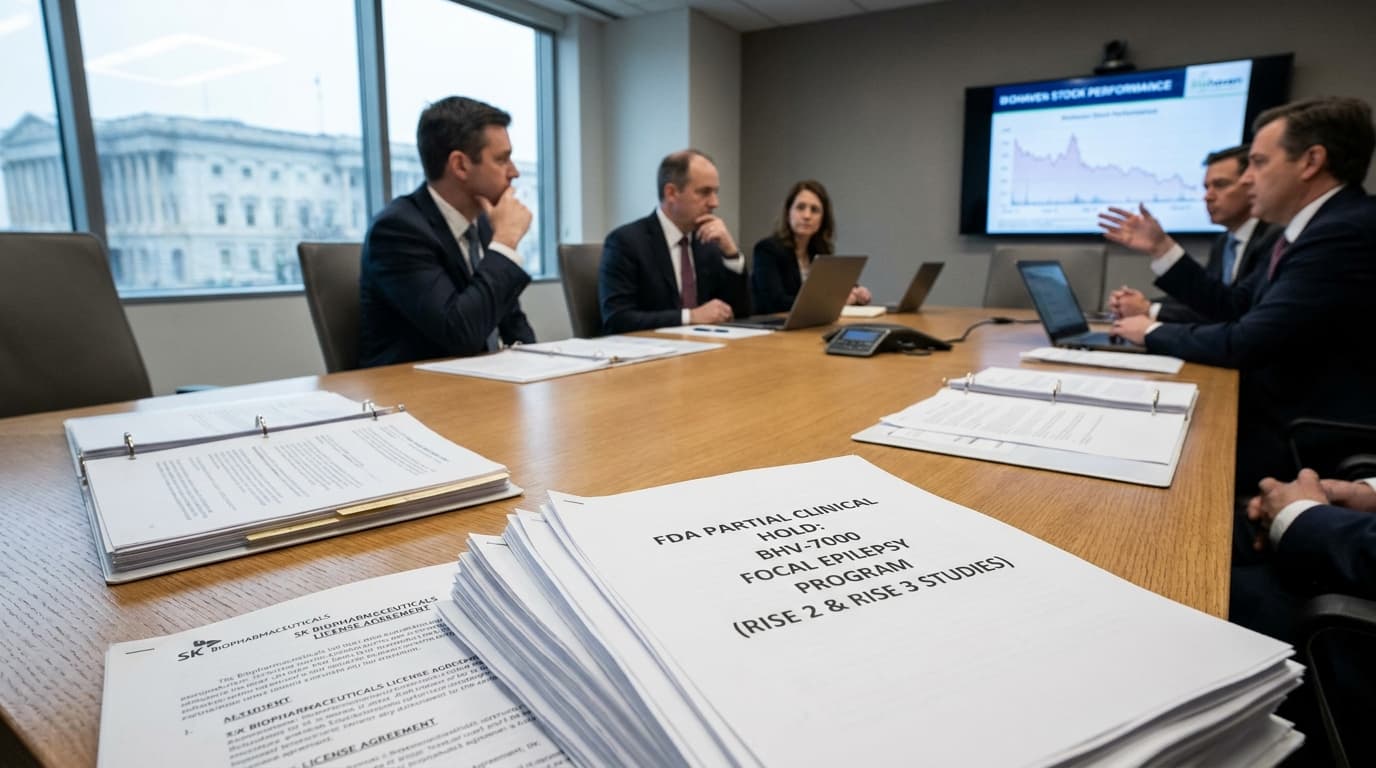
Biohaven said the FDA has placed a partial clinical hold on BHV-7000, also called opakalim, preventing the recruitment of new patients in its focal epilepsy program while allowing already enrolled participants to continue treatment. The hold was disclosed in a Thursday SEC filing and was tied to the agency’s review of a metabolite identified during rodent testing.
The decision hit Biohaven shares, which BioSpace said fell more than 13% in premarket trading Thursday. It also came days after SK Biopharmaceuticals agreed to a worldwide license for Biohaven’s Kv7 ion channel platform, including BHV-7000, turning what had been framed as a business development validation into a more complicated regulatory handoff.
The regulatory issue
According to Biohaven, the FDA wants additional nonclinical research to better understand whether the metabolite finding poses any risk to humans. The company said the significance of the finding to humans is uncertain and that it may be specific to rodents rather than relevant to human safety.
Fierce Biotech described metabolites as substances generated when the body breaks down a drug and said Biohaven had contacted the FDA about those findings from rodent tests. Biohaven added that more than 1,200 participants have been dosed with BHV-7000 in clinical studies to date and that the drug has generally been safe and well-tolerated.
The partial hold applies to RISE 2 and RISE 3, two late-stage studies in focal epilepsy that together include more than 600 participants. Dosing will continue for patients already randomized. Enrollment in RISE 3 was completed in June, and Biohaven said a topline data readout from that study remains on track for the second half of this year. RISE 2 had not yet completed recruitment, making that study the program’s immediate pressure point.
Program and deal implications
RBC Capital Markets said the enrollment pause is likely to delay the RISE 2 readout and added that the trial will also likely need to read out positively for regulatory approval. BioSpace said RISE 2 had previously been expected to reach a primary completion date in December this year.
Fierce Biotech reported that SK Biopharmaceuticals agreed late last month to pay Biohaven $350 million upfront plus another $50 million next year for the worldwide license to BHV-7000, with up to $150 million in milestones. BioSpace, citing the Aug. 26 agreement signed by Biohaven Bioscience Ireland Limited, described the transaction as worth up to $795 million and said it also covers other Kv7 compounds and products under the deal. The sources present different deal totals because one reports the upfront, next-year payment and milestones, while the other reports the broader maximum value.
Biohaven said all clinical and nonclinical data, including metabolite characterization results submitted to global regulatory authorities, were fully disclosed to SK before the license agreement was signed. The company added that the partners will continue working to complete the deal.
That matters because BHV-7000 is the lead asset in Biohaven’s Kv7 platform, which the company describes as a selective activator of Kv7.2/7.3 potassium channels, a target aimed at regulating the hyperexcitable state in epilepsy. A hold that limits one trial’s enrollment does not stop the program outright, but it does inject uncertainty into timing, and timing is now tied to both a registrational path and a freshly signed licensing transaction.
The road here
This is not the first setback around BHV-7000. BioSpace noted that the drug failed in December 2025 to improve symptoms in major depressive disorder versus placebo in a Phase 2 proof-of-concept study.
It is also the second regulatory blow to Biohaven in a year, according to BioSpace. Last November, the FDA turned away Biohaven’s spinocerebellar ataxia treatment troriluzole, prompting the company to cut its R&D budget by 60%. In that context, the BHV-7000 hold is less about one toxicology question in isolation than about how much regulatory friction investors will tolerate around Biohaven’s next prospective growth asset.