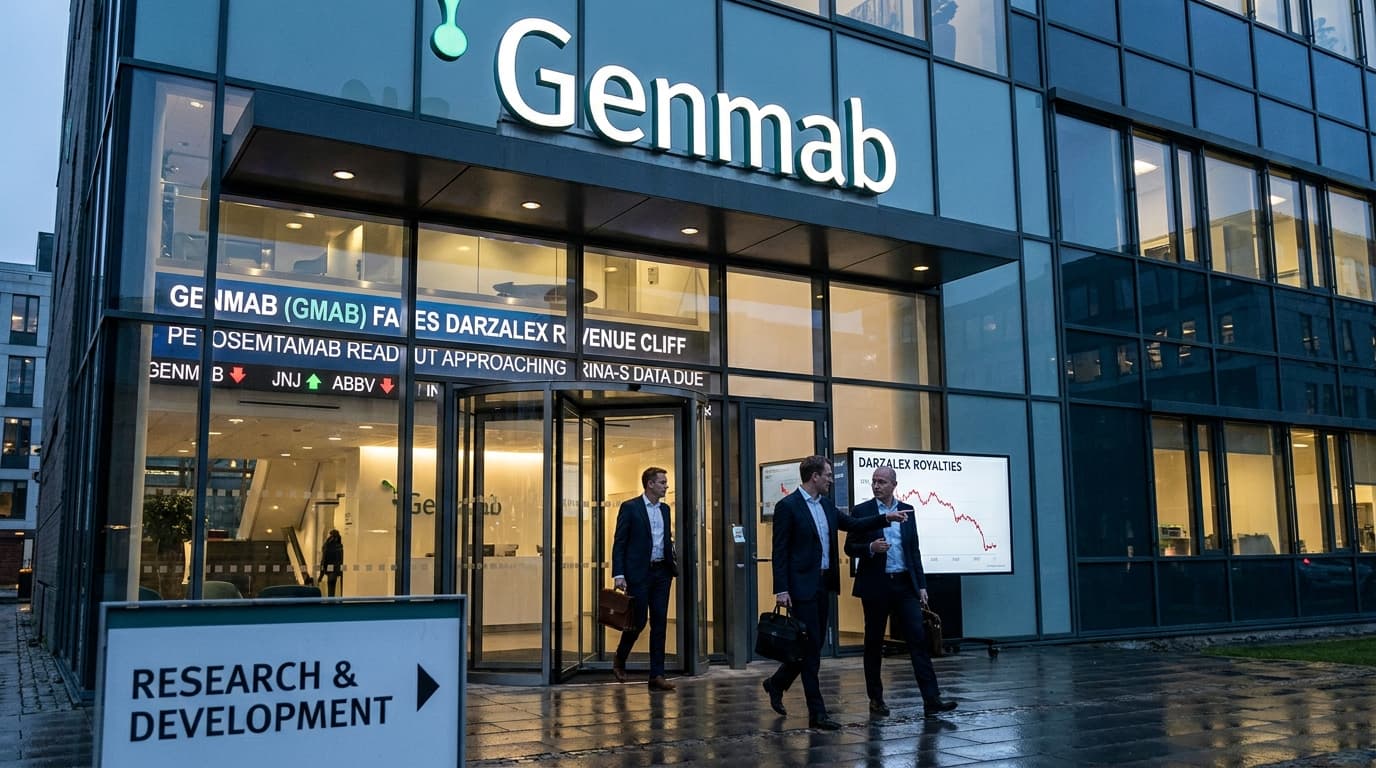
Genmab is approaching what its chief medical officer and head of experimental medicines Tahamtan Ahmadi called an unprecedented setup for a pharma company: a revenue source that accounts for 90% of sales is nearing loss of exclusivity. The pressure point is Darzalex, the Johnson & Johnson-partnered cancer drug that still anchors the company through royalties and whose U.S. patents expire in 2029.
That concentration risk is now colliding with a dense readout calendar. Two clinical wins earlier this month gave Genmab support heading into two more expected data events by the end of the year, and the market’s read on those programs is becoming central to whether the company can bridge what H.C. Wainwright’s Raghuram Selvaraju described as a steep drop in Darzalex-derived revenue.
The Commercial Picture
Selvaraju told BioSpace by email that Darzalex revenue could fall from about $3.3 billion in 2028 to under $1 billion by 2031, and to roughly zero by 2032. Genmab had already lost cases that could have softened that decline as the 2029 patent expiry approaches.
Even with that drop, Selvaraju argued that Genmab has enough depth to emerge from the 2029 and 2030 trough years in a strong position. In his view, that depends on three wholly owned or partnered oncology assets: AbbVie-partnered Epkinly, the FRα-directed antibody-drug conjugate rinatabart sesutecan, or Rina-S, and petosemtamab, the bispecific antibody Genmab obtained in its $8 billion takeover of Merus last year.
The signal for investors is that Genmab is no longer being judged mainly on whether individual pipeline programs can add growth. It is being judged on whether a small set of assets can replace a revenue base that is expected to collapse on a defined timeline.
The Data
Genmab recently reported Phase 3 findings for Epkinly in first-line lymphoma that analysts said could potentially set a new standard of care in that indication. The company also posted what BioSpace described as durable and clinically meaningful Phase 2 results for Rina-S in ovarian cancer.
The more binary event, in Selvaraju’s assessment, is petosemtamab. He said the asset matters the most among Genmab’s three key programs because its sales ramp could make it a blockbuster by 2029, the year Darzalex’s U.S. patents expire, with room for expansion into additional indications.
Petosemtamab’s lead indication is head and neck squamous cell carcinoma. Genmab expects results by the end of the year from the Phase 3 LiGeR-HN1 trial in first-line HNSCC. In May 2025, Merus reported a 63% overall response rate in a Phase 2 study, compared with the 19% Keytruda achieved in the Phase 3 KEYNOTE-048 study, a comparison both Selvaraju and Ahmadi highlighted.
For the Phase 3 study, a 40-point or greater improvement in overall response rate, one of the co-primary endpoints, would support accelerated approval and fast uptake, Selvaraju said. The other primary outcome measure is overall survival, while progression-free survival is a secondary endpoint. Ahmadi said a dramatic response-rate difference with good durability should translate into a statistical or near-statistical progression-free survival difference and then separation in the overall survival curves, because otherwise the treatment would carry a safety liability.
Genmab’s other remaining Phase 3 readout this year is RAINFOL-02, which is testing Rina-S in platinum-resistant ovarian cancer. Selvaraju called the setup relatively risk-mitigated because of positive Phase 1/2 RAINFOL-01 data in the same setting. In that earlier trial, Rina-S was linked to a median progression-free survival of 9.5 months, hitting a secondary endpoint. AbbVie’s rival FRα-directed ADC Elahere achieved median progression-free survival of 5.6 months in the Phase 3 MIRASOL trial. Chemotherapy is the control treatment in RAINFOL-02.
Ahmadi said the RAINFOL-02 readout could be very positive on progression-free survival and potentially even on overall survival. Guggenheim Securities analysts said in an Oct. 4 note that success on the primary endpoint of progression-free survival is highly likely, with interim overall survival success possible in an upside scenario.
What To Watch
For Rina-S, the strategic question extends beyond whether the study reads out positive. Analysts are looking to see whether Genmab can reproduce the breadth of efficacy from Phase 1/2, where the company reported activity in patients with low or no FRα expression. Selvaraju said a label across FRα levels would double the addressable population compared with Elahere, making labeling terms a key determinant of the slope of Rina-S sales.
Genmab also sees competitive timing as material. Ahmadi said ovarian cancer is attracting a wave of TOPO-1 ADCs, and once a patient progresses after one TOPO-1 ADC, they are unlikely to benefit from another treatment with the same payload. That makes early positioning important enough that the company has changed how it communicates development plans. Ahmadi said Genmab is no longer pre-announcing these studies and instead makes them public when the first patient gets dosed.
If LiGeR-HN1 and RAINFOL-02 both work, Genmab will have a stronger case that it can turn a patent cliff into a portfolio transition. If either program disappoints, the company’s dependence on Darzalex becomes harder to offset on the timetable the market is already modeling.