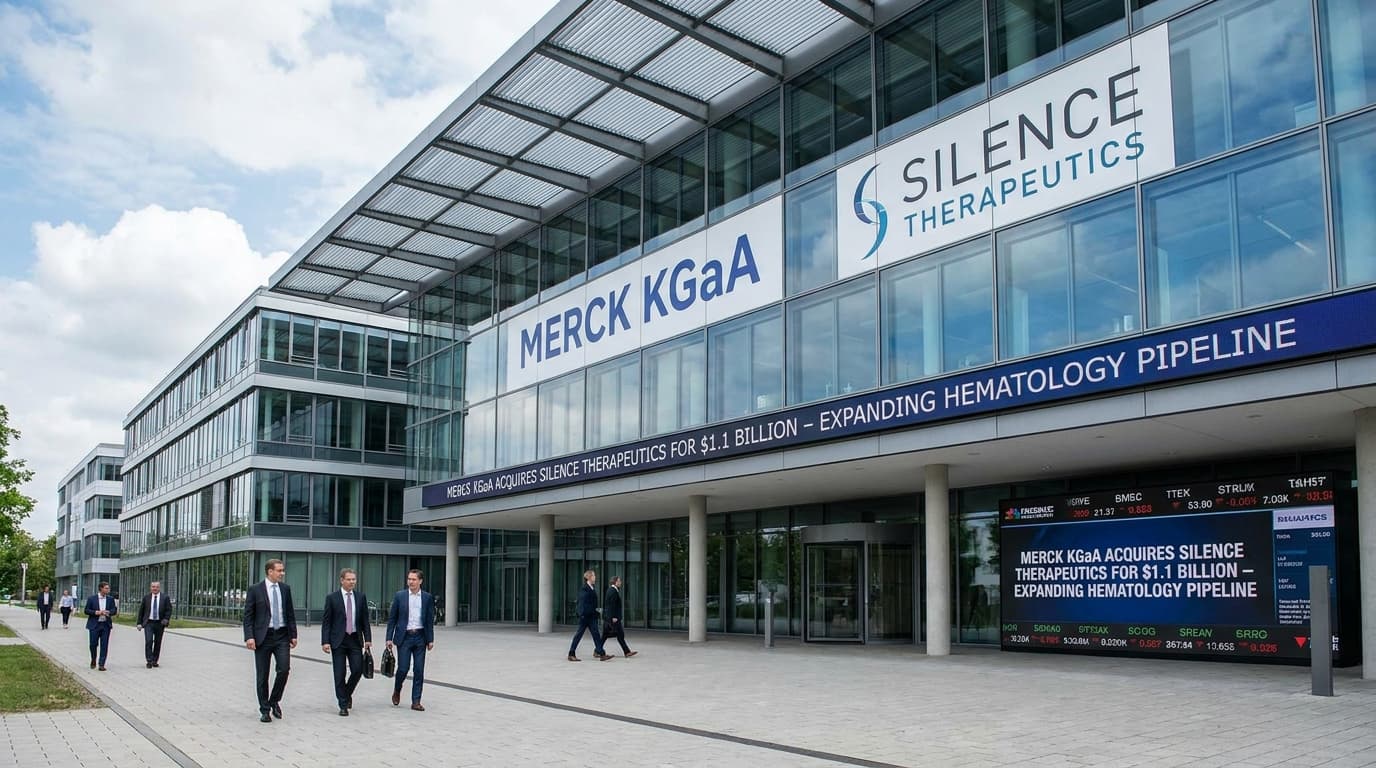
Merck KGaA is buying Silence Therapeutics in an all-cash transaction that values the U.K.-based siRNA specialist at about $1.1 billion on an enterprise-value basis and about $1.3 billion in equity value, according to the companies’ announcement. Silence shareholders will receive $20 per share, a figure the sources frame differently: Merck KGaA said that represents an 82% premium to Silence’s 30-day average price of $10.99, while Fierce Biotech reported it as a 130% increase on the biotech’s Friday closing price of $8.68.
For Merck KGaA, the transaction is less about adding another platform than about securing a defined entry into hematology through divesiran, Silence’s short interfering RNA candidate for polycythemia vera. Danny Bar-Zohar, member of Merck KGaA’s executive board and CEO of healthcare, said the deal gives the company “an entry point into hematology,” while group CEO Kai Beckmann placed it within a broader push toward high-specialization areas and external innovation. The deal is expected to close in the first quarter of 2027.
The Data
Divesiran is designed to silence production of TMPRSS6 in liver cells, with the aim of redirecting iron delivery away from bone marrow and slowing red blood cell production in polycythemia vera, a rare blood cancer characterized by excessive red blood cell production. Silence reported in August that 88% of patients in a Phase 2 study met the response criteria between Weeks 18 and 36. Fierce Biotech said the response rate was 93.8% in patients dosed every six weeks and 81.3% in the 12-week cohort.
Those results have positioned divesiran as a credible late-stage asset rather than a distant pipeline option. BioSpace reported that analysts had declared divesiran the likely front runner in the race to market, while Fierce described it as a strong follower to Takeda and Protagonist’s Mimrylo, which was approved by the FDA in PV in August. Taken together, the read-through is that Merck KGaA is buying into a market where timing matters, but where the lead asset still has room to differentiate on dosing.
That differentiation case rests largely on convenience. Fierce reported that Mimrylo was given as a weekly, self-administered injection in Phase 3, while Silence plans to administer divesiran every 12 weeks in its own Phase 3 trial. If that schedule is maintained in late-stage testing, Merck KGaA will be betting that less frequent dosing can matter commercially even against an approved competitor.
The Commercial Picture
The transaction also brings Merck KGaA a broader rare-disease and cardiometabolic pipeline, but the hierarchy of value in the sources is clear. Silence’s other programs include zerlasiran, a mid-stage siRNA therapy designed to treat atherosclerotic cardiovascular disease by silencing the LPA gene, and SLN312, a Phase 1 dyslipidemia program designed to silence ANGPTL3. Silence also has a partnership with AstraZeneca covering cardiovascular, cardiometabolic, renal and respiratory diseases, although BioSpace noted that AstraZeneca recently handed back rights to SLN312.
Those additional assets expand Merck KGaA’s optionality, but they also come with development uncertainty. Fierce reported that future development plans for zerlasiran were in limbo last year after Hansoh Pharma exited an mRNAi-focused collaboration with Silence. That leaves divesiran as the clearest near-term value driver and helps explain why William Blair said the deal made sense for Silence ADS holders given interest in the PV asset and the need to finance a Phase III trial in a competitive space.
The strategic fit also reflects Merck KGaA’s recent M&A behavior. BioSpace pointed to the 2025 acquisition of SpringWorks Therapeutics as part of the company’s move deeper into rare diseases, and Beckmann explicitly linked the Silence deal to that pipeline reshaping effort. After setbacks including the failure and discontinuation of evobrutinib in multiple sclerosis, Merck KGaA had already been identified by analysts as a likely buyer. This acquisition suggests the company is using dealmaking not just to add volume, but to rebuild around more specialized markets where differentiated development programs can still reset growth expectations.
The Road Here
Silence enters the deal after a leadership transition and what its interim chief described as a competitive sale process. Iain Ross has led the company on an interim basis since December 2025, when CEO Craig Tooman agreed to depart. Ross said the Merck KGaA agreement delivers “significant, immediate and certain value” to shareholders and gives the company’s programs a larger organization with the resources to accelerate divesiran’s Phase 3 development.
The timing matters because the PV field is no longer speculative. With Mimrylo already approved by the FDA in August and Disc Medicine also posting a major clinical win elsewhere in hematology, Merck KGaA is entering a segment where clinical execution and positioning against established or advancing rivals will determine whether the acquisition looks like a platform expansion or a targeted late-stage growth purchase.