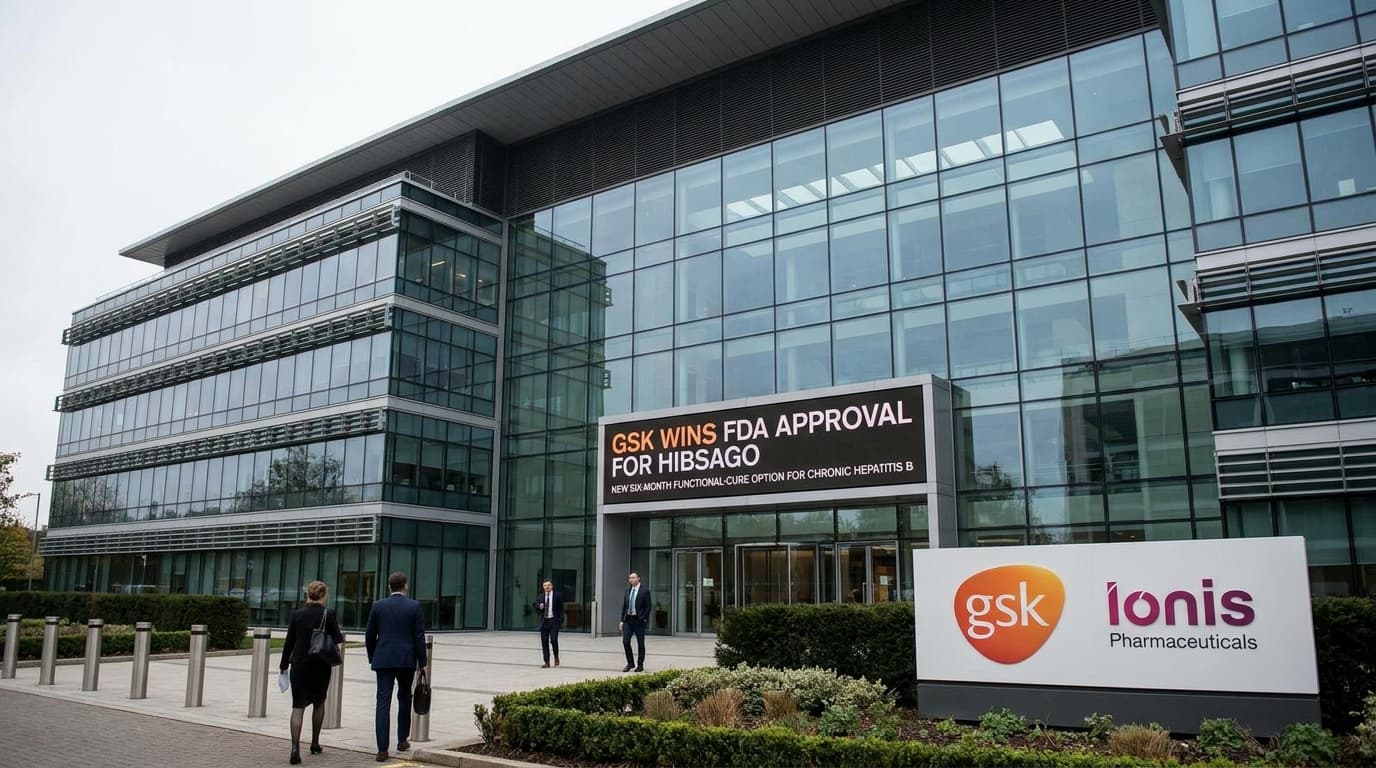
GSK has won FDA approval for bepirovirsen, which it will market as Hibsago, adding a new chronic hepatitis B product to its infectious disease business and introducing a different treatment goal than standard long-term antivirals. The drug, licensed from Ionis Pharmaceuticals, is intended to help some patients reach a functional cure: viral control after treatment ends rather than indefinite suppression while therapy continues.
That matters because current chronic hepatitis B management is typically built around antiviral drugs patients may need to take long-term, perhaps for life. In the sources provided, GSK said Hibsago can help patients achieve undetectable levels of the virus in the blood after six months, while MedCity described the central aim as knocking the virus down far enough for the immune system to regain control and keep infection in check.
The Data
Hibsago is an antisense oligonucleotide that targets hepatitis B virus genetic material. The mechanism described across the sources is consistent in direction but not identical in wording: MedCity said the drug is designed to degrade viral messenger RNA, reducing viral DNA and viral proteins, while BioSpace said it tags the virus’s genetic material for destruction, preventing replication and boosting the immune system’s ability to fight infection.
The approval was backed by two placebo-controlled Phase 3 studies. MedCity reported that the drug was administered as a weekly injection for up to 24 weeks, with participants continuing standard-of-care hepatitis B antiviral treatment during the dosing period; patients who met certain laboratory and health-test requirements could then stop the existing antiviral. BioSpace identified the program as B-Well 1 and B-Well 2 and said the studies together enrolled more than 1,800 adults with chronic hepatitis B who had been exposed to nucleos(t)ide analog reverse transcriptase inhibitor treatment.
Across both studies, MedCity said 24% of patients who received Hibsago met the requirements for stopping their existing medicine, versus none in the placebo arm. At 24 weeks after stopping all hepatitis B treatment, 19% of patients in the Hibsago arm still had the virus under control, and a protein that signals hepatitis B infection could not be detected in their blood.
BioSpace added key label boundaries around who can receive the drug. Hibsago is approved for use in combination with nucleos(t)ide analog reverse transcriptase inhibitors in adult patients who have no liver scarring, have been on NRTI treatment for at least six months, and meet certain biomarker thresholds as determined by an FDA-approved test.
Safety limits are also prominent in the launch profile. MedCity said the most common adverse reactions included injection site reactions, fever, and fatigue. Some patients also had elevated liver enzyme levels. The label carries a black box warning instructing clinicians to conduct liver enzyme tests before treatment begins and periodically during treatment, and it also flags a potential reduction in blood platelet levels that raises the risk of life-threatening bleeding.
Alongside the drug approval, BioSpace reported that the agency cleared Roche’s Elecsys HBsAg II quant II RxDx assay to identify patients with chronic hepatitis B who are eligible for treatment and to help monitor patients during treatment. That pairing suggests the commercial rollout is likely to depend not just on physician adoption but also on a relatively defined diagnostic funnel.
The Commercial Picture
The strategic value of the approval is clear even though sales expectations differ sharply in the sources. BioSpace, citing Reuters, said GSK has forecast peak worldwide sales of over £2 billion, or $2.67 billion, for the drug. In the same article, BMO Capital Markets took a more conservative view, projecting peak risk-unadjusted sales of $659 million.
For Ionis, the economics are meaningful but not transformative on their own. BioSpace said the company will receive 10% to 12% tiered royalties on GSK’s sales, which BMO estimated at about $163 million. BMO described that as a relatively modest contribution to Ionis’ commercial business, but said the approval adds meaningful validation for the company’s antisense oligonucleotide platform after recent setbacks elsewhere in the class.
That validation point may matter beyond hepatitis B. BioSpace noted that Hibsago is Ionis’ third antisense oligonucleotide approval this year, after Zanvastro in September and Tryngolza in June. For GSK, the approval creates a differentiated offering in a market where functional cure rates with older therapies have been low, but the label’s combination requirement, biomarker gatekeeping, and safety monitoring needs could shape how quickly use broadens beyond the initial specialist base.
The Road Here
The program had already received breakthrough and priority review designations from the FDA, according to BioSpace. The drug was originally developed by Ionis and licensed by GSK in August 2019 in a deal that included $25 million upfront plus up to $262 million in milestones.
MedCity said detailed Phase 3 results were presented in May at the European Association for the Study of the Liver annual meeting and simultaneously published in the New England Journal of Medicine. After years in which chronic hepatitis B drug development has struggled to move beyond suppression strategies, the approval gives GSK a finite-course product that can be positioned around treatment exit rather than permanent maintenance.