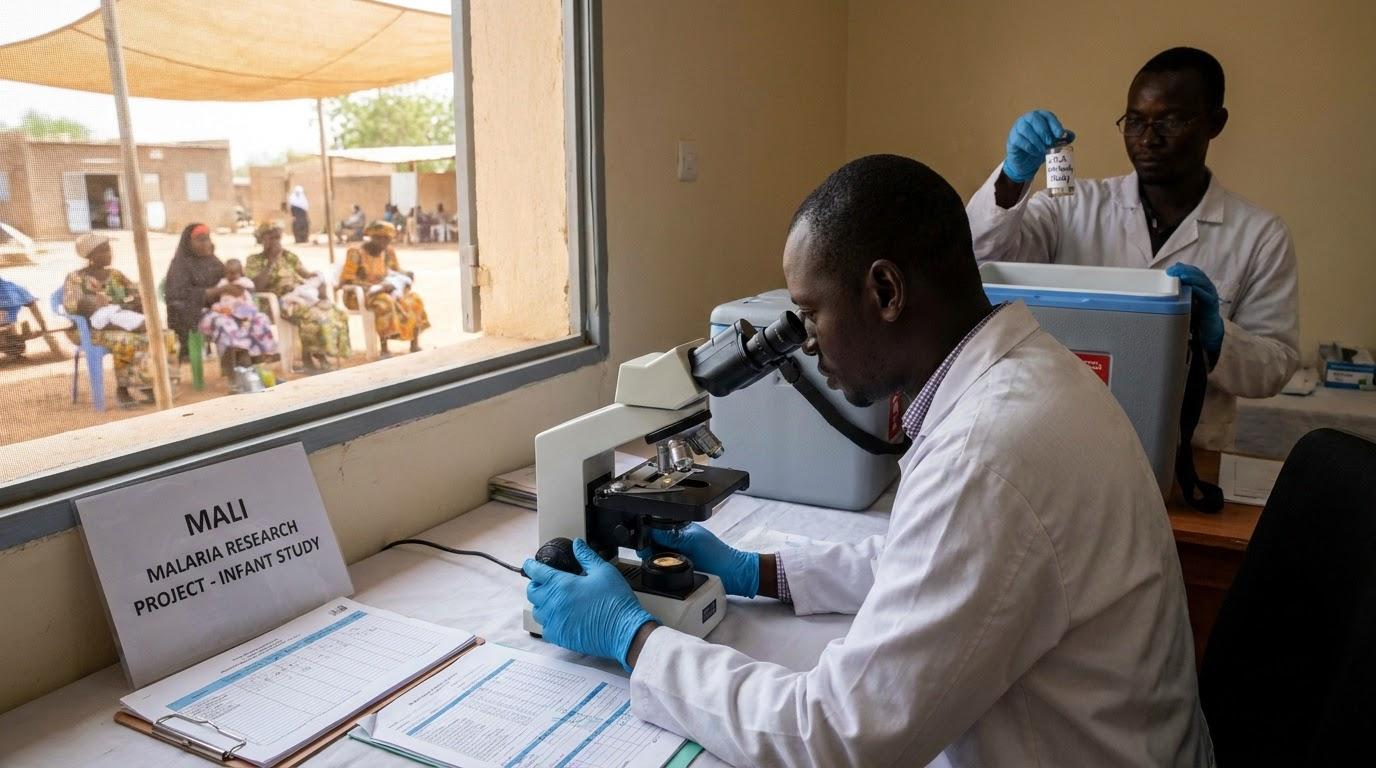
A study in infants in Mali delivered a mixed result for the malaria monoclonal antibody L9LS: researchers said one injection was 78% effective versus a placebo in protecting against the malaria parasite over the six-month transmission season, but they also found that giving L9LS before the malaria vaccine R21 reduced the vaccine-induced antibody response.
The combination result matters because one of the hoped-for roles for a long-acting malaria antibody had been to protect babies before they begin receiving malaria vaccines. Instead, the infant data suggest that sequence can create an immunologic tradeoff, making the most straightforward early-life use case less attractive even as the efficacy result supports continued development of the antibody itself.
The Data
According to an abstract presented at the annual meeting of the American Society of Tropical Medicine and Hygiene, researchers enrolled infants from 1 month to 12 months, gave them either a placebo or L9LS, and then administered doses of the R21 vaccine.
Over the six-month transmission season, L9LS was 78% effective versus placebo. Robert Seder of the National Institute of Allergy and Infectious Diseases said that was similar to what had been seen in studies of the antibody in older children and adults.
The complication was immunologic interference. Researchers reported a 20% to 30% drop in antibody levels generated by R21 when infants had first received L9LS. Their explanation is mechanistic: the malaria vaccines train the immune system to recognize a parasite protein called circumsporozoite protein, or CSP, and L9LS also binds to CSP. When infants later received R21, the monoclonal appears to have bound to the vaccine as well, interfering with the full immune response it was meant to trigger.
Researchers said it is not yet clear what the lower immune responses seen in blood tests would mean for real-world vaccine protection. That distinction matters for development decisions, but it was not enough to preserve infants as the near-term focus.
What The Result Changes
Seder said researchers plan to focus on groups other than babies as they prepare the studies that could lead to approval of L9LS, which they hope to start in 2028. His view was pragmatic: with other clear use cases available, the group can pursue those first and revisit infants later.
That shifts the commercial and public health logic for malaria monoclonals toward settings where a single dose can cover a discrete high-risk period without colliding with the early vaccine schedule. The appeal of the modality remains straightforward. A monoclonal can provide several months of protection with one shot, which may be enough for peak transmission periods; in areas with year-round transmission, experts said deploying antibodies might require two to three doses a year.
By contrast, R21 and RTS,S require multiple doses, beginning at 5 months of age, though they provide some level of protection for years. Existing seasonal chemoprevention with antimalarial drugs is described as cheap and effective, but monthly dosing creates adherence challenges.
Where L9LS May Still Fit
Researchers and outside experts highlighted several groups where monoclonals may still have a clearer role. Kassoum Kayentao of Mali’s University of Sciences, Techniques, and Technologies of Bamako said the logistics could be attractive in Sahelian regions because one shot could cover the malaria season.
Pregnant people are one target because malaria infection during pregnancy can be dangerous for both parent and baby. Another is children leaving the hospital after a malaria admission. In the months after discharge, while recovering from infection-caused anemia, they are especially vulnerable to severe outcomes from another case. Current post-discharge malaria chemoprevention relies on preventive drugs taken every month, whereas one monoclonal shot at discharge could provide protection for months.
The main constraint is cost. Antibodies are comparatively costly, though the source said efforts are underway to bring down the price per dose as developers head toward later-stage studies.
André-Marie Tchouatieu of the Medicines for Malaria Venture, who was not involved in the study, said the interference issue did not materially weaken the broader case for monoclonals and next-generation versions as part of malaria control. The strategic takeaway is narrower than the initial infant-protection thesis but still meaningful: if efficacy and safety hold up, malaria antibodies may be most valuable not as universal companions to infant vaccination, but as targeted tools for specific high-risk populations and seasonal deployment.