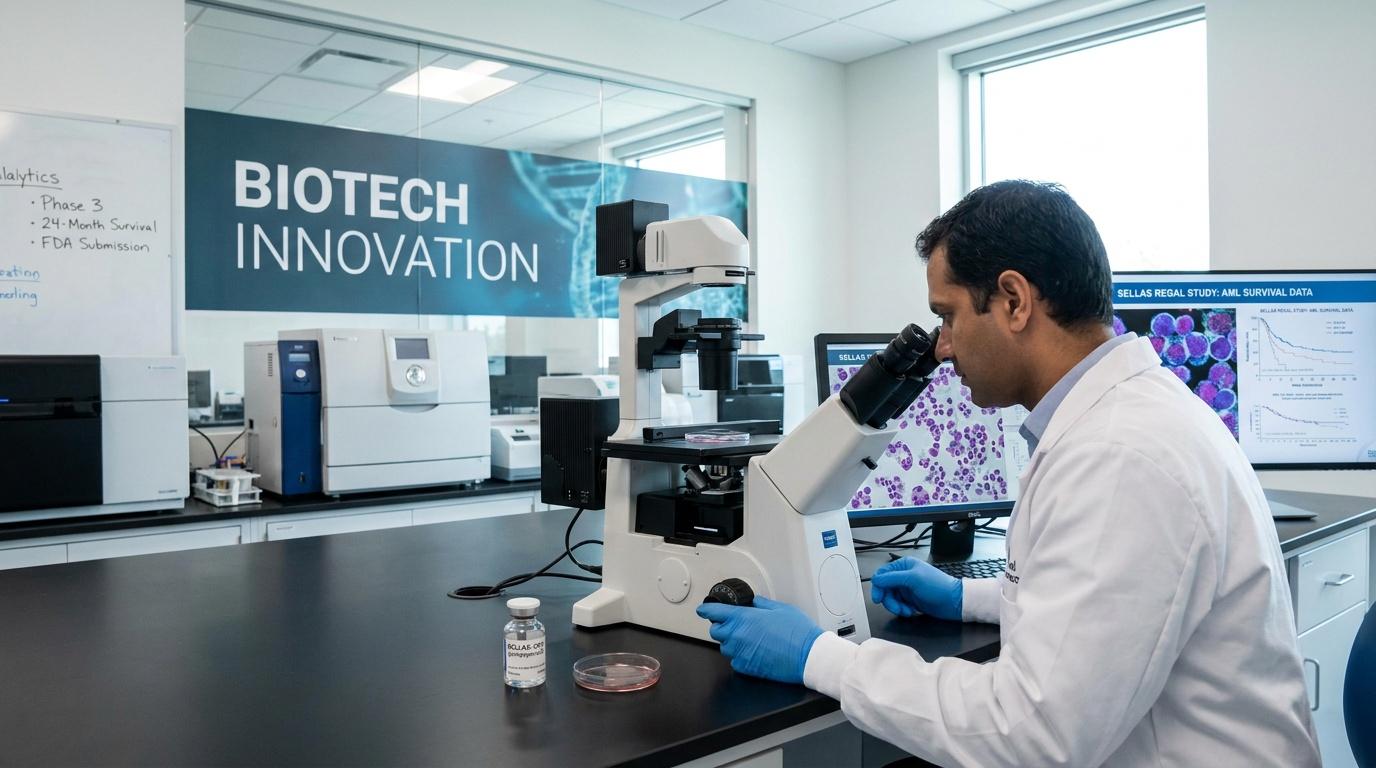
Sellas Life Sciences said its phase 3 REGAL trial of galinpepimut-S, or GPS, met its primary endpoint in acute myeloid leukemia, giving the company late-stage survival data in a maintenance setting where patients have limited alternatives. According to BioSpace, the off-the-shelf cancer vaccine cut the risk of death by 41% and extended median overall survival to 24 months, compared with 14.7 months for investigator’s choice of best available treatment.
For a small biotech, the signal is straightforward: this is no longer an early immunotherapy concept looking for relevance in AML. Sellas now has randomized phase 3 overall survival data in patients in second or later remission, or in remission but ineligible for an allogeneic stem cell transplant, and it is preparing to take that package to the FDA.
The data
REGAL enrolled 126 patients with AML, a cancer that starts in the bone marrow and quickly spreads to the blood. The randomized, open-label study evaluated GPS as a maintenance monotherapy intended to extend survival after remission.
The main result was a statistically significant overall survival benefit. Sellas reported median overall survival of 24 months for GPS versus 14.7 months for patients receiving investigator’s choice treatment, translating to the 41% reduction in risk of death.
Safety, based on the company’s summary, did not appear to complicate the efficacy readout. BioSpace reported that GPS was generally well tolerated, with treatment-related adverse events described as predominantly mild to moderate. The most common adverse events were local injection site reactions.
Sellas said it is still conducting a statistical evaluation of REGAL’s secondary endpoints and plans to present detailed findings at an upcoming medical conference. That means the headline survival result is in hand, but the full depth of the dataset has not yet been publicly detailed.
The platform and regulatory path
Sellas said it plans to meet with the FDA about a potential accelerated pathway and an approval submission in the first half of next year. CEO Angelos Stergiou said the company’s goal is to make the therapy available to patients as rapidly as possible, given what he described as a significant unmet need.
The product itself is an immunotherapeutic cancer vaccine designed at Memorial Sloan Kettering Cancer Center. GPS consists of four WT1-derived peptides and is intended to stimulate both CD4+ and CD8+ T cell immune responses against WT1-expressing cancer cells.
That matters strategically because AML maintenance has not produced many simple post-remission options for patients unable to proceed to transplant. The REGAL steering committee said this population faces poor survival outcomes and has a significant need for new treatment approaches. If regulators view the phase 3 survival advantage as sufficient support for filing, GPS could give Sellas a clearer commercial and clinical identity than many small oncology companies achieve with earlier-stage data.
BioSpace noted that REGAL is Sellas’ most advanced trial. The company has also studied GPS in smaller, earlier studies in ovarian cancer and mesothelioma, and it is developing the CDK9 inhibitor SLS009, also called tambiciclib, in several cancers including AML. For now, though, the company’s near-term story is concentrated on whether this phase 3 AML result can translate into a viable FDA submission.